Lyme disease, science, and society: Camp Other

Friday, January 18, 2013

10 Questions on Borrelia Miyamotoi and Lyme Disease

I have been working diligently on a post about the pseudoscience and science of Lyme disease, in hopes of publishing it soon. However, given the recent news out of Yale University this week, I have decided to delay publication on that post because there is a lot to say about the research from Yale:

Yale research confirms Borrelia miyamotoi causing infection in US

A tickborne disease caused by spirochetes more closely related to relapsing fever spirochetes than Lyme disease spirochetes was found in 18 patients in southern New England and New York, according to research published in the New England Journal of Medicine January 17.

The infection - caused by spirochetal bacteria known as Borrelia miyamotoi - was detected in 21 percent of 14 patients with unexplained summertime febrile illness, 3 percent of 273 patients with Lyme disease (or suspected Lyme disease), and 1 percent of 584 healthy people from areas endemic for Lyme disease.

This study is one of a few which offer the indication that infection with Borrelia miyamotoi in North America is less common than its well-known more distantly related relative, Borrelia burgdorferi, the spirochete which causes Lyme disease.

It's estimated 2-3,000 people* in the United States may be infected with Borrelia miyamotoi annually - but due to it being an emerging infectious disease which is difficult to diagnose, how common it is and will be in the future remains to be seen.

In surveillance studies, anywhere from 1-16% of Ixodes scapularis ticks have been infected with Borrelia miyamotoi, depending on the region. This is about the same percentage range of Ixodes ticks which are infected with Borrelia miyamotoi in Russia and Western Europe.

In North America, Ixodes ticks infected with Borrelia miyamotoi have been found in the northeastern US, midwest, west coast, and Canada.

How Borrelia miyamotoi infection differs from Lyme disease

Early symptoms

Clinically speaking, an infection with B. miyamotoi has symptoms which overlap those of Lyme disease. They include fever, muscular aches and pains, joint aches, chills, sweats, vomiting (sometimes), headaches and fatigue, with a small portion also developing a rash such as with Lyme disease. Also, symptoms can be more severe than those found in Lyme disease and some patients may require treatment in a hospital.

The two most striking differences between B. miyamotoi infections and Lyme disease?

Usually there isn't a rash - the exact opposite of Lyme disease. One Russian study stated that more than 50% of patients documented with the disease did not have a characteristic rash. According to Dr. Peter Krause, only 10-15% of patients get a rash and it is usually smaller than those seen in Lyme disease.

Sometimes, people get cycling, spiking fevers. Studies demonstrated that some patients had episodes of high spiking fevers which occurred days or one to two weeks apart. These cyclical fevers and the lack of a rash map closely to symptoms found in relapsing fever - a spirochetal disease which is usually transmitted by soft-bodied ticks.

Here is an example of two patterns of fever and symptoms found in patients studied in Russia [pdf]:
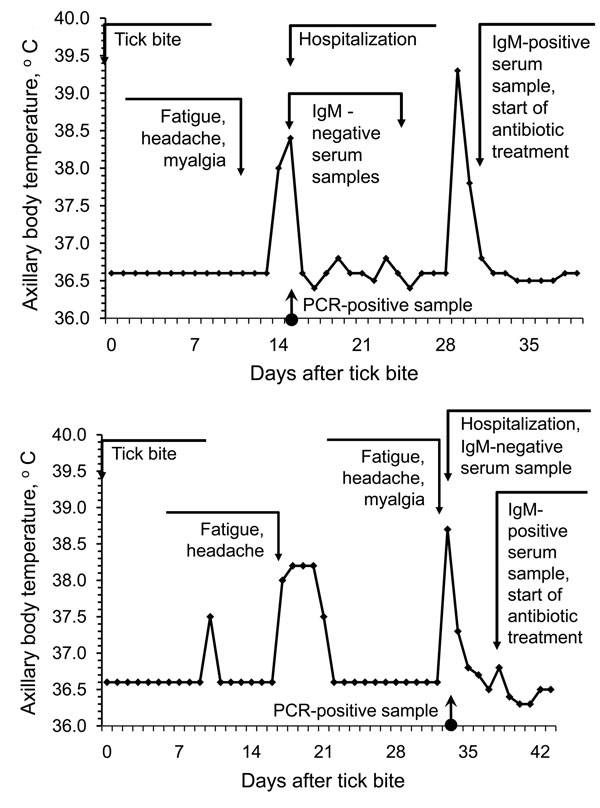
Graph From: Humans Infected with Relapsing Fever
Spirochete Borrelia miyamotoi, Russia
Emerg Infect Dis. 2011;17:1816-1823
Note that two patients' patterns of fevers and symptoms differed, but a spiking fever with periods of normal temperature between fevers is common in relapsing fever. (These two patterns are not representative of all patients - other patients may have their own variation on how the disease process unfolds.)

Later stages of infection

Not much is known about later stages of infection with B. miyamotoi. This is because its study in human and animal hosts is relatively new, having been discovered only in 1995 in Japan.

However, one could potentially extrapolate how B. miyamotoi will behave after initial infection by looking at research on its genetically closest living relatives which are also relapsing fever spirochetes.

Borrelia miyamotoi's closest living relatives appear to be Borrelia hermsii and Borrelia lonestari.


Image from: Typing of Borrelia Relapsing Fever Group Strains.
Emerg Infect Dis. 2004 September; 10(9): 1661–1664.
doi: 10.3201/eid1009.040236

Testing for the presence of Borrelia miyamotoi

From both the patient's and the doctor's point of view, one troubling aspect of being infected with Borrelia miyamotoi is that even if the patient has a history of a tick bite and has symptoms which seem similar to those found in Lyme disease - a blood test for Lyme disease will be negative.

This is because Borrelia miyamotoi is genetically distant enough from Borrelia burgdorferi that the antibodies produced in response to miyamotoi seldom cross react with those of Borrelia burgdorferi.

So how do you test for the presence of Borrelia miyamotoi?

If you're a microbiologist and do not have access to antibody testing, have an acutely ill patient in front of you with a current flare up of symptoms including spiking fever, a blood smear and dark field microscopy might yield a positive result for Borrelia miyamotoi - as it does for other relapsing fever spirochetes.

But most family physicians will likely want to order a blood test using PCR and/or an antibody test specifically designed for relapsing fever in order to detect infection.

In a study of 47 Russian patients found to have infections with Borrelia miyamotoi, presence of infection could be detected using an ELISA (EUROIMMUN AG, Lübeck, Germany) for major Borrelia burgdorferi sensu latu genospecies found in Europe - but it could not discriminate (sort) specific antibodies against any of these species.

Given that ELISA tests for Borrelia other than Borrelia burgdorferi sensu strictu are hard to come by in the US and Canada, the detection of Borrelia miyamotoi using standard Lyme disease ELISA may not work in North America.

Instead of a standard North American Lyme disease ELISA or EUROIMMUN AG, an ELISA or Western Blot for relapsing fever which contains GlpQ protein - an antigen which is non-reactive to Borrelia burgdorferi antibody - can be used to detect infection with Borrelia miyamotoi.

This information should serve as a cautionary tale for the doctor:

If a patient has been in an environment where ticks are found and has Lyme disease-like symptoms or a summer flu, consider relapsing fever as a differential diagnosis - especially if the patient does not recover as they would from a flu and has a negative Lyme disease ELISA.

Blood tests and PCR are most likely to yield a positive result when a sample is taken during a patient's spiking fever and the height of symptoms because that is when spirochetemia is peaking. With each relapse of infection, the number of spirochetes in the blood is reduced - thus making it less likely to obtain positive test results the later it is during the course of infection.

Treatment

So far, all the research points to the same antibiotics being used for Lyme disease as being effective for treating relapsing fever, and this extends to infections with Borrelia miyamotoi. In addition to amoxicillin, tetracycline, and doxycycline, relapsing fever has also been treated with chloramphenicol with success. Intravenous ceftriaxone may be required for more severe illness.

If a patient with Borrelia miyamotoi is treated with antibiotics and continues to suffer from high spiking fevers and other symptoms, retreatment may be needed with intravenous antibiotics. Co-infections such as babesiosis and ehrlichiosis should be investigated as they can produce similar symptoms.

In a 2011 study on Russian patients treated for Borrelia miyamotoi infection, this was the treatment and outcome:

Therapy consisted of ceftriaxone, 2 g intravenously every 24 hours for 2 weeks (42 patients) or doxycycline 100 mg orally every 12 hours for 2 weeks (2 patients). Two patients received no antimicrobial drug while hospitalized; 1 later received doxycycline at home, and the other was readmitted to the hospital for relapse and received ceftriaxone.

Outcome

Some relapsing fever strains can cause severe illness, and without treatment these strains have a high rate of case fatality. So far, B. miyamotoi lies along a spectrum of illness which appears to range from mild to moderate severity, but even so, infection should be treated with antibiotics immediately to avoid complications.

The good news is that most people who are infected with relapsing fever and are treated promptly with antibiotics go on to recover. The same will probably apply to infection with B. miyamotoi based on research published to date - but the true picture remains uncertain until more patients are diagnosed, treated, and proper follow-up is completed.

Complications

Are the complications found in Borrelia miyamotoi infections going to be the same as those found in Lyme disease? Given that it is genetically closer to relapsing fever spirochetes and more distant to Borrelia burgdorferi, one could speculate that it may have characteristics and complications common to relapsing fever - but without further research, it is unclear.

The risk for infected untreated pregnant women to pass on infection to the fetus in utero with a negative outcome (e.g. miscarriage; defects) might be more likely than it is in Lyme disease. Infection of the central nervous system may also occur more rapidly than it typically does in Lyme disease. But this is speculative, due to being based on research where there is variability in severity and outcome across relapsing fever strains.

Facts and uncertainties

It is known that in many cases, Borrelia miyamotoi - unlike Borrelia burgdorferi - is transmitted transovarially in deer ticks. This means the female tick infects her offspring, which produces infected larvae. These larvae will go on to molt and become infected nymphs. (Transovarial infection is rare to nonexistent in Borrelia burgdorferi.)

It is also known that relapsing fever spirochetes in soft-bodied ticks reside in tissues throughout the tick - whereas Lyme disease spirochetes are only found in the midgut.

Thus a significant question arises: What role does a relapsing fever spirochete play in relation to its hard-bodied tick host, and how soon can a tick transmit infection with Borrelia miyamotoi after attachment? This appears to be unknown.

Other questions based on how other relapsing fever strains also present themselves: How neurotropic is Borrelia miyamotoi? Can it become a latent infection, as was discovered in other relapsing fever strains? How rapidly does it differentiate into different serotypes found in different tissues?

The answers to these questions - and more - are also unknowns until this bacteria is studied more carefully. Similar questions may also arise in research on Borrelia lonestari in Amblyomma americanum ticks - another relapsing fever type spirochete found in a hard-bodied tick.

* Jan 19, 2013 Edited to add: Dr. Peter Krause offered a more recent estimate of 3-4,000 cases of B. miyamotoi occur in US annually.


Image Credit: Photography by Alan R. Walker, of Borrelia theileri infecting the blood plasma of a cow. Giemsa stained. Borrelia theileri is closely related to both B. lonestari and B. miyamotoi, and causes bovine Borreliosis in cattle. Source: http://commons.wikimedia.org/wiki/File:Borrelia-theileri-cow.jpg

References

Human Borrelia miyamotoi Infection in the United States
N Engl J Med 2013; 368:291-293 January 17, 2013 DOI: 10.1056/NEJMc1215469 http://www.nejm.org/doi/full/10.1056/NEJMc1215469

Carl-Johan Fraenkel, Ulf Garpmo,Johan Berglund. Determination of Novel Borrelia Genospecies in Swedish Ixodes ricinus Ticks. J. Clin. Microbiol. September 2002 ; 40:9 3308-3312 doi:10.1128/JCM.40.9.3308-3312.2002 http://jcm.asm.org/content/40/9/3308.full

Rebaudet, Stanislas, and Philippe Parola. Epidemiology of relapsing fever borreliosis in Europe. FEMS Immunology & Medical Microbiology 48.1 (2006): 11-15. http://onlinelibrary.wiley.com/doi/10.1111/j.1574-695X.2006.00104.x/full

Sarah A Hamer, Graham J Hickling, Rich Keith, Jennifer L Sidge, Edward D Walker, and Jean I Tsao. Associations of passerine birds, rabbits, and ticks with Borrelia miyamotoi and Borrelia andersonii in Michigan, U.S.A. Parasit Vectors. 2012; 5: 231.
Published online 2012 October 11. doi: 10.1186/1756-3305-5-231 http://www.ncbi.nlm.nih.gov/pmc/articles/PMC3497883/

Scott, M. C., et al. High-Prevalence Borrelia miyamotoi Infection Among Wild Turkeys (Meleagris gallopavo) in Tennessee. Journal of medical entomology 47.6 (2010): 1238-1242. http://www.bioone.org/doi/abs/10.1603/ME10075

Mun J, Eisen RJ, Eisen L, Lane RS. Detection of a Borrelia miyamotoi sensu lato relapsing-fever group spirochete from Ixodes pacificus in California.
http://www.ncbi.nlm.nih.gov/pubmed/16506458

Ogden, Nick H., et al. Investigation of genotypes of Borrelia burgdorferi in Ixodes scapularis ticks collected during surveillance in Canada. Applied and environmental microbiology 77.10 (2011): 3244-3254. http://www.ncbi.nlm.nih.gov/pmc/articles/PMC3126474/

Fukunaga M, Takahashi Y, Tsuruta Y, et al. Genetic and phenotypic analysis of Borrelia miyamotoi sp. nov., isolated from the ixodid tick Ixodes persulcatus, the vector for Lyme disease in Japan. Int J Syst Bacteriol 1995;45:804-810
http://ijs.sgmjournals.org/content/45/4/804.full.pdf

Jonas Bunikis, Jean Tsao, Ulf Garpmo, Johan Berglund, Durland Fish, Alan G. Barbour.
Typing of Borrelia Relapsing Fever Group Strains. Emerg Infect Dis. 2004 September; 10(9): 1661–1664. doi: 10.3201/eid1009.040236 http://www.ncbi.nlm.nih.gov/pmc/articles/PMC3320305/

Scoles, Glen A., et al. A relapsing fever group spirochete transmitted by Ixodes scapularis ticks. Vector Borne and Zoonotic Diseases 1.1 (2001): 21-34. http://online.liebertpub.com/doi/abs/10.1089/153036601750137624

Tamar Halperina, Nadav Orrb, Regev Cohena, Tal Hasina, Nadav Davidovitchc, Eyal Klementa, Raid Kayoufa, Gad Banethd, Dani Cohenb, Miri Yavzoria. Detection of relapsing fever in human blood samples from Israel using PCR targeting the glycerophosphodiester phosphodiesterase (GlpQ) gene. Acta Tropica. Volume 98, Issue 2, May 2006, Pages 189–195 http://www.sciencedirect.com/science/article/pii/S0001706X0600074X

Schwan TG, Schrumpf ME, Hinnebusch BJ, Anderson DE Jr, Konkel ME. GlpQ: an antigen for serological discrimination between relapsing fever and Lyme borreliosis. J Clin Microbiol 1996;34:2483-2492 http://jcm.asm.org/content/34/10/2483.full.pdf

Karan' LS, Koliasnikova NM, Toporkova MG, Makhneva MA, Nadezhdina MV, Esaulkova AIu, Romanenko VV, Arumova EA, Platonov AE, Maleev VV. [Usage of real time polymerase chain reaction for diagnostics of different tick-borne infections]. [Article in Russian] Zh Mikrobiol Epidemiol Immunobiol. 2010 May-Jun;(3):72-7. http://www.ncbi.nlm.nih.gov/pubmed/20734723

Alan G. Barbour, Jonas Bunikis, Bridgit Travinsky, Anne Gatewood Hoen, Maria A. Diuk-Wasser, Durland Fish, and Jean I. Tsao. Niche Partitioning of Borrelia burgdorferi and Borrelia miyamotoi in the Same Tick Vector and Mammalian Reservoir Species. Am J Trop Med Hyg. 2009 December; 81(6): 1120–1131. doi:10.4269/ajtmh.2009.09-0208 http://www.ncbi.nlm.nih.gov/pmc/articles/PMC2841027/

Relapsing Fever. Columbia University Lyme and Tickborne Diseases Research Center. http://www.columbia-lyme.org/patients/tbd_relapsing.html

Researchers discover new tickborne infection. WTNH News 8. January 18, 2013 http://www.wtnh.com/dpp/news/health/researchers-discover-new-tick-borne-infection

Read More

Thursday, December 13, 2012

5 Part Two: How A Skeptic Ended Up Seeing An ILADS Doctor

In the first installment of this series, the circumstances which gave rise to my seeing an LLMD were outlined. Having issues getting proper diagnosis and treatment for an early acute case of Lyme disease, the inability to secure a referral to an infectious disease specialist, a referral to a doctor from local Lyme disease support groups, and being incredibly ill all led to my first visit with an LLMD.

In today's installment, I'll talk about how I decided to take antibiotics long term, how the Lyme disease patient community became part of my life, and the inner conflicts which have arisen by being a patient with my condition.

On Being A Somewhat Different Chronic Lyme Disease Patient

Unlike the majority of chronic Lyme disease patients who were surveyed, I did not have to see many doctors before my diagnosis. And unlike the majority of chronic Lyme disease patients, I still felt like modern medicine worked pretty well for me up to that point: If I got bronchitis - the doctor helped. If I got a sinus infection - the doctor helped. If I got an ingrown toenail... You get the idea.

So for me, the health care system - at least up until my Lyme disease experience - worked well enough for me. I received as much care as I needed for the problems I faced and made few demands on the system because I was (for the most part) healthy.

This perspective initially carried over to my LLMD: I thought we would have an appointment or two, I'd check in if I had a question or needed a prescription filled; I'd take antibiotics for a few weeks - and otherwise, our paths probably wouldn't cross again unless I got another EM rash someday.

But as I reached the month mark and realized how lousy I felt, I wasn't so sure about stopping antibiotics. I was severely ill. And when I stopped antibiotics, I discovered that within a few days I was even less functional and in even more pain than I was while taking antibiotics.

I told my LLMD, "I don't understand. I thought I'm supposed to feel better by now. I caught this early." My LLMD said, "This is Lyme. This is how it is."

What do you mean, "This is how it is?"

At that point in the game, my brain was so cognitively impaired I had to take notes and try to reason through this explanation given over time - but to be frank, nothing made sense at that point because I was too ill and wasn't tracking conversations well.

I found out that the choice to continue taking antibiotics rapidly became a pragmatic one:

Every time I stopped taking antibiotics, the worst of my symptoms would return and I would drop out of being an active member of society.

With the antibiotics, I was eventually able to walk up and downstairs at a slow to normal speed. I could drive short distances, I could run some errands, I could walk to the train station, and even begin working part time again. I'd still be in some pain and have some fatigue - but I could at least do something.

Without the antibiotics, I would be overcome with pain and fatigue and begin losing cognitive ground again. I would have trouble leaving the bed - let alone leaving the house. The pain and fatigue were so overwhelming that any stoic attempts on my part to push past them failed.

I didn't like this new reality - but I didn't want to lose my job.

I reasoned to myself that I knew a few diseases were treated with longer courses of antibiotics so there was risk management for such situations - and considered treatment was probably low risk, provided I didn't stop antibiotics and restart them often as that would create antibiotic resistance. Or if I decided to stop and wanted to restart - I could restart with a different antibiotic which was effective in order to avoid resistance.

I rationalized my decision at each step, and I did so directly in response to the improvements I experienced while on antibiotics - but also due to the projected loss if I stopped antibiotics entirely.

I knew the risks to continue the drugs were there - and the risks to stop them were as well. I thought I was damned if I did...and damned if I didn't.

The Ups And Downs Of My New Condition

When I first went off antibiotics and symptoms resurgence occurred, I joined a few online support mailing lists for Lyme disease patients and asked if people knew what was happening to me. I was also in so much pain, I wanted someone else to complain to who would understand and not have to dump on my friends about it.

Outside of Lymeland, my healthy friends knew I contracted Lyme disease - but they could not relate to what I was going through. A few of them had Lyme disease in the past and got it treated - but none of them had developed the kind of problems I had. None of them had symptoms which were as severe as mine or had lasted as long.

It was frustrating, because I didn't understand why my path wasn't the same as theirs. It made me wonder just what was in that tick that bit me that I ended up so much sicker than any of them had been.

Not knowing what else to do, I read the posts and archives on my patient mailing lists and struggled to understand what had happened to me. It was challenging because reading and comprehension came very slowly; I had to take notes because I kept forgetting things.

Before I could understand what was happening to me, a clear picture began to form of what life was like for many patients diagnosed with chronic Lyme disease:

- Most people there had symptoms for a long time before they were given a diagnosis of chronic Lyme;
- Most had already seen multiple doctors who had not been able to diagnosis them - or they were diagnosed with something else but were told their case was "atypical";
- Most felt disowned and dismissed by the medical community at large;
- Most if not all had their lives destroyed in some way by the onset of these symptoms which continued plague them.

Patients who were once married were divorced, due to having partners who were unwilling to be supportive or adapt to the reality of their illness. Patients who lost five and six-figure jobs had to sell their homes and downsize considerably - sometimes moving back in with their elderly parents. Patients who were once avid hunters and rock climbers had to stop doing what they loved and either sold their gear or enshrined it prominently in hopes of using it someday in the far off future.

I didn't know what to make of myself and how I fit into all of this as time went on. It was overwhelming to hear how much physical suffering everyone had endured, how much personal loss everyone experienced, and how much humiliation everyone went through at the hands of various medical professionals.

I swore to myself. This wasn't going to be me. After all, I just had early Lyme disease. Not this chronic stuff. Right?

But as time went on, I realized that as early as my infection had been treated, something wasn't right because like the rest of the group - I was still quite sick.

I was barely able to work part time even with extended treatment. I would get home, take off my shoes, and immediately lie down. I would wait two or three hours before getting up to attempt making myself dinner. And after a simple dinner, I would lie down and pass out for the night.

There was no energy to go out and socialize. It hurt too much to return to clubbing, hiking, and biking. My plan to take surfing classes on Hawaii's beaches was scuttled...There was no money to do it, anyway.

Periodically, I would stop all antibiotics and take painkillers and anti-inflammatory medication instead. But each time, the symptoms which made me totally dysfunctional would come back, and I would give in to taking the antibiotics again and double my consumption of yogurt and acidophilus capsules. Pain medication - over the counter and prescription, both - had little effect on the symptoms I had.

Slowly, very slowly, I improved. Months later, I eventually managed to get a new, full time job - and by the time I did, I was about 80% of my pre-tickbite baseline for health. I was initially relieved and thrilled, because to me this meant I'd finally made it. I thought I'd gotten past the Lyme disease, and wrote off remaining 20% of symptoms as residual fatigue and odd random aches which would heal in time.

This little victory was to be short-lived, however, as after many months of no antibiotics (I had decided to quit, having felt mostly better), I began to relive that sinking sense of decline I'd had the previous year. Cognitive abilities began to wane. Energy lacked. More new symptoms I never had before joined the chorus. I fell behind at work. I attempted to telecommute. But long story short: I had to leave this job, too.

I went to my new family doctor and saw a few specialists and tried to figure out if anything else was going on. We tested for autoimmune disorders - nothing. CBC and metabolic panels - nothing. Vitamin deficiencies? Okay, I was slightly low on B-12, but that was easily correctible.

Nothing else showed up, though. And yet I continued to decline and become increasingly useless. Despondent. Exhausted.

Concerned for my sanity, I decided on my own to consult with a therapist and see if depression or other psychiatric conditions could be causing any of my symptoms. The therapist's evaluation of my situation was that I was somewhat depressed, but the nature and magnitude of my symptoms indicated I had a medical problem that wasn't being properly addressed. What problem? The therapist had no idea.

Not finding any answers from my family doctor, specialists, or therapist, I returned to my LLMD. There, the reason for some of the absolute worst of my symptoms had been revealed: My spiking fevers, sweats, chest compression, and shortness of breath which began attacking at night were pinned down to babesiosis, a tickborne disease caused by babesia - protozoa which cause symptoms similar to malaria. The grinding fatigue and cognitive slowing I'd been struggling with may also have been caused by this organism.

It turned out babesia treatment was the best investment I ever made since the entire Lyme disease debacle began, as it began to alleviate my most serious symptoms. It enabled me to sleep more than three hours a night, restored a huge chunk of my cognitive ability, stopped sharp stabbing pains in my legs, and restored my breathing to normal.

I improved, but to this day have still not returned to my former health before the tick bite.

Trying To Make Sense Of It All

A couple years prior to this point, I went into my situation expecting to take a couple weeks' worth of antibiotics then go back to work. I didn't expect to experience not only a protracted improvement - but also an improvement followed by a more serious decline.

After my cognitive abilities began to improve again, I tried to make sense of my situation: On one hand, clinical trials had shown that only a subset of the most symptomatic patients enrolled improved with additional antibiotic treatment. But on the other hand, I had my own experience with antibiotics over a longer trajectory than those in trials, and had seen greater improvement. On one hand, anecdote is not evidence. On the other hand, I had nothing else to go on because there was no officially sanctioned treatment from the Infectious Disease Society of America, who labeled my condition as being "Post Lyme Disease Syndrome" - hypothesized to be an autoimmune-like disorder.

Tired of having either the contested and hotly debated chronic Lyme disease or the ill-defined Post Lyme Disease Syndrome, I wanted answers. Where were they? Where was the scientific research which would determine my diagnosis without any doubt?

My patient support groups and research I'd read reinforced the idea that Borrelia burgdorferi could cause a persistent infection. But I'd also read that molecular mimicry was associated with Lyme arthritis - at least in some instances. I began to read through all the research I could find, and see if I could independently draw my own conclusions about my condition.

I half jokingly wanted someone to conduct a clinical trial pitting antibiotics against non-antibiotic analogs which contained the anti-inflammatory component. I thought maybe this would answer some questions as to whether it was the anti-inflammatory component of antibiotics which alleviated patients' symptoms - or the antibacterial one. But it was quickly pointed out to me that if any patients were still infected, this would be considered an unethical trial if those patients were placed in the analog arm. I dropped that idea.

I had looked to enroll in clinical treatment trials for either chronic Lyme disease or Post Lyme Disease Syndrome, willing to bet on either horse in this race - but neither was ever running on the NIH-NIAID track whenever I looked. And to this day, there has been no Post Lyme Disease Syndrome treatment trial, and no test of the hypothesis that PLDS - outside of Lyme arthritis - is autoimmune in nature. So my career as a lab rat was over before it could even start.

I wanted to do everything right, and not rely on anecdote alone for my treatment - even if it showed some signs of success. I looked for how I could engage in the research needed to help myself and others - but there was no avenue open for this, either.

So here I was, stuck doing something which I didn't think I'd be doing in the first place and which I wanted to understand: How could I have ended up taking antibiotics longer term when officially published trials indicated that more antibiotics were not better? I thought that as someone with a research background, that I would have used the outcome of those trials as a basis for my decision. I didn't.

One could argue I did it out of desperation. That's probably true. I was so seriously sick, I didn't know what else to do. I was desperate for relief and at one point, nearly suicidal with pain. So desperation played a role - there is no denying that. It was the reality of the situation.

But it really began with the need for a short course of antibiotics to begin with - and ending up continuing it because the alternative was much worse.

And at the time, it was really the only option presented to me by any medical professional outside of pain medicine, and I needed to make sure my brain worked in order to hold down even a part time job - opiates and narcotic pain medicine would have stolen away what brains I had.

I did it because no other options were presented to me, no one else knew how to treat my condition, and the boundaries defining my condition were ill-defined. I definitely had Lyme disease - at least at one point. I definitely had babesia, and now I can never donate blood again. I don't know if any other pathogen was in that tick and will likely never know; perhaps some entirely different microorganism which was antibiotic responsive was killed off by my efforts.

After some time has passed, I've noted that the most severe of my symptoms have not returned. I'm hesitant to say they're permanently gone, given how I was at 80% of my baseline before, only to decline again. And while I'm not well enough to work, I'm not so disabled I can't get out of bed and do a number of basic tasks - provided I pace myself.

Arriving at this stage, I have had to reevaluate how I decide to treat my condition. Since I'm concerned about antibiotic resistance and allergies, I wanted to avoid taking more antibiotics. And since I'm concerned about the condition of my digestive system, I thought stopping antibiotics was in my best interest. So I have stopped again, and tried other methods of treating my symptoms - but none have been effective enough to worth noting.

Today, life goes on - to some degree. I am not improving. I miss working. I miss doing all the things I love to do that I - like so many others on the mailing lists I inhabited - cannot do.

And I debate about what to do next - especially if my symptoms deteriorate more. I am on a rollercoaster where I can't be sure how I'm going to be affected next, and most of the medical community seems ill equipped to know how to manage a patient with my condition.

This is not a blame thing, by the way - this is a simple fact. And yet, if the projections are anything to go by, I am the medical face representing tomorrow's patients: More of us are going to be chronically ill, and have to cope with complex conditions. What can we do to set the groundwork in place to prevent others from becoming chronically ill as I have - and to effectively help those who have become as ill as I am?

(Part three of this series next: The pseudoscience and science of chronic Lyme disease. Part one of this series is here.)

Read More

Wednesday, December 5, 2012

7 Part One: How A Skeptic Ended Up Seeing An ILADS Doctor

Early November 2012, the International Lyme and Associated Diseases Society - also known as ILADS - held their annual conference in Boston, Massachussetts. Due to the incoming frankenstorm, Sandy -  and other reasons - I did not attend the conference. Instead, I joined hundreds of viewers in watching a prerecorded version of different ILADS conference presentations on livestream last weekend.

I was originally going to give my own bullet summary about each of the conference presentations I viewed - but I think that if you are interested in what each of the presenters had to say, it's best to view a replay of their presentations during the next two weekends and view their slides on the ILADS website. It is going to take me a long time to write on the presentations I intend to single out.

(I did write a quick overview of my initial impressions of the streamed video feed on a thread on Lymenet Europe, and that - along with other conference watchers' opinions - can be found here: Thoughts re ILADS 2012 Streamed Conference, Dec. 1-2 )

But before I write more extensively on specific conference presentations (and also grade them based on how much they are evidence-based) what I want to do today is share part one of a series of posts on how it is I got involved with ILADS and LLMDs in the first place. Not only as a patient - but as a skeptic.

This series will hopefully shed some light on how someone like me would fall into ILADS' orbit instead of accepting the Infectious Disease Society of America's guidelines for the treatment of Lyme disease, and explain how someone like me has come to view the issue of chronic Lyme disease after several years of living with persisting symptoms.

How I Ended Up Seeing An LLMD

It's important to offer some backstory so you know how I came to know ILADS doctors, and how some patients with similar backgrounds such as my own may end up seeing an ILADS doctor - or even more generally, what is called a Lyme Literate Medical Doctor (LLMD).

It should be noted that the term "Lyme literate doctor" is in and of itself almost meaningless to most people, and in various circles it can mean anything from an infectious disease specialist to a doctor who knows enough about Lyme disease to know it when he sees it and will treat it. For the sake of discussion here, a Lyme literate doctor is one who knows about multiple tickborne infections, is willing to treat patients using longer courses of antibiotics than the IDSA guidelines state, and does not put a hard limit on either treatment duration or dosage.

But I digress... Here's my story:

One day several years ago I went for the hike in the mountains, and that evening, found a tick embedded in my back. I was alone, there was no one else around to remove it, and I am certain I removed it improperly.

Fast forward... I developed a rash around the bite site, and went to a local clinic to get it checked out. I was told I was having a localized allergic reaction to the bite, and that there wasn't any Lyme disease in the area I'd been bitten. In fact, I was told Lyme didn't exist in the area and was rare in the state.

The doctor gave me a prophylactic dose of doxycycline, but little did I know at the time that it wouldn't be enough. In another week, my rash had expanded, I felt like I was getting a flu, and I returned to the clinic - only to be prescribed Zithromax and get diagnosed with a sinus infection. I got very sick after I finished my Z-pack (the full story in all its gory detail is on this page), had to get dropped off at the door to the clinic rather than walk there, and during my appointment was told again that I couldn't have Lyme disease. Lyme disease wasn't endemic to the area in which I'd been bitten. But nonetheless, a blood draw for an ELISA was taken at my insistence.

The test result came back negative, and I was told that I did not have Lyme disease. However, what I did not know at the time - and learned later - is that people don't always immediately produce antibodies to Borrelia burgdorferi, the bacteria which causes Lyme disease. It can take 4-6 weeks to produce a positive antibody response.

I also learned later that taking antibiotics early in infection can abrogate the immune response to the degree that antibodies may not register on the test even if you are infected. (Fortunately, this was not the case with me, as some time later I did have a positive test.)

Even the Centers For Disease Control (CDC) - viewed by many chronic Lyme disease patients as being too restrictive in its approach to diagnostic criteria, testing, and treatment of Lyme disease - has made it clear that these two factors can lead to a false negative in testing for early Lyme disease.

By now, you might be sitting there wondering where I'm going with all this. It's this simple:

My family doctor knew nothing about Lyme disease.

My (now ex) family doctor did not think I had Lyme disease because of where I was bitten - and missed the pathognomonic (which means a symptom which is the gold standard for diagnosis) sign of Lyme disease which should have led to my immediate treatment with a few weeks of doxycycline - if not a few weeks of IV Ceftriaxone.

The doctor did not even treat me based on the IDSA's own guidelines when they should have.

I am considered in the minority among chronic Lyme disease patients - at least so far as I know. The largest survey of chronic Lyme disease patients that I know of was conducted by Lorraine Johnson of lymedisease.org, a patient advocacy organization. The results indicated that in their survey of over 4,500 patients with chronic Lyme, 73% were not diagnosed within a year. And many patients report not remembering receiving a tick bite, not seeing an EM rash, and having to see numerous doctors before receiving a diagnosis of Lyme disease.

This was not me. I am the person who, in many ways, was already an outlier in life - and now I had become an outlier among outliers; the estranged among the estranged.

Had my family doctor known what I had and referred me to an infectious disease specialist immediately - and had that specialist seen the severity of my symptoms - odds are good I would not be here writing all this here for you to read.

But between having gone online to contact Lyme disease support groups for a referral, and my inability to get a referral to an infectious disease specialist, I ended up seeing a LLMD for diagnosis and treatment.

My LLMD told me that I was in fact a textbook case of Lyme disease, and it was astonishing that I had not received treatment right away. I agreed, knowing exactly what happened to me and just how seriously ill I was, I did not understand why this happened to me.

When I returned to the original clinic a couple times, enlarging EM rash and all, that should have been the signal to act. Instead, it was written off.

My LLMD informed me that he and the state health department knew the region in which I'd been hiking was endemic for Lyme disease, and further follow up with the state health department confirmed this as true. My LLMD immediately gave me my first round of antibiotic treatment, and while I should have had IV antibiotics, I could not because insurance would not cover it. I also could not afford to pay for it out of pocket because I stopped working when I got too sick.

I had a test for Lyme disease and at that point, my test was positive. And as I continued to get sicker while on treatment, my LLMD suspected I had a coinfection and tested me for a few - of which babesiosis also came back positive, and it made sense because my symptom presentation matched the diagnosis.

What I experienced early on in this LLMD's office was not what I'd experienced in my local clinic. First, the LLMD knew about early Lyme disease and knew where endemic areas in the state were. I had no idea where they were - nor did the previous doctor I'd seen. The LLMD was well informed about different coinfections ticks can carry. At the time, I knew nothing about coinfections - and I barely knew anything about Lyme. The LLMD also ran additional tests to rule out other conditions at the time, and make sure nothing outside of tickborne infection was missed. I appreciated the thorough analysis.

The appointment was thorough, and I got the impression my new LLMD was more competent than the doctors I had seen in my local clinic. And over the following months, this LLMD's treatment took me from being unable to think straight, hardly being able to walk, and being in so much pain I had been contemplating suicide to slowly thinking again and walking from the bedroom to the mailbox and back.

So here are the factors which lead to my getting involved with the world of LLMDs and ILADS:

- Repeated misdiagnosis of early infection by my family doctor when I had a glaringly obvious EM rash.
- Being denied a diagnosis due to a negative ELISA when the doctor should have known it was given too early to result in a positive test.
- The inability to get a referral to an infectious disease specialist.
- The impression that the LLMD was knowledgable and competent, and more knowledgable and competent than doctors at my clinic.
- Being believed that I was in fact as severely ill as I had stated.
- Receiving an extensive exam and having a full medical history taken - more time was spent with me than any doctor had ever spent on me.
- Being given tests to rule out any other conditions - both tickborne coinfections and non-tickborne related medical conditions.

So to any family doctors who are out there who have a patient in front of them with an expanding dark red oval rash with no central clearing and a tick bite in the middle of it: Treat them. Don't wait for a positive blood test result. A little doxycycline goes a long way in early Lyme disease and helps patients avoid becoming a late stage case or take on this controversial diagnosis of chronic Lyme disease.

But the number one factor which landed me in the LLMD's office cannot be emphasized enough:

I was very, VERY sick. Sicker than I had ever been in my entire life. What I had did not feel like a mild or even moderate flu-like illness. I had so much pain in my body, it felt bone-breaking. I had a high fever and shortness of breath. I had so much inflammation and weakness in my arms that I could not wash my own back. I could not stand in the shower. This went on for weeks, and did not match in magnitude or form the experience that a patient, John, describes of his own brush with Lyme disease on the CDC's website.

I needed to see someone who would treat me, and I wasn't going to go to some alternative doctor who was going to give me herbs and supplements and send me on my way. The clinic had already blown me off. And my friends were concerned about me - some even thought with my symptoms that I should see a neurologist - but getting an appointment for one had its own slow timeline.

When I ended up looking online and called a few local Lyme disease support groups and told them about what happened to me and asked which clinic I should go to, I was informed by multiple members of these groups that my experience was not that uncommon; that I was better off getting an appointment with an LLMD right away.

Lyme disease patient advocacy played a role in my getting to see a LLMD. Before I had made any of my phone calls, I had never heard of an LLMD nor did I know what it meant. I did not know all about how LLMDs treated patients. All I knew was that I had contracted Lyme disease recently and needed help. And who else do you call about specific diseases outside of doctors who treat them other than other patients who have them?

At that stage, I did not know there was a controversy surrounding Lyme disease. That would come later. All I knew at this stage was that I had early Lyme disease and it needed treating. The pain needed to stop - and stop soon.

(Part Two next: How I decided to take antibiotics long term, how the Lyme disease patient community became part of my life, and the inner conflicts which have arisen by being a patient with my condition. Followed up by Part Three: Lyme disease pseudoscience and science.)

Read More

Friday, November 30, 2012

0 Placeholder: ILADS 2012 Conference Remarks


Coming soon... ILADS 2012 Conference Remarks - watch this space.


Read More

0 Late November Newsletter From Camp Other

There are a few announcements I'd like to make today...

For those of you who are here for the first time, via Twitter: Welcome to Camp Other blog. I'm glad to see you here, and I look forward to having interesting discussions with you both here and on Twitter.

Whether you are new to this blog or a returning visitor, the following announcements may help you make sense of what's been happening here at Camp Other blog:

An Effort to Change Writing Style and Reporting

Joining Twitter is a recent move I made in the past couple of weeks in order to pick up more great writing on science and links to posts from science bloggers.

In some ways, this is great because I'm learning more, and I recommend following those I follow because there are a lot of interesting articles out there. But in other ways, this is a humbling experience because there are so many good writers out there - and once I've read them, I can't help but notice there is room for improvement here.

I'm not a professional blogger and do what I do for my own education and share it with others. I never attempted to make this blog a profitable enterprise because I felt that the information was something everyone should have and I wanted to remain neutral by not being funded by anyone who could be perceived as having editorial influence over my posts. This is how it has been - and this is how I want this site to continue - even if someday I manage to become a professional writer in the future.

Open source or not, after reading more science blogs and articles, I can only see that learning from those already in the trenches longer than I have been will teach me how to be a better blogger for everyone.

One thing I am already noticing, unfortunately, is that blogs which are more accessible than mine in some way - those which reach a wider audience, or those which are high volume and have short,  focused posts - are blogs which are going to be difficult for me to emulate.

Reason being: I am suffering from a medical condition which affects my cognitive abilities and energy. My ability to either stay focused on one topic or publish a brief post is challenged due to having chronic fatigue and trouble focusing.

Ironically, having more fatigue doesn't translate into shorter posts - it comes coupled with altered executive function in my brain - so I can ramble on and write a long post yet have trouble getting to the point.

I'd like to make an effort to change this, but where to begin? I could use some advice as to how to overcome these stumbling blocks and make my blog not only more easily readable for a wider audience but also optimize and work with the cognitive abilities I do have.

REMOVED: The Poll On What Causes Persisting Symptoms of Lyme Disease

For almost a year, a blogspot poll widget was on the upper lefthand corner of this blog. It asked readers to select among a number of choices as to the cause for persisting symptoms in patients after initial treatment of Lyme disease.

In recent weeks I have been monitoring the output of this widget and decided in all fairness it needed to be removed because votes were not being recorded and displayed accurately: One week I would see a score of over 110 votes, and the following week it would dip down to 93 - only to waver between 97 and 92 in the following weeks.

Any poll should be gaining and not losing the total number of votes. So it got voted off the Camp Other island, and I won't be using that widget again. Other online sources reported similar issues with this widget as well, and had I known in advance it was a problem, I would have used a different poll widget.

Despite this setback, know that each choice and the most recent results will be discussed in a future post.

A sneak preview: A little over 90% of readers who responded to the poll thought that Lyme disease can be a chronic and persisting infection after initial treatment - while a little over 30% thought persisting symptoms that occur after initial treatment are caused by an autoimmune condition.

The Challenge Of Being Both A Patient And Researcher: Bias

I placed a request on Twitter earlier today asking followers for any information on scientists who study the disease they themselves have - and in particular, blog about it.

I'm hoping to ask them a few questions about how they handle the issue of bias, and how they sort out other research they read about their own condition in order to know which leads to follow, which leads are cold, and which leads are questionable.

One of the walls I find myself banging against as I continue to write this blog is my concern over the issue of bias: Can a patient research their own disease and its causes and treatment without bias, or is there always going to be a certain amount of bias in what one reads and writes about because one is a patient?

Not sure I can sort out all the issues around this, but I wanted to bring up the question because I think it is an important one. I'd like to explore this more.

Sick, Symptomatic, And Struggling

I mention it only in passing because I am still not posting as frequently as I hoped:

I'm not doing so well lately. I suspect the symptoms I'm having are due to a new condition and I am in the middle of getting referrals to specialists to help sort it all out. In the meantime, hopefully I can find a way to continue to do research and blog more regularly.

And there is a certain level of frustration I'm experiencing here which is difficult to put into words, but it basically boils down to, "I'm sick and tired of being sick and tired, and sick of being poked, prodded, biopsied, scanned, bled, x-rayed, ultra-sounded, and analyzed in general."

I am not a number... but I have felt like one. (I'd rather say, "I am not a number, I'm a free man" - but I'm not sure how many of you reading along would catch that ref.)

Read More

2 A Pocket Review of Dr. Steere's NEJM Reinfection Editorial

I finally had the opportunity to sit down and read Dr. Steere's editorial which accompanied Nadelman et al's study, "Differentiation of Reinfection from Relapse in Recurrent Lyme Disease".

Before I comment on the editorial, I want to acknowledge the research which was accomplished in the study as it deserves more attention.

I think it was an interesting study on two counts:

One, it showed that in a group of 17 patients, it was highly unlikely that a patient would get reinfected with the same genotype of Borrelia burgdorferi compared to one with which they'd previously been infected. Does this suggest that patients have some form of immunity to specific genotypes - or is this a reflection of random chance of infection with specific genotypes?

Two, it provided evidence in two patients that a person can be infected with one genotype of Borrelia burgdorferi in skin - while an entirely different genotype can be found in the blood. The significance of this has yet to be determined, but it does raise some interesting questions about the nature of Borrelia burgdorferi infection. How often are patients coinfected with different types of Borrelia burgdorferi? Are these genotypes competitive in any way? Can one genotype affect a patient more profoundly than the other? If there is a delay in treatment, can one genotype be more effectively treated than another?

The findings from this study inspire curiosity and more questions about the nature of Lyme disease.

Thoughts on the editorial, "Reinfection versus Relaspe in Lyme Disease"

Now that I have acknowledged two interesting findings from the Nadelman reinfection study, I have to say that unlike the connections made by Dr. Steere, I do not see the relationship between data presented in this study and patients who have been infected with Lyme disease and continue to have persisting symptoms after initial treatment.

Any good study and its findings stand on their own and an editorial on them by the authors themselves is usually unnecessary. The work should speak for itself, and I think this study does well to demonstrate a relationship between the presence of new genotypes and reinfection in a small group of patients who were bitten by ticks in the same geographic location.

If there is an editorial accompanying research, it should in some way enhance or broaden our understanding and appreciation of the findings - and by extension, lead our curiosity to new horizons.

Unfortunately, Dr. Steere's editorial is not additive in nature. It does not add nuance to or a greater appreciation of the reinfection study - nor does it address the kind of questions raised above which directly apply to his study. Instead, his editorial seems to stretch the findings' significance in order to provoke discussion on chronic Lyme disease based on claims that a small percentage of patients' erythema migrans rashes have been thought to indicate a relapsing infection.

References
Robert B. Nadelman, M.D., Klára Hanincová, Ph.D., Priyanka Mukherjee, B.S., Dionysios Liveris, Ph.D., John Nowakowski, M.D., Donna McKenna, A.N.P., Dustin Brisson, Ph.D., Denise Cooper, B.S., Susan Bittker, M.S., Gul Madison, M.D., Diane Holmgren, R.N., Ira Schwartz, Ph.D., and Gary P. Wormser, M.D. Differentiation of Reinfection from Relapse in Recurrent Lyme Disease. N Engl J Med 2012; 367:1883-1890November 15, 2012DOI: 10.1056/NEJMoa1114362
Allen C. Steere, M.D. Reinfection versus Relapse in Lyme Disease. N Engl J Med 2012; 367:1950-1951November 15, 2012DOI: 10.1056/NEJMe1211361

ALSO, to read my detailed report on the Nadelman reinfection study, see:
http://campother.blogspot.com/2012/11/what-does-reinfection-study-have-to-do.html

Read More

The Camp Other Song Of The Month


Why is this posted? Just for fun!

Get this widget

Lyme Disease

Borrelia

Bacteria

Microbiology