Lyme disease, science, and society: Camp Other

Thursday, March 28, 2013

2 2009 Final Report's Proposed Changes to IDSA Lyme Disease Guidelines

I decided to take a break from discussing The Lancet antiscience letter and highlight a few items of note about proposed upcoming changes to the Infectious Disease Society of America's 2006 guidelines for the treatment of Lyme disease.

Below is a list of some Lyme disease guideline items and recommendations for their revision taken from the 2009 Final Report [.pdf] that the Infectious Disease Society of America (IDSA) review panel wrote in response to Senator Blumenthal's antitrust investigation of the IDSA a few years ago.

In this report, an independent review panel came to the conclusion that several changes needed to be made to the 2006 guidelines which would be included in the next version of the guidelines (which has yet to be published).

I have provided a table from the original final report which outlines what the quality of the evidence is which supports each recommendation and the strength of each recommendation, based on the IDSA review panel's judgment.

Following that table, I have provided a more detailed table which takes portions of the original 2006 Lyme disease diagnosis and treatment guidelines (which are more or less identical to the IDSA's 2000 treatment guidelines for Lyme disease with few exceptions) alongside the recommendations of the 2009 panel for the next version of the IDSA guidelines.

I provide this information, along with a few questions for readers:
  1. The state of the science in Lyme disease has been moving along at a fair clip, and with more cases, more doctors are also getting a fair amount of clinical experience in treating Lyme disease (as well as other tickborne infections which are on the rise). Why is it that now, in 2013, doctors are referring to guidelines based on data from 2000 and not recommendations made from 2009? Is it the view of most doctors that they won't change their practice concerning Lyme disease until the IDSA's official guidelines are updated to include the changes in this 2009 report? Why wait?

  2. A number of proposed changes which the panel highlighted - such as measuring elevated liver enzymes and looking for signs of disseminated disease - are old news to patients who were treated by LLMDs during the past decade. If LLMDs found these tests and diagnoses of value in helping patients earlier, couldn't their clinical experience have been incorporated into changes to guidelines sooner? Or, is the case that because there are some LLMDs who are viewed with suspicion by mainstream medical professionals that all of their experience is of no value and cannot be validated - therefore their clinical approach would not be considered in new guidelines? Or, is it the case that LLMDs were doing something some infectious disease doctors already had been doing - but none of their clinical ideas were being integrated into new guidelines anyway? What happened?

  3. If one were to write out a table such as the one below with the strength of the recommendation and quality of evidence for each of the ILADS'guidelines, how would they compare to the revised guidelines with the included changes below?


Table 1 - Infectious Diseases Society of America-US Public Health Service Grading System for ranking recommendations in clinical guidelines:

Category, grade
Strength of Recommendation:

A - Strongly in favor
B - Moderately in favor
C - Optional
D - Moderately against
E - Strongly against

Ranking of Quality of the Evidence:

I - Evidence from >1 properly randomized, controlled trial
II - Evidence from >1 well-designed clinical trial, without randomization; from cohort or case-controlled analytic studies (preferably from >1 center); from multiple time series studies; or from dramatic results from uncontrolled experiments
III - Evidence from opinions of respected authorities, based on clinical experience, descriptive studies, or reports of expert committees

Please take note of the category AND quality of the evidence ranking for each item below. In particular, note items marked with a Level III evidence ranking, and those of Level I ranking which were considered by panel members to be too high.

Table 2 - Old 2006 Guidelines Versus Recommended Changes For New Guidelines:

Item - Tick Bite Prophylaxis JudgmentRecommendation
(p. 6) A single dose of doxycycline may be offered to adult patients (200 mg dose) and to children >8 years of age (4 mg/kg up to a maximum dose of 200 mg) (B-I) when all of the following circumstances exist: (a) the attached tick can be reliably identified as an adult or nymphal I. scapularis tick that is estimated to have been attached for >36 h on the basis of the degree of engorgement of the tick with blood or of certainty about the time of exposure to the tick; (b) prophylaxis can be started within 72 h of the time that the tick was removed; (c) ecologic information indicates that the local rate of infection of these ticks with B. burgdorferi is >20%; and (d) doxycycline treatment is not contraindicated. The time limit of 72 h is suggested because of the absence of data on the efficacy of chemoprophylaxis for tick bites following tick removal after longer time intervals. Infection of  >20% of ticks with B. burgdorferi generally occurs in parts of New England, in parts of the mid-Atlantic States, and in parts of Minnesota and Wisconsin, but not in most other locations in the United States. Whether use of antibiotic prophylaxis after a tick bite will reduce the incidence of HGA or babesiosis is unknown.When the 2006 Lyme Guidelines are next updated, the Review Panel recommends the careful consideration of the grading for quality of evidence. One panel member thought the quality of evidence assigned to the recommendation (I) might be too high.
Item - Doxycycline Use, Pregnant Women and Young ChildrenRecommendation
(p. 7) Doxycycline is relatively contraindicated in pregnant women and children less than 8 years old. The panel does not believe that amoxicillin should be substituted for doxycycline in persons for whom doxycycline prophylaxis is contraindicated because of the absence of data on an effective short-course regimen for prophylaxis, the likely need for a multiday regimen (and its associated adverse effects), the excellent efficacy of antibiotic treatment of Lyme disease if infection were to develop, and the extremely low risk that a person with a recognized bite will develop a serious complication of Lyme disease (D-III).When the 2006 Lyme Guidelines are next updated, the Review Panel recommends removal of the modifiers “relatively” contraindicated and “excellent” efficacy.
Item - Need For Doctors To Identify Tick & Engorgement DegreeRecommendation
(p. 7) To prescribe antibiotic prophylaxis selectively to prevent Lyme disease, health care practitioners in areas of endemicity should learn to identify I. scapularis ticks, including its stages (figure 1), and to differentiate ticks that are at least partially engorged with blood (figure 2A and 2B) (A-III).When the 2006 Lyme Guidelines are next updated, the Review Panel recommends the careful consideration of the strength of recommendation. Although a subjective measure, two Review Panel members thought that the strength assigned to this recommendation (A) might be too high.
Item - Specifics On Monitoring Tickborne Coinfections & Disseminated Lyme DiseaseRecommendation
(p. 8) Health care practitioners, particularly those in areas of endemicity, should become familiar with the clinical manifestations and recommended practices for diagnosing and treating Lyme disease, HGA, and babesiosis (A-III).
Persons who have removed attached ticks from themselves (including those who have received antibiotic prophylaxis) should be monitored closely for signs and symptoms of tickborne diseases for up to 30 days; in particular, they should be monitored for the development of an expanding skin lesion at the site of the tick bite (erythema migrans) that may suggest Lyme disease. Persons who develop a skin lesion or viral infection–like illness within 1 month after removing an attached tick should promptly seek medical attention to assess the possibility of having acquired a tickborne infection.
The Review Panel determined that this recommendation is medically/scientifically justified in light of all of the evidence and information provided (8-0). When the 2006 Lyme Guidelines are next updated, the Review Panel recommends that consideration be given to specifying what constitutes “monitoring” and to providing anticipatory guidance for patients about possible manifestations of disseminated Lyme disease (e.g., arthritis, meningitis).
Item - Treatment of Early Lyme DiseaseRecommendation
(p. 9) Doxycycline (100 mg twice per day), amoxicillin (500 mg 3 times per day), or cefuroxime axetil (500 mg twice per day) for 14 days (range, 10–21 days for doxycycline and 14–21 days for amoxicillin or cefuroxime axetil) is recommended for the treatment of adult patients with early localized or early disseminated Lyme disease associated with erythema migrans, in the absence of specific neurologic manifestations (see Lyme meningitis, below) or advanced atrioventricular heart block (A-I). Ten days of therapy is sufficient if doxycycline is used; however, given the much shorter half-life of ß-lactam drugs, such as amoxicillin or cefuroxime axetil, it is unclear whether a 10-day course of these drugs would be as effective. Therefore, for uniformity, a 14-day course of therapy is recommended for all of the first-line oral agents. Each of these antimicrobial agents has been shown to be highly effective for the treatment of erythema migrans and associated symptoms in prospective studies. Doxycycline has the advantage of being effective for treatment of HGA (but not for babesiosis), which may occur simultaneously with early Lyme disease. Doxycycline is relatively contraindicated during pregnancy or lactation and in children less than 8 years of age.When the 2006 Lyme Guidelines are next updated, the Review Panel suggests removal of the modifiers “highly” and “relatively.”
Item - Choice of Treatment ModalityRecommendation
(p. 10) Because of a lack of biologic plausibility, lack of efficacy, absence of supporting data, or the potential for harm to the patient, the following are not recommended for treatment of patients with any manifestation of Lyme disease: first-generation cephalosporins, fluoroquinolones, carbapenems, vancomycin, metronidazole, tinidazole, amantadine, ketolides, isoniazid, trimethoprim- sulfamethoxazole, fluconazole, benzathine penicillin G, combinations of antimicrobials, pulsed- dosing (i.e., dosing on some days but not others), long-term antibiotic therapy, anti-Bartonella therapies, hyperbaric oxygen, ozone, fever therapy, intravenous immunoglobulin, cholestyramine, intravenous hydrogen peroxide, specific nutritional supplements, and others (see table 4) (E-III).When the 2006 Lyme Guidelines are next updated, the Review Panel suggests that “lack of biological plausibility, lack of efficacy” be replaced with “lack of demonstrated efficacy in controlled studies.”

There are data demonstrating that the following are ineffective in the treatment of Lyme disease: first-generation cephalosporins, fluoroquinolones, carbapenems, vancomycin, metronidazole, tinidazole, ketolides, isoniazid, trimethoprim-sulfamethoxazole, fluconazole, benzathine penicillin G and combinations of antimicrobials. There are also data demonstrating that the following are potentially harmful: combinations of antimicrobials, pulsed-dosing (i.e., dosing on some days but not others), and long-term antibiotic therapy (e.g., more than 4 weeks). There is
a paucity of data regarding the safety and effectiveness of the use of the following in the treatments for Lyme disease: hyperbaric oxygen, ozone, fever therapy, intravenous immunoglobulin, cholestyramine, intravenous hydrogen peroxide, and specific nutritional supplements, but some of these are likely to be harmful to the patient. Many of these examples, such as fever therapy and hydrogen peroxide, carry considerable risk of harm to the patient.
Item - Diagnosing Tickborne CoinfectionsRecommendation
Coinfection with B. microti or A. phagocytophilum or both may occur in patients with early Lyme disease (usually in patients with erythema migrans) in geographic areas where these pathogens are endemic. Coinfection should be considered in patients who present with more- severe initial symptoms than are commonly observed with Lyme disease alone, especially in those who have high-grade fever for >48 h, despite receiving antibiotic therapy appropriate for Lyme disease, or who have unexplained leukopenia, thrombocytopenia, or anemia (A-III).When the 2006 Lyme Guidelines are next updated, the Review Panel recommends that abnormal hepatic transaminases (AST and ALT), lactate dehydrogenase, or bilirubin should also prompt evaluation for coinfection with B. microti or A. phagocytophilum.
(p. 11) Coinfection might also be considered in the situation in which there has been resolution of the erythema migrans skin lesion, but either no improvement or worsening of viral infection like symptoms (B-III).When the 2006 Lyme Guidelines are next updated, the Review Panel recommends that consideration be given to changing “might” to “should.”
Item - Early Acute Neuroborreliosis Treatment Recommendation
For adult patients with early Lyme disease and the acute neurologic manifestations of meningitis or radiculopathy, the use of ceftriaxone (2 g once per day intravenously for 14 days; range, 10–28 days) in early Lyme disease is recommended for adult patients with acute neurologic disease manifested by meningitis or radiculopathy (B-I).When the 2006 Lyme Guidelines are next updated, the Review Panel recommends that consideration be given to the emerging data supporting the use of oral doxycyline as first line therapy in selected patients with neurologic manifestations of Lyme disease, such as those with hypersensitivity to beta lactam antibiotics.
Item - Lyme Arthritis Without Neurological DiseaseRecommendation
(p. 14) Lyme arthritis can usually be treated successfully with antimicrobial agents administered orally. Doxycycline (100 mg twice per day) (B-I), amoxicillin (500 mg 3 times per day) (B-I), or cefuroxime axetil (500 mg twice per day) (B-III) for 28 days is recommended for adult patients without clinical evidence of neurologic disease.When the 2006 Lyme Guidelines are next updated, the Review Panel suggests that careful consideration be given to the current quality of evidence for amoxicillin. Two Review Panel members thought that the quality of evidence assigned to doxycycline in this recommendation (I) might be too high based on the available evidence.
Item - Lyme Arthritis in ChildrenRecommendation
For children amoxicillin (50 mg/kg per day in 3 divided doses [maximum of 500 mg per dose]) (B-I), cefuroxime axetil (30 mg/kg per day in 2 divided doses [maximum of 500 mg per dose]) (B-III), or, if the patient is >8 years of age, doxycycline (4 mg/kg per day in 2 divided doses [maximum of 100 mg per dose]) (B-I) is recommended. Oral antibiotics are easier to administer than intravenous antibiotics, are associated with fewer serious complications, and are considerably less expensive.
However, it is important to recognize that a small number of patients treated with oral agents have subsequently manifested overt neuroborreliosis, which may require intravenous therapy with a ß-lactam antibiotic for successful resolution. Further controlled trials are needed to compare the safety and efficacy of oral versus intravenous therapy for Lyme arthritis.
When the 2006 Lyme Guidelines are next updated, the Review Panel suggests that careful consideration be given to the current quality of evidence for amoxicillin. Two Review Panel members thought that the quality of evidence assigned to this recommendation (I) might be too high based on the available evidence.
Item - Diagnosis and Treatment of Neurological DiseaseRecommendation
Neurologic evaluation that may include lumbar puncture should be performed for patients in whom there is a clinical suspicion of neurologic involvement.
Adult patients with arthritis and objective evidence of neurologic disease should receive: parenteral therapy with ceftriaxone (A-II) for 2-4 weeks. Cefotaxime or penicillin G administered parenterally is an acceptable alternative (B-II).
When the 2006 Lyme Guidelines are next updated, the Review Panel suggests consideration of specifying neurological issues that should be included/excluded. In addition, the Review Panel suggests that “evidence of neurologic disease” be defined and that the adjective “objective” be deleted. Clarifying the language to indicate that penicillin is inferior to cefotaxime in this clinical setting should also be considered when the guideline is next updated.
For children intravenous ceftriaxone or intravenous cefotaxime is recommended (B-III); penicillin G administered intravenously is an alternative (B-III).When the 2006 Lyme Guidelines are next updated, the Review Panel suggests that consideration be given to clarifying the language to indicate that penicillin is inferior to cefotaxime.
Adult patients with late neurologic disease affecting the central or peripheral nervous system should be treated with intravenous ceftriaxone for 2 to 4 weeks (B-II).
Cefotaxime or penicillin G administered intravenously is an alternative (B-II). Response to treatment is usually slow and may be incomplete. Re-treatment is not recommended unless relapse is shown by reliable objective measures.
When the 2006 Lyme Guidelines are next updated, the Review Panel suggests that consideration be given to adding a rating for strength of recommendation and level of evidence to the last part of this recommendation. Consideration should also be given to providing examples of reliable “objective measures.”
Item - Post (-Treatment) Lyme Disease SyndromeRecommendation

There is no well-accepted definition of post–Lyme disease syndrome. This has contributed to confusion and controversy and to a lack of firm data on its incidence, prevalence, and pathogenesis. In an attempt to provide a framework for future research on this subject and to reduce diagnostic ambiguity in study populations, a definition for post–Lyme disease syndrome is proposed in these guidelines. Whatever definition is eventually adopted, having once had objective evidence of B. burgdorferi infection must be a condition sine qua non. Furthermore, when laboratory testing is done to support the original diagnosis of Lyme disease, it is essential that it be performed by well-qualified and reputable laboratories that use recommended and appropriately validated testing methods and interpretive criteria. Unvalidated test methods (such as urine antigen tests or blood microscopy for Borrelia species) should not be used.
When the 2006 Lyme Guidelines are next updated, the Review Panel suggests that the sentence that begins with “Whatever definition” be modified as follows: “Whatever definition is eventually adopted, having once had objective clinical or laboratory evidence of B. burgdorferi infection must be a condition sine qua non until a syndrome is formally defined.”
To date, there is no convincing biologic evidence for the existence of symptomatic chronic B. burgdorferi infection among patients after receipt of recommended treatment regimens for Lyme disease.When the 2006 Lyme Guidelines are next updated, the Review Panel suggests that consideration be given to changing the phrase “no convincing biologic evidence” to something more specific, such as “Reports purporting to show the persistence of viable B. burgdorferi organisms after treatment with recommended regimens for Lyme disease have not been conclusive or corroborated by controlled studies.” It has been proposed by some that there are hardy, drug-tolerant reservoirs of B. burgdorferi, including intracellular cystic forms. To date, this has not been shown to correlate with symptom persistence, nor has eradication of these forms been shown to correlate with symptom improvement.
Antibiotic therapy has not proven to be useful and is not recommended for patients with chronic (>6 months) subjective symptoms after recommended treatment regimens for Lyme disease (E-I).Panel determination summary: [...] in the case of Lyme disease, there has yet to be a single high quality clinical study that demonstrates comparable benefit to prolonging antibiotic therapy beyond one month. Therefore, the Review Panel concluded that in the case of Lyme disease inherent risks of long-term antibiotic therapy were not justified by clinical benefit.

[...] This conclusion was reached despite the large volume of case reports, case series, anecdotes, and patient testimonials reviewed that attested to perceived clinical improvement during antibiotic therapy.

In the end, such sources of evidence were felt to be fertile material for hypothesis- generation, but intrinsically incapable of hypothesis-testing. By contrast, the prospective, randomized, controlled trials were formal hypothesis tests with strict recruitment criteria, prospectively defined outcome measures, and independent oversight.

The Panel’s conclusions, which are consistent with those reached by guidelines panels from the IDSA as well as other societies, represent the state of medical science at the time of writing. Only high-quality, prospective, controlled clinical trial data demonstrating both benefit and safety will be sufficient to change the current recommendations.


These proposed changes to some of the guidelines look like a case of updating them to reflect a reality those of us who have been ill already knew years ago based on testing and experience. In particular:
  • It appears antibiotics used to treat Lyme disease in its early acute stage are not as effective as they were originally thought to be. 
  • It appears that objective evidence of neurological involvement isn't the only reason to consider more intense antibiotic treatment - subjective neurological symptoms may be considered, too - provided they are well-characterized and defined.
  • Abnormal liver panels can be used to indicate the presence of coinfections.
  • Coinfections should always be considered when symptoms are severe and/or persist after initial antibiotic treatment for Lyme disease.
  • A single 200 mg dose of doxycycline as prophylaxis may not have the originally stated quality of evidence to back its use. 
The IDSA has stated repeatedly that its current 2006 guidelines are evidence-based and are the best science has to offer. But it seems that the current guidelines are already outdated and have been, and do not reflect the state of the science nor clinical experience. They need to be updated, even within the most conservative perspective of how Lyme disease should be viewed and treated.

It should be noted that in a number of cases, items with Level I evidence ratings were considered to be rated too high according to some members of the review panel.

One thing I question is what the state of the science is and level of transparency on any recommendation which is labeled with an evidence level of "III". Those who wrote the guidelines used their expertise and unpublished information to determine that recommendation, with no external validation as to which data they relied upon and how they drew their conclusions about that recommendation based on that data. Level III recommendations are about opinion - not double blind, random controlled trials or observational studies on patients, which are a higher level of evidence.

If anyone is an investigative reporter or researcher on Lyme disease - let alone a patient suffering from it - wouldn't you like to know more about how the experts came to their conclusions about such recommendations in the first place?

While the debate rages on about chronic Lyme disease or Post-treatment Lyme Disease Syndrome, and the reviewers of these guidelines stated that there isn't evidence to support the use of long term antibiotics for patients with persisting symptoms - the reviewers do not offer any alternative treatment methods or recommendations, either. This is a long outstanding issue which strongly needs to be addressed.

Either doctors who are using long term treatments and having success with their patients will be asked to produce evidence of that success outside of testimonials and case studies - or longer clinical trials using antibiotic regimens other than those already used in double blind clinical trials will need to be conducted.

But even before one gets there, one has to ask this question: How adequately have early stage Lyme disease cases been treated based on some of the above proposed changes to the guidelines? 

And whether patients agree or not with the proposed changes to guideline recommendations, why is anyone still waiting for these proposed changes to be included and published 3 YEARS after the 2009 report?

Has any research been completed in the past 3 years which challenges the content in these guidelines?

Read More

Tuesday, March 26, 2013

4 Lyme disease pseudoscience and science: The antiscience letter

When I first read this Personal View paper, "Antiscience and ethical concerns associated with advocacy of Lyme disease",  a truncated version was making the rounds between patient mailing lists and online groups. I didn't yet know what the full version contained, and given that the truncated version was high on accusation and negative characterization of Lyme disease advocates and low on science and attribution, I could do nothing but rant at it.

The full text was (and continues to be) officially behind a paywall, so most patients have not seen the full version unless they sought out alternative links, such as this site's copy (pdf) posted by Dr. Susan O'Connell, who was a co-author of the letter.

One of my ongoing complaints about paywalls is that disabled and often financially challenged patients cannot afford to pay for 24 hours access to a paper about an issue which concerns them or is about their medical condition. Another issue is some patients have cognitive issues including short term memory problems, so even if they have the money, they need more than 24 hours access to a paper. But when it comes to this particular paper, I think most Lyme disease patients would give it a pass when they read it and realize that the authors' focus is on criticizing the organizations which have served and represented them for years.

But I digress… Now that I've read the full text more than once, I'm left in a difficult position in how to respond to this paper as a patient who has persisting symptoms related to Lyme disease and is also skeptical.

First of all, when you read the first paragraph and find that advocates and activists around your disease are being equated with AIDS denialists and antivaccine campaigners, you know you're off to a bad start. It angers me, because making such comparisons has a tendency to stereotype and label all Lyme disease advocates and activists as being analogous to these groups.

Reading this made me feel defensive because I'm not an AIDS denialist and I support vaccine development - but I have ground to cover, and I am going to work on addressing the core content of this letter over a series of entries in the weeks future entries to come. I don't want to get too caught up in how certain comparisons or portrayals by the authors inflame me for now - I want to focus more on the substance.

Many of the authors' criticisms and concerns were ones I was familiar with before - I just had never seen them concentrated all in one place until now, serving as a sort of beacon which informs the readers of The Lancet just how dreadful they think Lyme disease advocates and activists are. And a lot of the criticisms are not even about advocates and activists themselves.

I'm not naive - a number of these issues are ones of which I as a patient am also critical. Bad things have happened in regards to how some medical professionals have treated Lyme disease patients. There are charlatans out there without medical degrees who have taken advantage of patients who are sick and vulnerable. There was a self-defined Lyme disease expert who killed a patient with an injection of bismuth. There was some man who pretended to be a doctor in California who told a woman to sit in a hot tub with a watermelon to help her kidneys and misdiagnosed her mother with Lyme disease when she had MS. There are some doctors and laboratories who may have conflicts of interest, and that's something which would require a full investigation if it is going on. I also know that some advocates and activists hold unsubstantiated beliefs about Lyme disease, too - and hope that by having this blog and referring to scientific source material that they will leave here more informed.

So I'm not ignorant of the statements and criticisms the authors are emphasizing in their letter to The Lancet. Not at all. Some of the accusations and concerns voiced are based on situations which happened over twenty years ago, and notably, some of them deserve more than the quick soundbite the authors devoted to them because of the complex issues surrounding them.

Soundbite is what we get, though, and the letter's intent isn't to persuade anyone things are going well. It is a charge against all the authors see as erroneous, flawed, and egregious, without subtleties; without digging deeper or giving readers a wide angle view.

Reading this paper was difficult for me because it's a tired trope that's been pulled out before, again and again, in similar editorials and letters about chronic Lyme disease - in some cases from some of the same authors who wrote this one. I begin to think, "Don't you guys have anything new to say?"

And I'm not saying that to be dismissive of everything they wrote. It's just that it's no surprise when I've seen it before.

I want to start with focusing on one aspect of the letter which criticized Lyme disease patient advocacy groups and activists for supporting pseudoscience and funding Lyme disease research and publications which fall into a parallel universe.

The authors state on page one:
"As with other antiscience groups, some Lyme disease activists have created a parallel universe of pseudoscientific practitioners, research, publications, and meetings, arranged public protests and made accusations of corruption and conspiracy, used harassment and occasional death threats, and advocated legislative efforts to subvert evidence-based medicine and peer-reviewed science."
They also later state:
"Activists have organised their own scientific meetings, published their own journal, and funded research by LLMDs 58,59 All this activity has led to the creation of a cadre of doctors and activists with their own institutions, research, and conferences, a dedicated pool of patients, and unorthodox, alternative views of microbiology, immunology, and pharmacology."
(That's a pretty heavy indictment of these activists in the paragraph above - of which I'm certain only a very few engage in harassment or make threats. I don't endorse such behavior, and unfortunately in any group where there are empassioned activists, a few might step over the line that most of us won't.)

Anyway, when you examine citations #58 and #59, the institutions and research grants the authors are mentioning are none other than Columbia University's Lyme and Tickborne Diseases Research Center and many grants which the Lyme Disease Association have given toward research.

So it would seem that the authors think that Columbia University and the many researchers who were awarded grant money by the LDA are engaged in a parallel universe of pseudoscientific research, publications, and meetings?

If so, where are these pseudoscience-laiden research projects and publications?
  • The Lyme Disease Association awarded 94 research grants to researchers in 14 states between 1992 and 2012. A list of the grants can be found at the preceding link.

  • The above research led to the publication of 28 peer-reviewed papers in such journals as PLoSONE, Journal of Bacteriology, Genetics, Journal of Medical Entomology, Neurobiology of Disease, Gene, Emerging Infectious Diseases, Neurology, Infection and Immunity, JAMA, and others.

  • Research covers a wide range of Lyme disease related topics such as surveys of tick populations, comparative genomics of Borrelia burgdorferi plasmids, proteomic studies of cerebral spinal fluid of patients, investigation into Lyme disease and other tickborne diseases in the southern US, examination of the humoral response to Borrelia burgdorferi, and many other topics.

  • One project resulted in data used to apply for/receive $4.7 million NIH grant. Significant genome mapping initially funded by the LDA has shown that different strains of Borrelia have the ability to exchange genetic material among themselves.

  • The Lyme Disease Association's 2013 Conference in June will have a wide range of scientific researchers and a few doctors who have experience treating Lyme disease giving presentations.

  • The biographies of those researchers and doctors who attended the Lyme Disease Association's 2012 Conference cover a wide range of tickborne disease related specialists, none of whom seemed to support pseudoscience.

  • The Lyme Disease Assocation and Lyme Research Alliance, in collaboration with the trustees of Columbia University helped established the Lyme and Tickborne Diseases Research Center at the university. Here's an overview from the LRA of what the Center does: Columbia Lyme disease research summary.

  • The Lyme Research Alliance has a list of currently active projects: research on vertebrate reservoirs for tick-borne diseases in central US, identification of better diagnostic tests and better treatments for people with chronic persistent symptoms, strain virulence characterization from EM rashes, research on antineuronal antibodies in patients with persistent symptoms, exploration of potential biomarkers for persisting brain and nervous system symptoms, and investigation into autoimmunity treatment for chronic Lyme disease.

  • The Tickborne Disease Alliance and X Prize Foundation created a diagnostic X Prize global competition to develop a fail-safe diagnostic tool for Lyme and tick-borne diseases.

  • Although there is no detailed list of projects provided, Lymedisease.org (formerly CALDA) states on its website that it "funds research projects at Stony Brook University (NY), the University of California at Davis, Stanford University, Johns Hopkins University, and the University of New Haven (CT)" and awards grants which "average between $15,000 and up to $50,000 for research projects up to 2 years."

  • Of historical significance, it's important to remember that the Lyme Disease Foundation (which is retired) originally supported development of an effective vaccine to prevent Lyme disease. It also supported a number of scientific conferences and projects, and partnered with the NIH's Rocky Mountain Labs, Tulane University, Texas A & M, Connecticut Agricultural Experiment Station, and many others.
I think that many patients, researchers, and members of the public will look at the above list and wonder just which of these researchers, organizations, and universities are supporting pseudoscience. The authors of The Lancet letter never spell out the particulars of what research has been done which comes from a parallel universe or which publications they consider to be pseudoscience.

To add to the confusion I have about The Lancet antiscience letter, it also seems as if leaves open the potential for the authors' statements to shoot themselves in the foot. One of the researchers who is part of the IDSA and CDC-endorsed American Lyme Disease Foundation's (ALDF) science advisory board is also a member of a Lyme disease patient advocacy science advisory board. Dr. Robert S. Lane is a science advisor to both Lymedisease.org/CALDA's science advisory board and the ALDF's science advisory board. Dr. Stephen Barthold, who is often called upon by Lyme disease advocacy groups to discuss his research at conferences and in interviews and was a recipient of an LDA grant - is also a member of the ALDF's science advisory board and has served on ad hoc committees for the National Research Fund for Tick-Borne Diseases, Inc.

Any of a number of the researchers who have attended and given presentations at major Lyme disease advocacy organization conferences and events and were awarded grant money by Lyme disease advocacy organizations were at times affiliated with (either directly or indirectly) the authors of the antiscience letter in The Lancet. It would be strange if they found their research to come from a parallel universe - but if it did, at least part of it would be coming from their own.

Next installment on Lyme disease pseudoscience and science: Discussing what constitutes the facts about Lyme disease in relation to the antiscience paper. Stay tuned...

Animated gif credit: GRPH3B18


Read More

Sunday, March 17, 2013

2 Introduction: Lyme Disease Science And Pseudoscience

When I began this blog, part of it was in response to The Chicago Tribune's article, "Chronic Lyme: A dubious diagnosis". And while I did a fair deconstruction of it of my own, I think Paul Raeburn's original comment on the piece pretty much captured my opinion, too:
"Again and again, Callahan and Tsouderos give far more space to advocates making questionable claims than they do to experts who refute those claims, allowing the serious case for chronic Lyme disease, whatever that might be, to be buried under the dubious claims of advocates.

The reporters go on and on impuguning patients and advocates without ever telling us whether there is a debate among legitimate experts about whether Lyme disease might assume a chronic form."
Raeburn's remarks did not go without criticism from others. Orac, of Respectful Insolence blog, pointed out that Raeburn was demonstrating that he supported false balance in reporting - that as long as the evidence against chronic Lyme disease outweighed the evidence in favor of it, there was no way to give it equal time. (More on this in a later post.)

Since reading the Tribune article, I've read a number of articles, blogs, and editorials which questioned if not denied the existence of chronic Lyme disease, such as Hoofnagle's Denialism blog entry on chronic Lyme being a fake disease; White Coat Underground's "Lyin about Lyme" entry; The Lippard Blog's "Science-based Medicine Conference, part 5: Chronic Lyme"; "A Critical Appraisal of Chronic Lyme Disease"(NEJM); "Chronic Lyme disease: In defense of the scientific enterprise"(FASEBJ); "Antiscience and ethical concerns associated with advocacy of Lyme disease"- and more.

I read them because wanted to find out why people had doubts about chronic Lyme disease - and what, if anything, they would say about an alternative hypothesis for patients with persisting symptoms - namely post-Lyme disease syndrome, an autoimmune-like disorder triggered by Lyme disease.

Far as I could see, most blog posters and many of their commenters made no mention of the scientific evidence that some patients who contract Lyme disease do in fact go on to experience persisting symptoms - while many editorials and journal publications at least acknowledged this fact.

To quote Dr. Paul Lantos of Duke University, who wrote about chronic Lyme in "Chronic Lyme disease: The controversies and the science"(full text here):
"It is well-established that some patients experience prolonged somatic or neurocognitive symptoms during convalescence from Lyme disease, and a subset suffer significant functional impairment. Whether this phenomenon occurs frequently or rarely, and whether it is caused by persistent infection with B. burgdorferi, lie at the heart of the often acrimonious controversy over what has been termed ‘chronic Lyme disease’."
This is me. I am part of "some patients". I had a tick bite, developed an erythema migrans or bull's eye rash, and a positive blood test for Lyme disease. I have a history of being significantly functionally impaired. I have taken antibiotics - and even took more than was advised under the IDSA's treatment guidelines. I have tried prescription pain medicine and other treatments for my symptoms.

Yet I still suffer, and as a patient one of the problems I face is that a lot of negative media press, blogs, and articles not only deny chronic Lyme disease's existence but also neglect to mention that there is scientific evidence that some patients who contract Lyme disease develop prolonged symptoms after initial treatment.

To give Orac on his Respectful Insolence post some credit, when he wrote about the dubious diagnosis article in The Chicago Tribune he did say:
"Don’t get me wrong. Lyme disease is real. There does even appear to be a post-Lyme disease syndrome, which is seen in patients who had Lyme disease and now have chronic symptoms (such as fatigue, various pains, and difficulty concentrating) after having been treated. Indeed, this is even referred to as category 4 Lyme disease. What causes this syndrome is a mystery, and there is no doubt that there are patients out there with debilitating symptoms after being treated for Lyme disease, but current scientific and clinical evidence does not support the idea that these symptoms are due to a chronic ongoing infection or that prolonged courses of antibiotics do any good."
And a commenter on that post, Kyle, also said something which hit home for me:
"When it comes to the advocacy surrounding the disease, it can be difficult to separate those that are truly sick with tick-borne disease, and those that seek the diagnosis of Lyme disease to explain their symptoms. Unfortunately, for this reason, I believe the truly ill may be simply ignored.

We also have to take in account that there are many other pathogens that can be transmitted from a tick that have symptoms that resemble that of Lyme disease, and it’s not uncommon for an infected individual to receive multiple infections at the same time."
These two at least acknowledge that yes, there are patients with tickborne diseases who suffer from them and also those who suffer with persisting symptoms after initial treatment - though unlike most patients and their advocates, they disagree that symptoms can arise from a chronic infection.

But getting back to it: Let's say for the sake of argument here it's firmly established I'm an individual who became truly sick with a tickborne disease, took antibiotics, and continue to have symptoms since the fateful day I was bitten.

What now?

The person in my situation is faced with a dilemma, when it comes to knowing what to do once the symptoms acquired during infection do not go away - especially after treatment. Not after a week. Not after a few months. And not after years.

Given my history of being a skeptic, I initially hoped that reading what other skeptics had written would be useful. I thought it would challenge me to think and inform me with facts about Lyme disease and other tickborne diseases I hadn't known before.

Surely, I thought, they would have gotten deep into an explanation of Lyme disease's pathogenesis and explained the mechanisms behind my condition and provided evidence as to why chronic infection wasn't a viable cause for my symptoms. And I thought they would have educated me and others on not only Lyme disease and chronic Lyme disease - but on Post Lyme Disease Syndrome and how it occurs.

This is not how things turned out, though. I've read pretty much all the skeptics' blog posts and critical editorials on chronic Lyme disease that I can get my hands on, thinking I could learn something from them - only to realize three things about them:
  1. They don't typically offer enough detailed weighing of the data to show how those who do not support the existence of chronic Lyme disease came to their conclusion.
  2. Most do not even mention the concept of post-treatment or post Lyme disease syndrome; those that do, do so briefly and offer no advice on how to handle it.
  3. They don't help patients in my situation with ideas on how to get better.
When it gets down to it,  the main reason these skeptical venues lacked value for me was that they contain no useful, actionable information for me as a patient. There is no helpful advice given. There is sometimes a verbal note of sympathy (see above) but that's as far as it goes.

And from a scientific perspective, there has been little actual discussion from skeptics about which lines of research could be pursued next which could help someone in my shoes. There is little detailed discussion of the specifics of why precisely it is that the authors and commenters reject the idea that Borrelia burgdorferi - as well as any other Borrelia or tickborne pathogen - might persist in its host.

The conversation never gets that far. I was hoping it would. But mostly, skeptical people have chosen not to engage me on this topic even though I myself have been a skeptic and question many things.

There has been nothing to learn there, so I began my own line of inquiry and began doing my own research on my condition once my brain began working well enough to read again. And instead of skeptics, I have turned to other patients for support during my illness who commiserate with what I'm going through - patients who mostly support a model of chronic and persisting infection of Lyme disease - though a few also wonder if something immune-related or autoimmune might be contributing to their symptoms as well.

I know when I talk to another patient that I will have someone in my corner who understands what I'm going through; it's one small consolation for dealing with a difficult condition. We can share ideas with each other about what kinds of treatment we've experienced and our outcomes, and sometimes there is a useful gem to be found there which when acted on will make our lives better.

For those who are skeptical about having a chronic infection and/or truly think their situation is post-infectious, it should be noted that there are no "post Lyme disease syndrome" support groups. Googling "post Lyme disease support" will redirect you to any of a number of friendly and welcoming sites informing you about chronic Lyme disease. (To the skeptical, go ahead and open a new browser window and try it. I'll be waiting for you right here until you get back.)

Given this, if you think dealing with chronic Lyme disease on its own is hard enough, when you think you have a newly acquired autoimmune condition that was triggered by Lyme disease it becomes even more challenging to find information and support. You might find your answers in a few isolated forum posts where patients bring up the issue of developing hypothyroidism or a case of antiphospholipid syndrome after contracting Lyme disease.

This situation is slowly changing, though, as more patients acknowledge that alongside infection, immune factors in general can play a role in their condition, and advocacy groups fund research on novel treatments for chronic Lyme disease such as VG LifeSciences VGV-L.

It seems to me that most patients give up on interacting with those who are skeptics of chronic Lyme disease and stick to mingling with those who do not question their condition in any way. It's understandable to withdraw and be self-protective when there is so much suffering - especially since all some skeptics seem to want to do is tell patients our symptoms are "all in our heads" without really knowing a damn thing about us. Since this is not the sort of feedback anyone needs when we are genuinely struggling with a chronic illness, those who deny the reality of our condition are usually avoided.

However, I'm not fully avoidant. I'm more confrontational, and I've never been "most patients" because I've had one foot in the world of the skeptic and have continued to question the nature of my own condition. Could what I have really be a chronic infection? Is it something else? Or is it a combination of things from which I suffer? I periodically visit and revisit the writings of those who are skeptical of either the existence of chronic Lyme disease or its hypothetical cause to see if there is anything new to learn... Something. Anything.

In the end, I'm not always sure where to turn when coming from this space. I ask the questions many patients ask, such as, "What is the truth about Lyme disease?", "What exactly is the best thing for me to do as an individual, based on my condition?", and "Is there any external auditor who can look at all the information about Lyme disease that is out there and give me a straight answer about it?"

In the end, are there any clear answers?

I offer all of the above as an introduction for what I plan to discuss in the coming days and weeks on this blog: The issue of skepticism around chronic Lyme disease, how the science and pseudoscience of Lyme disease has been discussed online and in journals, and a meta-discussion of how a patient approaches these discussions with the kinds of questions a patient like myself might be inclined to ask.

This is no minor undertaking. As a patient, I am always drowning in information about tickborne diseases and trying to make sense of it while simultaneously having to understand and fend off criticism from individuals who and organizations which don't even know me and don't understand my condition. They treat me as some vague data point or offer up a two-dimensional stereotypical patient when I'm a real human being living a three-dimensional life full of daily struggles.

Somehow, there has to be a way to address being in the situation in which I find myself. Somehow there has to be a way to break out of this box which has been imposed on me and add another dimension.

During my exploration of these issues, it's important to question and respond to the statements which are offered in editorial pieces such as "Antiscience and ethical concerns associated with advocacy of Lyme disease" (full text here) because in a very real way, the statements within affect the way society not only looks at a condition such as chronic Lyme disease but also how it looks at and characterizes the patient population which is suffering from the condition.

As a patient, I'd like to give a face to and a voice to a condition which - while hotly contested in terms of cause - is definitely real to me. And I intend to question and discuss the criticisms and skepticism offered in a logical and methodical way. Stay tuned to take that journey with me.

Photo credit: Tim Houlihan

Read More

Friday, January 18, 2013

10 Questions on Borrelia Miyamotoi and Lyme Disease

I have been working diligently on a post about the pseudoscience and science of Lyme disease, in hopes of publishing it soon. However, given the recent news out of Yale University this week, I have decided to delay publication on that post because there is a lot to say about the research from Yale:

Yale research confirms Borrelia miyamotoi causing infection in US

A tickborne disease caused by spirochetes more closely related to relapsing fever spirochetes than Lyme disease spirochetes was found in 18 patients in southern New England and New York, according to research published in the New England Journal of Medicine January 17.

The infection - caused by spirochetal bacteria known as Borrelia miyamotoi - was detected in 21 percent of 14 patients with unexplained summertime febrile illness, 3 percent of 273 patients with Lyme disease (or suspected Lyme disease), and 1 percent of 584 healthy people from areas endemic for Lyme disease.

This study is one of a few which offer the indication that infection with Borrelia miyamotoi in North America is less common than its well-known more distantly related relative, Borrelia burgdorferi, the spirochete which causes Lyme disease.

It's estimated 2-3,000 people* in the United States may be infected with Borrelia miyamotoi annually - but due to it being an emerging infectious disease which is difficult to diagnose, how common it is and will be in the future remains to be seen.

In surveillance studies, anywhere from 1-16% of Ixodes scapularis ticks have been infected with Borrelia miyamotoi, depending on the region. This is about the same percentage range of Ixodes ticks which are infected with Borrelia miyamotoi in Russia and Western Europe.

In North America, Ixodes ticks infected with Borrelia miyamotoi have been found in the northeastern US, midwest, west coast, and Canada.

How Borrelia miyamotoi infection differs from Lyme disease

Early symptoms

Clinically speaking, an infection with B. miyamotoi has symptoms which overlap those of Lyme disease. They include fever, muscular aches and pains, joint aches, chills, sweats, vomiting (sometimes), headaches and fatigue, with a small portion also developing a rash such as with Lyme disease. Also, symptoms can be more severe than those found in Lyme disease and some patients may require treatment in a hospital.

The two most striking differences between B. miyamotoi infections and Lyme disease?

Usually there isn't a rash - the exact opposite of Lyme disease. One Russian study stated that more than 50% of patients documented with the disease did not have a characteristic rash. According to Dr. Peter Krause, only 10-15% of patients get a rash and it is usually smaller than those seen in Lyme disease.

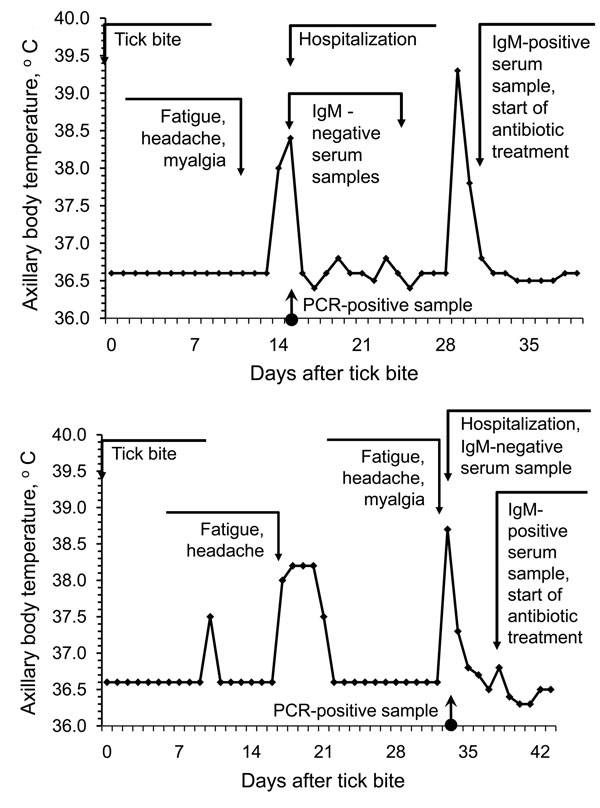
Sometimes, people get cycling, spiking fevers. Studies demonstrated that some patients had episodes of high spiking fevers which occurred days or one to two weeks apart. These cyclical fevers and the lack of a rash map closely to symptoms found in relapsing fever - a spirochetal disease which is usually transmitted by soft-bodied ticks.

Here is an example of two patterns of fever and symptoms found in patients studied in Russia [pdf]:

Graph From: Humans Infected with Relapsing Fever
Spirochete Borrelia miyamotoi, Russia
Emerg Infect Dis. 2011;17:1816-1823
Note that two patients' patterns of fevers and symptoms differed, but a spiking fever with periods of normal temperature between fevers is common in relapsing fever. (These two patterns are not representative of all patients - other patients may have their own variation on how the disease process unfolds.)

Later stages of infection

Not much is known about later stages of infection with B. miyamotoi. This is because its study in human and animal hosts is relatively new, having been discovered only in 1995 in Japan.

However, one could potentially extrapolate how B. miyamotoi will behave after initial infection by looking at research on its genetically closest living relatives which are also relapsing fever spirochetes.

Borrelia miyamotoi's closest living relatives appear to be Borrelia hermsii and Borrelia lonestari.


Image from: Typing of Borrelia Relapsing Fever Group Strains.
Emerg Infect Dis. 2004 September; 10(9): 1661–1664.
doi: 10.3201/eid1009.040236

Testing for the presence of Borrelia miyamotoi

From both the patient's and the doctor's point of view, one troubling aspect of being infected with Borrelia miyamotoi is that even if the patient has a history of a tick bite and has symptoms which seem similar to those found in Lyme disease - a blood test for Lyme disease will be negative.

This is because Borrelia miyamotoi is genetically distant enough from Borrelia burgdorferi that the antibodies produced in response to miyamotoi seldom cross react with those of Borrelia burgdorferi.

So how do you test for the presence of Borrelia miyamotoi?

If you're a microbiologist and do not have access to antibody testing, have an acutely ill patient in front of you with a current flare up of symptoms including spiking fever, a blood smear and dark field microscopy might yield a positive result for Borrelia miyamotoi - as it does for other relapsing fever spirochetes.

But most family physicians will likely want to order a blood test using PCR and/or an antibody test specifically designed for relapsing fever in order to detect infection.

In a study of 47 Russian patients found to have infections with Borrelia miyamotoi, presence of infection could be detected using an ELISA (EUROIMMUN AG, Lübeck, Germany) for major Borrelia burgdorferi sensu latu genospecies found in Europe - but it could not discriminate (sort) specific antibodies against any of these species.

Given that ELISA tests for Borrelia other than Borrelia burgdorferi sensu strictu are hard to come by in the US and Canada, the detection of Borrelia miyamotoi using standard Lyme disease ELISA may not work in North America.

Instead of a standard North American Lyme disease ELISA or EUROIMMUN AG, an ELISA or Western Blot for relapsing fever which contains GlpQ protein - an antigen which is non-reactive to Borrelia burgdorferi antibody - can be used to detect infection with Borrelia miyamotoi.

This information should serve as a cautionary tale for the doctor:

If a patient has been in an environment where ticks are found and has Lyme disease-like symptoms or a summer flu, consider relapsing fever as a differential diagnosis - especially if the patient does not recover as they would from a flu and has a negative Lyme disease ELISA.

Blood tests and PCR are most likely to yield a positive result when a sample is taken during a patient's spiking fever and the height of symptoms because that is when spirochetemia is peaking. With each relapse of infection, the number of spirochetes in the blood is reduced - thus making it less likely to obtain positive test results the later it is during the course of infection.

Treatment

So far, all the research points to the same antibiotics being used for Lyme disease as being effective for treating relapsing fever, and this extends to infections with Borrelia miyamotoi. In addition to amoxicillin, tetracycline, and doxycycline, relapsing fever has also been treated with chloramphenicol with success. Intravenous ceftriaxone may be required for more severe illness.

If a patient with Borrelia miyamotoi is treated with antibiotics and continues to suffer from high spiking fevers and other symptoms, retreatment may be needed with intravenous antibiotics. Co-infections such as babesiosis and ehrlichiosis should be investigated as they can produce similar symptoms.

In a 2011 study on Russian patients treated for Borrelia miyamotoi infection, this was the treatment and outcome:

Therapy consisted of ceftriaxone, 2 g intravenously every 24 hours for 2 weeks (42 patients) or doxycycline 100 mg orally every 12 hours for 2 weeks (2 patients). Two patients received no antimicrobial drug while hospitalized; 1 later received doxycycline at home, and the other was readmitted to the hospital for relapse and received ceftriaxone.

Outcome

Some relapsing fever strains can cause severe illness, and without treatment these strains have a high rate of case fatality. So far, B. miyamotoi lies along a spectrum of illness which appears to range from mild to moderate severity, but even so, infection should be treated with antibiotics immediately to avoid complications.

The good news is that most people who are infected with relapsing fever and are treated promptly with antibiotics go on to recover. The same will probably apply to infection with B. miyamotoi based on research published to date - but the true picture remains uncertain until more patients are diagnosed, treated, and proper follow-up is completed.

Complications

Are the complications found in Borrelia miyamotoi infections going to be the same as those found in Lyme disease? Given that it is genetically closer to relapsing fever spirochetes and more distant to Borrelia burgdorferi, one could speculate that it may have characteristics and complications common to relapsing fever - but without further research, it is unclear.

The risk for infected untreated pregnant women to pass on infection to the fetus in utero with a negative outcome (e.g. miscarriage; defects) might be more likely than it is in Lyme disease. Infection of the central nervous system may also occur more rapidly than it typically does in Lyme disease. But this is speculative, due to being based on research where there is variability in severity and outcome across relapsing fever strains.

Facts and uncertainties

It is known that in many cases, Borrelia miyamotoi - unlike Borrelia burgdorferi - is transmitted transovarially in deer ticks. This means the female tick infects her offspring, which produces infected larvae. These larvae will go on to molt and become infected nymphs. (Transovarial infection is rare to nonexistent in Borrelia burgdorferi.)

It is also known that relapsing fever spirochetes in soft-bodied ticks reside in tissues throughout the tick - whereas Lyme disease spirochetes are only found in the midgut.

Thus a significant question arises: What role does a relapsing fever spirochete play in relation to its hard-bodied tick host, and how soon can a tick transmit infection with Borrelia miyamotoi after attachment? This appears to be unknown.

Other questions based on how other relapsing fever strains also present themselves: How neurotropic is Borrelia miyamotoi? Can it become a latent infection, as was discovered in other relapsing fever strains? How rapidly does it differentiate into different serotypes found in different tissues?

The answers to these questions - and more - are also unknowns until this bacteria is studied more carefully. Similar questions may also arise in research on Borrelia lonestari in Amblyomma americanum ticks - another relapsing fever type spirochete found in a hard-bodied tick.

* Jan 19, 2013 Edited to add: Dr. Peter Krause offered a more recent estimate of 3-4,000 cases of B. miyamotoi occur in US annually.


Image Credit: Photography by Alan R. Walker, of Borrelia theileri infecting the blood plasma of a cow. Giemsa stained. Borrelia theileri is closely related to both B. lonestari and B. miyamotoi, and causes bovine Borreliosis in cattle. Source: http://commons.wikimedia.org/wiki/File:Borrelia-theileri-cow.jpg

References

Human Borrelia miyamotoi Infection in the United States
N Engl J Med 2013; 368:291-293 January 17, 2013 DOI: 10.1056/NEJMc1215469 http://www.nejm.org/doi/full/10.1056/NEJMc1215469

Carl-Johan Fraenkel, Ulf Garpmo,Johan Berglund. Determination of Novel Borrelia Genospecies in Swedish Ixodes ricinus Ticks. J. Clin. Microbiol. September 2002 ; 40:9 3308-3312 doi:10.1128/JCM.40.9.3308-3312.2002 http://jcm.asm.org/content/40/9/3308.full

Rebaudet, Stanislas, and Philippe Parola. Epidemiology of relapsing fever borreliosis in Europe. FEMS Immunology & Medical Microbiology 48.1 (2006): 11-15. http://onlinelibrary.wiley.com/doi/10.1111/j.1574-695X.2006.00104.x/full

Sarah A Hamer, Graham J Hickling, Rich Keith, Jennifer L Sidge, Edward D Walker, and Jean I Tsao. Associations of passerine birds, rabbits, and ticks with Borrelia miyamotoi and Borrelia andersonii in Michigan, U.S.A. Parasit Vectors. 2012; 5: 231.
Published online 2012 October 11. doi: 10.1186/1756-3305-5-231 http://www.ncbi.nlm.nih.gov/pmc/articles/PMC3497883/

Scott, M. C., et al. High-Prevalence Borrelia miyamotoi Infection Among Wild Turkeys (Meleagris gallopavo) in Tennessee. Journal of medical entomology 47.6 (2010): 1238-1242. http://www.bioone.org/doi/abs/10.1603/ME10075

Mun J, Eisen RJ, Eisen L, Lane RS. Detection of a Borrelia miyamotoi sensu lato relapsing-fever group spirochete from Ixodes pacificus in California.
http://www.ncbi.nlm.nih.gov/pubmed/16506458

Ogden, Nick H., et al. Investigation of genotypes of Borrelia burgdorferi in Ixodes scapularis ticks collected during surveillance in Canada. Applied and environmental microbiology 77.10 (2011): 3244-3254. http://www.ncbi.nlm.nih.gov/pmc/articles/PMC3126474/

Fukunaga M, Takahashi Y, Tsuruta Y, et al. Genetic and phenotypic analysis of Borrelia miyamotoi sp. nov., isolated from the ixodid tick Ixodes persulcatus, the vector for Lyme disease in Japan. Int J Syst Bacteriol 1995;45:804-810
http://ijs.sgmjournals.org/content/45/4/804.full.pdf

Jonas Bunikis, Jean Tsao, Ulf Garpmo, Johan Berglund, Durland Fish, Alan G. Barbour.
Typing of Borrelia Relapsing Fever Group Strains. Emerg Infect Dis. 2004 September; 10(9): 1661–1664. doi: 10.3201/eid1009.040236 http://www.ncbi.nlm.nih.gov/pmc/articles/PMC3320305/

Scoles, Glen A., et al. A relapsing fever group spirochete transmitted by Ixodes scapularis ticks. Vector Borne and Zoonotic Diseases 1.1 (2001): 21-34. http://online.liebertpub.com/doi/abs/10.1089/153036601750137624

Tamar Halperina, Nadav Orrb, Regev Cohena, Tal Hasina, Nadav Davidovitchc, Eyal Klementa, Raid Kayoufa, Gad Banethd, Dani Cohenb, Miri Yavzoria. Detection of relapsing fever in human blood samples from Israel using PCR targeting the glycerophosphodiester phosphodiesterase (GlpQ) gene. Acta Tropica. Volume 98, Issue 2, May 2006, Pages 189–195 http://www.sciencedirect.com/science/article/pii/S0001706X0600074X

Schwan TG, Schrumpf ME, Hinnebusch BJ, Anderson DE Jr, Konkel ME. GlpQ: an antigen for serological discrimination between relapsing fever and Lyme borreliosis. J Clin Microbiol 1996;34:2483-2492 http://jcm.asm.org/content/34/10/2483.full.pdf

Karan' LS, Koliasnikova NM, Toporkova MG, Makhneva MA, Nadezhdina MV, Esaulkova AIu, Romanenko VV, Arumova EA, Platonov AE, Maleev VV. [Usage of real time polymerase chain reaction for diagnostics of different tick-borne infections]. [Article in Russian] Zh Mikrobiol Epidemiol Immunobiol. 2010 May-Jun;(3):72-7. http://www.ncbi.nlm.nih.gov/pubmed/20734723

Alan G. Barbour, Jonas Bunikis, Bridgit Travinsky, Anne Gatewood Hoen, Maria A. Diuk-Wasser, Durland Fish, and Jean I. Tsao. Niche Partitioning of Borrelia burgdorferi and Borrelia miyamotoi in the Same Tick Vector and Mammalian Reservoir Species. Am J Trop Med Hyg. 2009 December; 81(6): 1120–1131. doi:10.4269/ajtmh.2009.09-0208 http://www.ncbi.nlm.nih.gov/pmc/articles/PMC2841027/

Relapsing Fever. Columbia University Lyme and Tickborne Diseases Research Center. http://www.columbia-lyme.org/patients/tbd_relapsing.html

Researchers discover new tickborne infection. WTNH News 8. January 18, 2013 http://www.wtnh.com/dpp/news/health/researchers-discover-new-tick-borne-infection

Read More

Thursday, December 13, 2012

5 Part Two: How A Skeptic Ended Up Seeing An ILADS Doctor

In the first installment of this series, the circumstances which gave rise to my seeing an LLMD were outlined. Having issues getting proper diagnosis and treatment for an early acute case of Lyme disease, the inability to secure a referral to an infectious disease specialist, a referral to a doctor from local Lyme disease support groups, and being incredibly ill all led to my first visit with an LLMD.

In today's installment, I'll talk about how I decided to take antibiotics long term, how the Lyme disease patient community became part of my life, and the inner conflicts which have arisen by being a patient with my condition.

On Being A Somewhat Different Chronic Lyme Disease Patient

Unlike the majority of chronic Lyme disease patients who were surveyed, I did not have to see many doctors before my diagnosis. And unlike the majority of chronic Lyme disease patients, I still felt like modern medicine worked pretty well for me up to that point: If I got bronchitis - the doctor helped. If I got a sinus infection - the doctor helped. If I got an ingrown toenail... You get the idea.

So for me, the health care system - at least up until my Lyme disease experience - worked well enough for me. I received as much care as I needed for the problems I faced and made few demands on the system because I was (for the most part) healthy.

This perspective initially carried over to my LLMD: I thought we would have an appointment or two, I'd check in if I had a question or needed a prescription filled; I'd take antibiotics for a few weeks - and otherwise, our paths probably wouldn't cross again unless I got another EM rash someday.

But as I reached the month mark and realized how lousy I felt, I wasn't so sure about stopping antibiotics. I was severely ill. And when I stopped antibiotics, I discovered that within a few days I was even less functional and in even more pain than I was while taking antibiotics.

I told my LLMD, "I don't understand. I thought I'm supposed to feel better by now. I caught this early." My LLMD said, "This is Lyme. This is how it is."

What do you mean, "This is how it is?"

At that point in the game, my brain was so cognitively impaired I had to take notes and try to reason through this explanation given over time - but to be frank, nothing made sense at that point because I was too ill and wasn't tracking conversations well.

I found out that the choice to continue taking antibiotics rapidly became a pragmatic one:

Every time I stopped taking antibiotics, the worst of my symptoms would return and I would drop out of being an active member of society.

With the antibiotics, I was eventually able to walk up and downstairs at a slow to normal speed. I could drive short distances, I could run some errands, I could walk to the train station, and even begin working part time again. I'd still be in some pain and have some fatigue - but I could at least do something.

Without the antibiotics, I would be overcome with pain and fatigue and begin losing cognitive ground again. I would have trouble leaving the bed - let alone leaving the house. The pain and fatigue were so overwhelming that any stoic attempts on my part to push past them failed.

I didn't like this new reality - but I didn't want to lose my job.

I reasoned to myself that I knew a few diseases were treated with longer courses of antibiotics so there was risk management for such situations - and considered treatment was probably low risk, provided I didn't stop antibiotics and restart them often as that would create antibiotic resistance. Or if I decided to stop and wanted to restart - I could restart with a different antibiotic which was effective in order to avoid resistance.

I rationalized my decision at each step, and I did so directly in response to the improvements I experienced while on antibiotics - but also due to the projected loss if I stopped antibiotics entirely.

I knew the risks to continue the drugs were there - and the risks to stop them were as well. I thought I was damned if I did...and damned if I didn't.

The Ups And Downs Of My New Condition

When I first went off antibiotics and symptoms resurgence occurred, I joined a few online support mailing lists for Lyme disease patients and asked if people knew what was happening to me. I was also in so much pain, I wanted someone else to complain to who would understand and not have to dump on my friends about it.

Outside of Lymeland, my healthy friends knew I contracted Lyme disease - but they could not relate to what I was going through. A few of them had Lyme disease in the past and got it treated - but none of them had developed the kind of problems I had. None of them had symptoms which were as severe as mine or had lasted as long.

It was frustrating, because I didn't understand why my path wasn't the same as theirs. It made me wonder just what was in that tick that bit me that I ended up so much sicker than any of them had been.

Not knowing what else to do, I read the posts and archives on my patient mailing lists and struggled to understand what had happened to me. It was challenging because reading and comprehension came very slowly; I had to take notes because I kept forgetting things.

Before I could understand what was happening to me, a clear picture began to form of what life was like for many patients diagnosed with chronic Lyme disease:

- Most people there had symptoms for a long time before they were given a diagnosis of chronic Lyme;
- Most had already seen multiple doctors who had not been able to diagnosis them - or they were diagnosed with something else but were told their case was "atypical";
- Most felt disowned and dismissed by the medical community at large;
- Most if not all had their lives destroyed in some way by the onset of these symptoms which continued plague them.

Patients who were once married were divorced, due to having partners who were unwilling to be supportive or adapt to the reality of their illness. Patients who lost five and six-figure jobs had to sell their homes and downsize considerably - sometimes moving back in with their elderly parents. Patients who were once avid hunters and rock climbers had to stop doing what they loved and either sold their gear or enshrined it prominently in hopes of using it someday in the far off future.

I didn't know what to make of myself and how I fit into all of this as time went on. It was overwhelming to hear how much physical suffering everyone had endured, how much personal loss everyone experienced, and how much humiliation everyone went through at the hands of various medical professionals.

I swore to myself. This wasn't going to be me. After all, I just had early Lyme disease. Not this chronic stuff. Right?

But as time went on, I realized that as early as my infection had been treated, something wasn't right because like the rest of the group - I was still quite sick.

I was barely able to work part time even with extended treatment. I would get home, take off my shoes, and immediately lie down. I would wait two or three hours before getting up to attempt making myself dinner. And after a simple dinner, I would lie down and pass out for the night.

There was no energy to go out and socialize. It hurt too much to return to clubbing, hiking, and biking. My plan to take surfing classes on Hawaii's beaches was scuttled...There was no money to do it, anyway.

Periodically, I would stop all antibiotics and take painkillers and anti-inflammatory medication instead. But each time, the symptoms which made me totally dysfunctional would come back, and I would give in to taking the antibiotics again and double my consumption of yogurt and acidophilus capsules. Pain medication - over the counter and prescription, both - had little effect on the symptoms I had.

Slowly, very slowly, I improved. Months later, I eventually managed to get a new, full time job - and by the time I did, I was about 80% of my pre-tickbite baseline for health. I was initially relieved and thrilled, because to me this meant I'd finally made it. I thought I'd gotten past the Lyme disease, and wrote off remaining 20% of symptoms as residual fatigue and odd random aches which would heal in time.

This little victory was to be short-lived, however, as after many months of no antibiotics (I had decided to quit, having felt mostly better), I began to relive that sinking sense of decline I'd had the previous year. Cognitive abilities began to wane. Energy lacked. More new symptoms I never had before joined the chorus. I fell behind at work. I attempted to telecommute. But long story short: I had to leave this job, too.

I went to my new family doctor and saw a few specialists and tried to figure out if anything else was going on. We tested for autoimmune disorders - nothing. CBC and metabolic panels - nothing. Vitamin deficiencies? Okay, I was slightly low on B-12, but that was easily correctible.

Nothing else showed up, though. And yet I continued to decline and become increasingly useless. Despondent. Exhausted.

Concerned for my sanity, I decided on my own to consult with a therapist and see if depression or other psychiatric conditions could be causing any of my symptoms. The therapist's evaluation of my situation was that I was somewhat depressed, but the nature and magnitude of my symptoms indicated I had a medical problem that wasn't being properly addressed. What problem? The therapist had no idea.

Not finding any answers from my family doctor, specialists, or therapist, I returned to my LLMD. There, the reason for some of the absolute worst of my symptoms had been revealed: My spiking fevers, sweats, chest compression, and shortness of breath which began attacking at night were pinned down to babesiosis, a tickborne disease caused by babesia - protozoa which cause symptoms similar to malaria. The grinding fatigue and cognitive slowing I'd been struggling with may also have been caused by this organism.

It turned out babesia treatment was the best investment I ever made since the entire Lyme disease debacle began, as it began to alleviate my most serious symptoms. It enabled me to sleep more than three hours a night, restored a huge chunk of my cognitive ability, stopped sharp stabbing pains in my legs, and restored my breathing to normal.

I improved, but to this day have still not returned to my former health before the tick bite.

Trying To Make Sense Of It All

A couple years prior to this point, I went into my situation expecting to take a couple weeks' worth of antibiotics then go back to work. I didn't expect to experience not only a protracted improvement - but also an improvement followed by a more serious decline.

After my cognitive abilities began to improve again, I tried to make sense of my situation: On one hand, clinical trials had shown that only a subset of the most symptomatic patients enrolled improved with additional antibiotic treatment. But on the other hand, I had my own experience with antibiotics over a longer trajectory than those in trials, and had seen greater improvement. On one hand, anecdote is not evidence. On the other hand, I had nothing else to go on because there was no officially sanctioned treatment from the Infectious Disease Society of America, who labeled my condition as being "Post Lyme Disease Syndrome" - hypothesized to be an autoimmune-like disorder.

Tired of having either the contested and hotly debated chronic Lyme disease or the ill-defined Post Lyme Disease Syndrome, I wanted answers. Where were they? Where was the scientific research which would determine my diagnosis without any doubt?

My patient support groups and research I'd read reinforced the idea that Borrelia burgdorferi could cause a persistent infection. But I'd also read that molecular mimicry was associated with Lyme arthritis - at least in some instances. I began to read through all the research I could find, and see if I could independently draw my own conclusions about my condition.

I half jokingly wanted someone to conduct a clinical trial pitting antibiotics against non-antibiotic analogs which contained the anti-inflammatory component. I thought maybe this would answer some questions as to whether it was the anti-inflammatory component of antibiotics which alleviated patients' symptoms - or the antibacterial one. But it was quickly pointed out to me that if any patients were still infected, this would be considered an unethical trial if those patients were placed in the analog arm. I dropped that idea.

I had looked to enroll in clinical treatment trials for either chronic Lyme disease or Post Lyme Disease Syndrome, willing to bet on either horse in this race - but neither was ever running on the NIH-NIAID track whenever I looked. And to this day, there has been no Post Lyme Disease Syndrome treatment trial, and no test of the hypothesis that PLDS - outside of Lyme arthritis - is autoimmune in nature. So my career as a lab rat was over before it could even start.

I wanted to do everything right, and not rely on anecdote alone for my treatment - even if it showed some signs of success. I looked for how I could engage in the research needed to help myself and others - but there was no avenue open for this, either.

So here I was, stuck doing something which I didn't think I'd be doing in the first place and which I wanted to understand: How could I have ended up taking antibiotics longer term when officially published trials indicated that more antibiotics were not better? I thought that as someone with a research background, that I would have used the outcome of those trials as a basis for my decision. I didn't.

One could argue I did it out of desperation. That's probably true. I was so seriously sick, I didn't know what else to do. I was desperate for relief and at one point, nearly suicidal with pain. So desperation played a role - there is no denying that. It was the reality of the situation.

But it really began with the need for a short course of antibiotics to begin with - and ending up continuing it because the alternative was much worse.

And at the time, it was really the only option presented to me by any medical professional outside of pain medicine, and I needed to make sure my brain worked in order to hold down even a part time job - opiates and narcotic pain medicine would have stolen away what brains I had.

I did it because no other options were presented to me, no one else knew how to treat my condition, and the boundaries defining my condition were ill-defined. I definitely had Lyme disease - at least at one point. I definitely had babesia, and now I can never donate blood again. I don't know if any other pathogen was in that tick and will likely never know; perhaps some entirely different microorganism which was antibiotic responsive was killed off by my efforts.

After some time has passed, I've noted that the most severe of my symptoms have not returned. I'm hesitant to say they're permanently gone, given how I was at 80% of my baseline before, only to decline again. And while I'm not well enough to work, I'm not so disabled I can't get out of bed and do a number of basic tasks - provided I pace myself.

Arriving at this stage, I have had to reevaluate how I decide to treat my condition. Since I'm concerned about antibiotic resistance and allergies, I wanted to avoid taking more antibiotics. And since I'm concerned about the condition of my digestive system, I thought stopping antibiotics was in my best interest. So I have stopped again, and tried other methods of treating my symptoms - but none have been effective enough to worth noting.

Today, life goes on - to some degree. I am not improving. I miss working. I miss doing all the things I love to do that I - like so many others on the mailing lists I inhabited - cannot do.

And I debate about what to do next - especially if my symptoms deteriorate more. I am on a rollercoaster where I can't be sure how I'm going to be affected next, and most of the medical community seems ill equipped to know how to manage a patient with my condition.

This is not a blame thing, by the way - this is a simple fact. And yet, if the projections are anything to go by, I am the medical face representing tomorrow's patients: More of us are going to be chronically ill, and have to cope with complex conditions. What can we do to set the groundwork in place to prevent others from becoming chronically ill as I have - and to effectively help those who have become as ill as I am?

(Part three of this series next: The pseudoscience and science of chronic Lyme disease. Part one of this series is here.)

Read More

The Camp Other Song Of The Month


Why is this posted? Just for fun!

Get this widget

Lyme Disease

Borrelia

Bacteria

Microbiology