Lyme disease, science, and society: Camp Other
Showing posts with label patent. Show all posts

Wednesday, February 22, 2012

1 Patent: Viral Genetics Chronic Lyme Disease Treatment

This post is related to an earlier post about Viral Genetics application for a pre-IND to begin clinical trials on their VGV-L product for the treatment of Chronic Lyme disease.

See: http://campother.blogspot.com/2012/02/viral-genetics-issues-latest-report-on.html

Apparently, I found Viral Genetics' current patent. And as I had previously speculated, I was correct that the treatment is going to modify B cells. I knew it! Buy me a drink, eh?

Here is a link to the patent online: http://www.faqs.org/patents/app/20100166789

Patent application title: PROTEINS FOR USE IN DIAGNOSING AND TREATING INFECTION AND DISEASE

Inventors: Haig Keledjian (San Marino, CA, US) Michael Agadjanyan (Huntington Beach, CA, US) Martha Karen Newell (Colorado Springs, CO, US) Evan Newell (Menlo Park, CA, US)
Assignees: THE REGENTS OF THE UNIVERSITY OF COLORADO Viral Genetics, Inc.
IPC8 Class: AA61K3900FI
USPC Class: 4241851
Class name: Amino acid sequence disclosed in whole or in part; or conjugate, complex, or fusion protein or fusion polypeptide including the same
Publication date: 07/01/2010
Patent application number: 20100166789

And here are the excerpts on how the invention will be used to treat chronic Lyme disease (patent text slightly modified to correct spelling errors):

[0114] Lyme Disease is a tick-borne disease caused by bacteria belonging to the genus Borrelia. Borrelia burgdorferi is a predominant cause of Lyme disease in the US, whereas Borrelia afzelii and Borrelia garinii are implicated in some European countries. Early manifestations of infection may include fever, headache, fatigue, and a characteristic skin rash called erythema migrans. Long-term the disease involves malfunctions of the joints, heart, and nervous system. Currently the disease is treated with antibiotics. The antibiotics generally used for the treatment of the disease are doxycycline (in adults), amoxicillin (in children), and ceftriaxone. Late, delayed, or inadequate treatment can lead to late manifestations of Lyme disease which can be disabling and difficult to treat.

[0115] A vaccine, called Lymerix, against a North American strain of the spirochetal bacteria was approved by the FDA and later removed from the market. It was based on the outer surface protein A (OspA) of B. burgdorferi. It was discovered that patients with the genetic allele HLA-DR4 were susceptible to T-cell cross-reactivity between epitopes of OspA and lymphocyte function-associated antigen in these patients causing an autoimmune reaction.

[0116] It is believed according to the invention that Borrelia burgdorferi also produces a Toll ligand for TLR2. Replacement of the CLIP on the surface of the B cell by treatment with a thymus derived peptide with high affinity for the MHC fingerprint of a particular individual, would result in activation of the important Tregs that can in turn cause reduction in antigen-non-specific B cells. Thus treatment with thymus derived peptides could reactivate specific Tregs and dampen the pathological inflammation that is required for the chronic inflammatory condition characteristic of Lyme Disease. With the appropriate MHC analysis of the subject, a specific thymus derived peptide can be synthesized to treat that subject. Thus individuals with all different types of MHC fingerprints could effectively be treated for Lyme disease.

[0117] Chronic Lyme disease is sometimes treated with a combination of a macrolide antibiotic such as clarithromycin (biaxin) with hydrochloroquine (plaquenil). It is thought that the hydroxychloroquine raises the pH of intracellular acidic vacuoles in which B. burgdorferi may reside; raising the pH is thought to activate the macrolide antibiotic, allowing it to inhibit protein synthesis by the spirochete.

Read more: http://www.faqs.org/patents/app/20100166789

How will this theoretically stop inflammation present in chronic Lyme disease? What does the above all mean, in English? More details coming soon - for now I wanted to share this.

In the meantime, you might want to review this: http://en.wikipedia.org/wiki/Thymus

Image credit: Thymus by LearnAnatomy from Wikipedia under a CC 3.0 license.


Read More

Tuesday, February 21, 2012

0 More On Lyme Disease In Australia On The Today Tonight Show

There's been increased interest from my readers in learning more about Lyme disease in Australia, so I decided I would offer an update on the situation for everyone including my northern hemisphere readers who are interested in new developments there.

Last week, the Australian television news show, Today Tonight, posted a segment on Lyme disease in Australia and how it has become a controversial issue as a number of Australians who have never left the country were bitten by ticks and developed symptoms very much like those of Lyme disease.

As far as it is known, the bacteria which causes Lyme disease has not been detected in ticks in Australia - unless the researchers mentioned in the previous episode of Today Tonight which was covered here have finally discovered it.  Without their official announcement, though, it has been the situation that cases of Lyme disease within the country which have been confirmed were attributed to infections acquired overseas. Any recent reports of Lyme disease contracted within Australia have become controversial.

This week, Today Tonight has posted another segment about a man, Robert Sotur, who became ill on the job after numerous tick bites and won a government workmans compensation case due to an infection with Lyme disease.

This is pretty notable because he received compensation for a disease that the Federal Government, the Australian Medical Association, and Australian State Governments all say doesn't exist in Australia.

View the video of the show and transcript here: http://au.news.yahoo.com/today-tonight/health/article/-/12972227/lyme-disease-compensation/

A lawyer, David Jones (yes, seriously, David Jones - wonder how much tiresome joking he gets about that name), who is working on behalf of over fifty patients who never left Australia yet have come down with Lyme disease-like symptoms in Australia made this statement to Today Tonight:

"There needs to be an acceptance that there are many people within our community that are having symptoms that are Lyme or Lyme-like, and Governments need to take these people seriously. They need to commission the research, and they need to determine whether or not this disease, or a disease like it, exists here in Australia.”

He's right. If one man has won a workmans compensation case within Australia for falling ill after tick bites, there will likely be others. More than fifty, judging from his caseload alone. But there will be far fewer cases if the research is done to find the causative agent of this disease and to treat people for it as soon as possible.

If it is a bacterial agent, then unlike Ross River Virus and other viral infections which are more well known throughout Australia - early treatment can prevent more serious symptoms and potential permanent damage, and in the worst case scenario - death, as in the case of Karl McManus.

Given the limited amount of recent surveillance and examination of ticks for an indigenous spirochete that could cause a condition similar to Lyme disease - if not the potential importation of Borrelia spirochetes from neighboring Asia - it is not clear what reality is. The last major study to discover if Australian ticks harbored a spirochete similar to one that causes Lyme disease was conducted over 15 years ago. The situation may be different now.

Australian support groups for patients with tickborne illnesses have not only reported being bitten by ticks and falling ill afterwards - some have also reported infestations of bird mites preceding the onset of their symptoms. If this is the case, there may be more than one pathogen and more than one vector responsible for an overlapping set of symptoms in patients. Careful and thorough research is needed to sort it out.

My advice to any Australians reading this is whether or not the controversy of the existence of Lyme disease in your country is resolved soon that you do what you can to protect yourself from tick bites. Learn how to properly remove a tick to minimize the risk of infection, find a place to send your ticks for analysis, and educate yourself about the spectrum of symptoms which are related to ALL tickborne diseases and not just Lyme disease.

Tularemia was discovered in Tasmania last year and there is evidence beyond a doubt of its presence. Lyme disease now appears to be a possibility. And then there are those mosquito-borne and tickborne conditions of which many Australians are already familiar with such as Ross River Virus, Barmah Forest Virus, Tick Typhus, and Tick Paralysis - none of which you want if you can avoid them.

See a doctor if you suspect you have contracted a tickborne infection - remember, it may or may not be Lyme disease and treatment will be different for coinfections. But do go as soon as possible in order to prevent serious and potentially long-lasting complications.

And last but not least:

Petition your government, CSIRO, and local universities to do more research on tickborne illnesses including Lyme disease. Make sure you have your own homegrown research teams that will investigate the possibility of Lyme-like illnesses from pathogens transmitted by both bird mites and ticks. Ask Australian scientists to pave their own path and to not feel obliged to model all their investigations and guidelines for treatment based on those found in the northern hemisphere until it is more certain what is happening. In the meantime, treatment will probably be empiric and based on history, symptoms, and test results.

Here is a helpful link with short videos on the prevention of tick bites and safe removal of ticks:

Rather than just "Slip, Slap, Slop", learn to "Cover, Check, Clasp"?: http://campother.blogspot.com/2011/06/video-tick-removal.html

Fine-nosed tweezers are your friends, and not flame throwers and lighters...

Links to Australian tick bite related posts on this site:

About the first Today Tonight show this year on Lyme disease:
http://campother.blogspot.com/2012/02/lyme-disease-in-australia-on-today.html

On the outbreak of Tularemia in Tasmania late last year:
http://campother.blogspot.com/2011/11/tickborne-disease-outbreak-hits.html

On the use of marsupial cathelicidin peptides to fight infection:
http://campother.blogspot.com/2011/11/two-notable-antibiotic-articles-long.html

On Australian research on the relationship between tick bites and red meat allergies:
http://campother.blogspot.com/2011/04/tick-bite-you-stick-to-eating-fish-and.html

On Google search trends, and how Australians rank in the search for information on Lyme disease using Google:
http://campother.blogspot.com/2011/07/google-trends-on-lyme-disease.html

Links to Australian resources on Lyme disease outside of this blog:

CSIRO Public Health Advice on Ticks:
http://www.publish.csiro.au/?act=view_file&file_id=NB04047.pdf

The Karl McManus Foundation:
http://karlmcmanus.org/

Lyme Disease Association of Australia:
http://www.lymedisease.org.au/

Lyme Green Australia blog:
http://lymegreenaustralia.blogspot.com/


Read More

Tuesday, October 25, 2011

0 News: New Molecular Test Could Detect Early Lyme Disease

The Guardian has written about a new molecular test using nanoparticles which was developed by Alessandra Luchini, of George Mason University, to initially detect cancers. The new test is being used in clinical trials to detect early Lyme disease - even if there is no rash present in the infected patient.

Excerpt that will be of interest to readers:
"Q: In years to come, is this something that could be available in hospitals? 
That's the hope we have. The first clinical trial is on the detection of Lyme disease. A fraction of patients get a skin rash but for those without the rash it is very difficult to diagnose. So with the particles we are able to capture the antigens that come from the spirochaete that is the causative agent of Lyme disease. If we see in the urine a piece of the bacteria of the spirochaete, we are sure that the patient has Lyme disease. We are gathering all the evidence and then we will need to go first for FDA approval before it is available in clinics. 
Q: How much earlier will you be able to detect Lyme disease? 
Lyme disease has a window of two to three weeks before seroconversion [production of antibodies in the host blood, indicating infection]. With our tests, we're able to detect it before seroconversion, because we're not looking for the antibodies, we just look for the spirochaete. I would say here, yes, by weeks, and earlier diagnosis would be beneficial for the prognosis."
Comment: One thing this does make me wonder about is how similar this test is to Temple Douglas' hydrogel nanoparticle test for early detection of Lyme disease. Maybe it's time to do a compare and contrast of patent application content?

MORE here at the link: http://www.guardian.co.uk/technology/2011/oct/23/bright-idea-nanoparticle-trap-cancer

Read More

Thursday, September 22, 2011

0 Failure of Topical Antibiotics to Prevent Disseminated Borrelia burgdorferi Infection

Last week, I posted an article on how topical azithromycin could help prevent Lyme disease infection. And now, this new abstract has turned up on PubMed...

Failure of Topical Antibiotics to Prevent Disseminated Borrelia burgdorferi Infection Following a Tick Bite in C3H/HeJ Mice. Wormser GP, Daniels TJ, Bittker S, Cooper D, Wang G, Pavia CS. J Infect Dis. 2011 Sep 19. [Epub ahead of print]

Abstract

A prior study in mice has shown that the timely application of topical antibiotics to the skin at the tick bite site could eradicate Borrelia burgdorferi infection. That study, however, did not evaluate antibiotic preparations that are considered suitable for use in humans. In this murine study, topical application of 2% erythromycin and 3% tetracycline preparations that are acceptable for use in humans was found to be ineffective in eliminating B. burgdorferi from the tick bite site or in preventing dissemination to other tissues. Reasons for the discrepant findings are discussed.


I find it very odd that they would choose erythromycin as a topical antibiotic for Borrelia burgdorferi - there is research that shows that Borrelia burgdorferi is resistant to erythromycin. I would have never thought to make that a choice for treatment. Tetracycline makes more sense.

How many previous studies of topical antibiotics for treating early Lyme disease have there been, and what have the outcomes been? How many have been done using suitable human antibiotic preparations versus ones only effective in animal subjects?

It seems to me that the researchers who filed this patent might already have a good idea of what might work - is this the same formulation that was used in the study I posted last week?

Composition C
Composition [mg]
Component per unit [1 g]
Azithromycin 150
Dermacryl 79 50
Klucel MF 25
Miglyol 812 50
Ethanol 94% (w/w) ad 1 g

Or is it different?

Results: There is no infection of Lyme disease detectable when composition C is applied to the area where the ticks were allowed to feed. The topical application of Formulation C results in antibody titers, which are not different from naïve mice (KELA values between 10 and 40), whereas the infected mice show KELA values of 160 to 400.

Especially, the tissue and serum samples taken from different parts of the mice 56 days after the tick bite show no Borrelia burgdorferi organisms when cultivated and no specific antigenes are detectable. Tissue probes are taken from heart tissue, bladder, joint and ear. The group of mice topically treated with Formulation C show complete absence of B. burgdorferi , whereas B. burgdorferi is detected in untreated mice, which are exposed to tick-feed.

The recultivation conditions of B. burgdorferi are suitable to detect B. burgdorferi in any morphological form known to date. Surprisingly, Formulation C was able to eradicate B. burgdorferi in a way, that no infectious agents of B. burgdorferi are detected in the target tissues of B. burgdorferi.

How were these tissue probes completed and could they have missed any bacteria? What about the parenchyma of the brain, since this is low passage N40 they're talking about? (Problematic in rodent studies - should be studied in other animals.) I wonder about the methodology...

Read More

Tuesday, September 13, 2011

0 New Lyme Disease Detection Tests

The latest buzz in the Lyme disease patient community is over Advanced Laboratory Services' new culture test for Borrelia burgdorferi.

The new test uses histology and growth characteristics in conjunction with fluorescent immunostaining to detect Borrelia burgdorferi. Positive results can be further confirmed using standard molecular biology methods (PCR) based on DNA sequencing.

The test is now available for use in all states except California, New York, and Florida, which require a higher level of lab certification for testing. Physicians can obtain lab test kits from ALSI in Pennsylvania.

(I'm still looking for more information on the design and development of this test. While it's been mentioned in numerous sources that it is based on Dr. Eva Sapi's research, I have only seen a citation for her work on morphological changes in Borrelia burgdorferi when exposed to different antibiotics in vitro where the new culture method is mentioned there only in passing.)

I'm keeping an eye on this test and look forward to hearing more about it. But I'm also very interested in hearing more about a new test to detect Lyme disease which was developed by this intelligent young woman, Temple Douglas.

Temple won the 2010 Intel Science Talent Search award for her project, Application of Hydrogel Nanoparticles for Early Lyme Disease Diagnosis. Here's an interview with her:


Temple, at age 18, conducted research on the application of hydrogel nanoparticles for early Lyme disease diagnosis. Her research provides a means to reduce the number of chronic cases of Lyme disease, thus saving many people from the associated complications. A clinical trial is being planned.

Not only was she an Intel Science Talent Search finalist, but she has a patent on this test,too:

BORRELIA BURGDORFERI BACTERIAL ANTIGEN DIAGNOSTIC TEST USING POLYMERIC BAIT CONTAINING CAPTURE PARTICLES
http://www.sumobrain.com/patents/wipo/Borrelia-burgdorferi-bacterial-antigen-diagnostic/WO2011068844.html

I am looking forward to hearing about these clinical trials.

Which test is going to be the most sensitive and accurate?

Additional links:
Official Press Release For Advanced Laboratory Services [PDF file]:
http://researchednutritionals.com/Announcements/LymeCultureTest.pdf

Student's research paper on Lyme disease ranks nationally
http://ww2.fairfaxtimes.com/cms/story.php?id=1021


Read More

Thursday, February 24, 2011

0 A History of Antigenic Variation in Borrelia hermsii, burgdorferi

I decided to investigate more of Norris et al's patent history, and found that the first patent Norris filed was back in 1991, entitled Virulence Associated Proteins In Borrelia Burgdorferi (BB).

I also learned that the patent I had posted earlier this week - VMP-LIKE SEQUENCES OF PATHOGENIC BORRELIA - was first applied for as early as 2002, and decided to do a head-to-head comparison of the 2010 and 2002 patent. Out of all the points I had highlighted and posted earlier this week, they were about 99% the same.

Essentially, what has been known about vlsE's role in antigenic variation in Borrelia burgdorferi has been known for a number of years before I posted about it this week.

From VMP-LIKE SEQUENCES OF PATHOGENIC BORRELIA
Patent number: 6719983
Filing date: Aug 16, 2002
Issue date: Apr 13, 2004
Application number: 10/222,566

This application is a Divisional Application of U.S. application Ser. No. 09/125,619 filed on Jan. 27, 1999, now 5 U.S. Pat. No. 6,437,116 which is a continuation of PCT Application PCT/US97/02952 filed Feb. 20, 1997, which is a continuation-in-part and claims priority to Provisional Application Ser. No. 60/012,028 filed on Feb. 21, 1996.

That's a lot of patent applications there.

What was known in 2010 was known back in 2002, and some time before then.

The 1991 patent is different in one major respect from its successors: There is no mention of antigenic variation as either a possible mechanism for evading the immune system or as a known fact.

From this one may guess that there were huge strides made in understanding antigenic variation in Borrelia burgdorferi that happened within that decade.

According to research, Borrelia hermsii was known to have antigenic variation many years prior to the discovery of Borrelia burgdorferi's antigenic variation.

The first record of Borrelia hermsii's antigenic variation was in the Journal of Experimental Medicine, Volume 156, Issue 5, 1982, Pages 1297-1311:

Antigenic variation of Borrelia hermsii

Stoenner, H.G., Dodd, T., Larsen, C.
Rocky Mountain Lab., Natl. Inst. Allergy Infect. Dis., NIH,
Hamilton, MT 59840, United States
Abstract 
At least 24 different serotypes were detected in populations of Borrelia hermsii that originated from a single organism. These serotypes were identified by staining with specific fluoresceinated antisera prepared against cloned populations of living organisms of each type.

In the order of decreasing frequency, the 10 types more often encountered were 7, which was clearly dominant, and 2, 17, 24, 13, 2, 1, 21, 11, and 12. Each of the 24 types were shown to change to 7 or more other serotypes. Spirochetemia in mice was persistent, and relapses occurred when the concentration of organisms was sufficient for detection by visual means.

After mice were inoculated with a single organism, peak spirochetemia usually occurred on day 4, after which clearance of organisms occurred, and an apparently pure population was replaced by a mixed population consisting of as many as seven variants.

These types persisted for 2-3 d before being replaced by other types. Conversions occurred constantly and were independent of relapses.

The rate of conversion in mice treated with cyclophosphamide to delay antibody production was comparable to that of controls.

Spontaneous conversion was clearly demonstrated in tubes of fortified Kelly's medium inoculated with a single organism of type 7 or 21. 11 different variants appeared in eight cultures of type 21 by the time growth had reached 4 x 10⁶-107 organisms/ml. The rate of spontaneous change was estimated to be
~ 10-4-10-3 per cell per generation.

That was in 1982.

And who should be working with Stoenner back at this time, but Barbour?

Indeed, in the same year, Barbour published another paper, with S. L. Tessier, and H. G. Stoenner - Variable major proteins of Borrelia hermsii. J. Exp. Med. 156:1312-1324.

So they were right there at the beginning, when antigenic variation was discovered in Borrelia hermsii.

So why did it take so long to find out Borrelia burgdorferi has antigenic variation?

Because the bacteria known to cause Lyme disease wasn't identified until that same year - 1982.

It actually didn't take all that long.

This particular spirochete had yet to really be studied, and studied with an increasing level of technology that bacteriologists did not possess in earlier generations.

According to research, Borrelia burgdorferi's antigenic variation wasn't known until the late 1990's.

This article was posted in Current Biology,Volume 7, Issue 9, 1 September 1997, Pages R538-R540:

Bacterial pathogenesis: A variation on variation in Lyme disease

Michael Koomey
Department of Microbiology and Immunology,
University of Michigan Medical School,
Ann Arbor, Michigan 48109, USA

Abstract

The discovery of antigenic variation in Borrelia burgdorferi, the bacterium that causes Lyme disease, provides a potential explanation for the chronic nature of infection as well as new insights into the genetic structure of highly recombinogenic loci responsible for combinatorial genetic diversification.

Text

Microbial pathogens evolve many strategies aimed at evading the immunoprotective surveillance systems that operate in mammals. Perhaps the most direct countermeasure to the humoral wing of the immune system — the part involving recognition by specific antibodies — is antigenic variation, the process in which the primary structure and antigenicity of key surface proteins are altered without perturbing their function(s). These changes are achieved almost without exception by the reassortment and recombination of repeated genes or gene segments [1]. Such combinatorial mechanisms of genetic diversification have been found to underlie high frequency changes in the surface components of a wide variety of pathogens — trypanosomes [2], malaria parasites [3], relapsing-fever-causing Borrelia species [4] and the gonorrheal agent Neisseria gonorrhoeae [5]. And now the Lyme disease pathogen, Borrelia burgdorferi can be added to this list; the recent discovery of antigenic variation in this species may explain the chronic nature of Lyme disease.

In each of the pathogens that have been found to exhibit antigenic variation, the phenomenon has been discovered and characterized by a sequence of observations starting with biochemical and immunochemical documentation of inter-strain, and subsequently intra-strain, variation of a predominant surface component. This initial observation was followed by cloning of the structural gene encoding the variable surface component, and the identification of multiple copies of related but divergent gene copies or elements. It then became a relatively straightforward matter (in retrospect) to document the DNA rearrangements and recombination of related genes that are responsible for the antigenic variation.

Relapsing fever, caused by Borreliae hermsii and related species, is arguably the best understood disease involving antigenic variation. The initial infection occurs during the bite from an infected tick, or a louse during epidemics, and following this the infected animal undergoes waves of spirochetemia and accompanying fever. The relapses are associated with the clonal emergence in the bloodstream of a variant expressing a novel variable major protein [6]. After up to ten such waves of parasitemia, occurring every four to seven days, the individual or animal can succumb or recover completely.

Lyme disease is a tick-borne infection caused by the spirochete B. burgdorferi, which is related to the relapsing fever borreliae [7]. In stark contrast to relapsing fever, which has been relatively quiescent for almost 50 years, Lyme disease is currently the most common arthropodborne disease in both North America and Europe. Although rarely fatal, the manifestations of Lyme disease can be physically and emotionally debilitating [7]. Early human infection is usually characterized by a spreading skin rash (erythema migrans) and flu-like illness, which is self-limiting. In the following weeks to months, most untreated infected individuals proceed into a chronic late disease characterized by systemic involvement of the joints, brain, nerves, eyes and heart [8].

From these presentations alone, it seemed likely that antigenic variation would play a role in the immune evasiveness displayed by B. burgdorferi. Subtle differences in highly expressed surface lipoproteins were found between B. burgdorferi strains, but no compelling evidence for major antigenic changes [9] or gross genetic rearrangements [10] was initially forthcoming, despite indirect evidence suggesting that antigenic shifts can occur during mouse infection [11] and [12]. One major problem has been that there are as yet no experimental animal models that mimic the course of Lyme disease and in which spirochetemias can be detected. To complicate matters further, basic methodologies for gene transfer and mutant isolation in borrelia spirochetes have been slow in developing.

In the absence of many of the reagents that play such an important part in current studies of bacterial infectious disease, it is not surprising that the identification of antigenic variation in Lyme disease borreliae came about through a rather circuitous series of findings and experiments. This story begins in much the same way as many of the early studies of microbial pathogenesis, with the observation that passage of the organism in the laboratory leads to the recovery of variants or mutants of reduced virulence. In the case of Lyme disease borreliae, it was well documented that they lose their ability to infect laboratory animals following ten or more blind in vitro passages [13] and [14]. Attempts to define the genetic basis for this attenuation phenomenon were complicated by the weaknesses of the system noted above. Moreover, B. burgdorferi contains a linear chromosome and a complex set of multiple circular and linear plasmid DNA species. The extrachromosomal plasmid profiles exhibit instability during laboratory cultivation, but it was difficult to correlate the presence of particular plasmids or known surface components with infectivity [15].

As the low-infectivity B. burgdorferi strains failed to give rise to virulent revertants in animals, Zhang et al. [16] surmised that the loss of one or more of the extrachromosomal elements might account for the irreversible genetic alteration. By using subtractive hybridization, they went on to identify sequences that are present only in high-infectivity strains. Characterization of one of the resulting clones revealed the presence of a single open reading frame, encoding a putative protein with greater than 25% amino acid sequence identity to a variable membrane lipoprotein (Vmp) of B. hermsii, the relapsing fever agent.

Using this clone as a DNA probe, Zhang et al. [16] were able to establish that the Vmp-like sequence (vls) resides on a 28 kilobase (kb) linear plasmid that was absent from the vast majority of low-infectivity strains enriched during in vitro passage. Further sequence characterization of the linear plasmid revealed the presence of an extensive vls locus consisting of a single telomeric gene expression site, vlsE, and 15 tandemly arrayed, non-expressed vls cassettes whose derived peptide sequences correspond to the central 200 residues of the predicted vlsE product. In light of the finding that the central segments encoded by the vls cassettes were closely related but not identical to one another, the genetic foundation for VlsE antigenic variability was established.

From findings in other systems that exhibit antigenic variation, it was expected that genetic recombination between the variant-encoding vls cassettes and the expressed locus would turn out to be the mechanism that generates VlsE antigenic variability. To examine this possibility, Zhang et al. [16] compared the vlsE DNA sequences from clones recovered from mice following four weeks of infection. By comparison with the vlsE of the inoculum clone, numerous nucleotide substitutions, insertions and deletions were found in the gene from each reisolate, which could only be accounted for by repeated rounds of templated recombination with individual vls cassettes. As a climax to the work, they demonstrated that the products of these vlsE alleles display altered levels of immunoreactivity with sera raised against the parental VlsE, sera from a white-footed mouse (the natural host for B. burgdorferi) infected by a tick bite, and sera from a human Lyme disease patient.

Given the similarity in sequence of the B. burgdorferi Vls and B. hermsii Vmp proteins, it is surprising that their mechanisms of antigen variation are so different. In relapsing fever, non-expressed B. hermsii vmp genes — of which there are more than 25 per strain — are carried in linear, storage plasmids whereas the single active gene — the expression locus — is telomerically located on a distinct linear plasmid [17]. Antigenic variation in B. hermsii occurs by partial or complete replacement of the vmp gene at the expression locus by any one of the silent vmp gene copies. [4], [18] and [19]. Many facets of this process are similar to the mechanism of antigenic variation of surface glycoproteins in African trypanosomes [2].

Antigenic variation of the Lyme disease agent B. burgdorferi, in contrast, involves the use of partial gene segments that are tightly clustered immediately upstream of the vls expression locus, an arrangement that is more similar in its overall design to what is seen in the avian immunoglobulin [20] and N. gonorrhoeae pilin [21] combinatorial diversification systems. In each of these three systems, despite the fact that a relatively small number of non-expressed alleles or pseudogenes are used as templates, an extremely high level of diversity is achieved by multiple rounds of recombination with different donor alleles or different length tracts of a single allele.

The key to each of these systems appears to be the ability to undergo efficient intragenic recombination within short homologous segments of nucleotides, which encode conserved domains within the proteins. A second common feature of these systems is the extremely high frequency with which variants arise in vivo compared with that occurring in vitro. For example, in the chicken, the complete pre-immune repertoire of immunoglobulin light chain genes is generated within the bursa of Fabricius in a matter of days by multiple segmental recombination events between a single rearranged variable (V) gene and 25 V pseudogenes [20]. Pilus expression by N. gonorrhoeae is quite stable in the laboratory, whereas an extensive mixture of antigenic variants are found at the earliest time points following infection [5] and [22]. For B. burgdorferi, Zhang et al. [16] have coined the term ‘promiscuous’ recombination to describe the extensive vls rearrangements that they suggest are induced when in the mammalian host. It will be very exciting to see what role the conserved gene organization of these systems plays in high frequency geneconversion-like events, and what signals are responsible for the enhanced recombination rates seen in vivo.

The potential impact of the discovery of Vls antigenic variation on the study of Lyme disease pathogenesis is enormous. As is so often the case with scientific break-throughs, many important and readily obvious questions can now be addressed. Does Vls antigenic variation occur in infected humans? What is the function of the Vls protein? Is the loss of infectivity of in vitro passaged clones accounted for by their lack of vls expression, or is it associated with another plasmid-encoded product?

With regard to immunization against Lyme disease, it will be of interest to determine if antibodies directed at conserved Vls domains are protective or modify the course of Vls variation. By chance, the new findings have come at a time when favorable results of phase III human vaccine trials with antigenically stable borrelia antigens are being reported. But as we have learned from other vaccines as well as from antibiotics and the development of resistance, current formulations can almost always be improved and the discovery of Vls may have important implications for a second generation of Lyme disease vaccines. The new findings also coincide with the impending completion of the B. burgdorferi genome sequence and the first report of gene transfer in borrelia [23], so it seems assured that research into this important pathogen will proceed at an accelerated pace.

References

[1] P Borst, Molecular genetics of antigenic variation, Immunol Today 12 (1991), pp. 29–33 91299105.

[2] P Borst, JH Gommers Ampt, MJ Ligtenberg, G Rudenko, R Kieft, MC Taylor, PA Blundell and F van Leeuwen, Control of antigenic variation in African trypanosomes, Cold Spring Harb Symp Quant Biol 58 (1993), p. 105 95044072.

[3] LH Van der Ploeg, K Gottesdiener and MG Lee, Antigenic variation in African trypanosomes, Trends Genet 8 (1992), pp. 452–457 93150551.

[4] AG Barbour, N Burman, CJ Carter, T Kitten and S Bergstrom, Variable antigen genes of the relapsing fever agent Borrelia hermsii are activated by promoter addition, Mol Microbiol 5 (1991), pp. 489–493 91251780.

[5] J Swanson, K Robbins, O Barrera, D Corwin, J Boslego, J Ciak, M Blake and JM Koomey, Gonococcal pilin variants in experimental gonorrhea, J Exp Med 165 (1987), pp. 1344–1357 87197065.

[6] HG Stoenner, T Dodd and C Larsen, Antigenic variation in Borrelia hermsii, J Exp Med 156 (1982), pp. 1297–1311 83032379.

[7] AG Barbour and D Fish, The biological and social phenomenon of Lyme disease, Science 260 (1993), pp. 1610–1616 93276286.

[8] AC Steere, Lyme disease, N Engl J Med 321 (1989), pp. 586–596 89344179.

[9] SW Barthold, Antigenic stability of Borrelia burgdorferi during chronic infections of immunocompetent mice, Infect Immun 61 (1993), pp. 4955–4961 94041611.

[10] B Stevenson, LK Bockenstedt and SW Barthold, Expression and gene sequence of outer surface protein C of Borrelia burgdorferi reisolated from chronically infected mice, Infect Immun 62 (1994), pp. 3568–3571 94314484.

[11] W Burgdorfer and TG Schwan, Lyme borreliosis: a relapsing fever-like disease?, Scand J Infect Dis Suppl 77 (1991), pp. 17–22 92054270.

[12] TG Schwan, RH Karstens, ME Schrumpf and WJ Simpson, Changes in antigenic reactivity of Borrelia burgdorferi, the Lyme disease spirochete, during persistent infection in mice, Can J Microbiol 37 (1991), pp. 450–454 92005004.

[13] SJ Norris, JK Howell, SA Garza, MS Ferdows and AG Barbour, High- and low-infectivity phenotypes of clonal populations of in vitro- cultured Borrelia burgdorferi, Infect Immun 63 (1995), pp. 2206–2212 95286265.

[14] TG Schwan, W Burgdorfer and CF Garon, Changes in infectivity and plasmid profile of the Lyme disease spirochete, Borrelia burgdorferi, as a result of in vitro cultivation, Infect Immun 56 (1988), pp. 1831–1836 88284899.

[15] Y Xu, C Kodner, L Coleman and RC Johnson, Correlation of plasmids with infectivity of Borrelia burgdorferi sensu stricto type strain B31, Infect Immun 64 (1996), pp. 3870–3876 96355903.

[16] J-R Zhang, JM Hardham, AG Barbour and SJ Norris, Antigenic variation in lyme disease borreliae by promiscuous recombination of VMP-like sequence cassettes, Cell 89 (1997), pp. 275–285 97262068.

[17] AG Barbour, Linear DNA of Borrelia species and antigenic variation, Trends Microbiol 1 (1993), pp. 236–239 94184809.

[18] BI Restrepo, CJ Carter and AG Barbour, Activation of a vmp pseudogene in Borrelia hermsii: an alternate mechanism of antigenic variation during relapsing fever, Mol Microbiol 13 (1994), pp. 287–299 95075314.

[19] BI Restrepo and AG Barbour, Antigen diversity in the bacterium B. hermsii through ‘somatic’ mutations in rearranged vmp genes, Cell 78 (1994), pp. 867–876 94373822.

[20] C-A Reynaud, V Anquez, H Grimal and J-C Weill, A hyperconversion mechanism generates the chicken light chain gene preimmune repertoire, Cell 48 (1987), pp. 379–388 87102887.

[21] R Haas and TF Meyer, The repertoire of silent pilus genes in Neisseria gonorrhoeae: evidence for gene conversion, Cell 44 (1986), pp. 107–115 86079567.

[22] HS Seifert, CJ Wright, AE Jerse, MS Cohen and JG Cannon, Multiple gonococcal pilin antigenic variants are produced during experimental infections, J Clin Invest 93 (1994), pp. 2744–2749 94259840.

[23] P Rosa, DS Samuels, D Hogan, B Stevenson, S Casjens and K Tilly, Directed insertion of a selectable marker into a circular plasmid of Borrelia burgdorferi, J Bacteriol 178 (1996), pp. 5946–5953 96427327.


The patent Norris filed in 1991 came 9 years after antigenic variation in Borrelia hermsii had been discovered - and there is no mention of Borrelia burgdorferi's antigenic variation until 1997.

What more has been learned about Borrelia burgdorferi in the past two decades and how is it relevant to current and future studies?

How is knowledge of the process of antigenic variation useful in finding a method of effectively treating affected patients?

More on this in a future post on Camp Other...
Read More

Tuesday, February 22, 2011

0 Package Insert excerpt: Athena Multi-Lyte Borrelia VlsE-1/pepC10 Plus Test System

The following excerpt contains only the intended use, significance, background, and cross reactivity portions of the package insert.

For your review of the remaining sections and more microbio prep info, the complete package insert is here: http://www.zeusscientific.com/fileadmin/media/pdfs/inserts/athena/autoimmune/R2455E.pdf

Borrelia VlsE-1/pepC10 Plus Test System
A Multiplexed, Microparticle-Based Immunoassay for IgG Antibodies
to VlsE-1 and IgM antibodies to pepC10 antigens.
Product Number: A90151

INTENDED USE

The Zeus Scientific, Inc AtheNA Multi-Lyte Borrelia VlsE-1/ pepC10 Plus Test System is a multiplexed sandwich assay for the qualitative detection of IgG class antibody to recombinant VlsE-1 and the IgM class of antibody to synthetic pepC10 in human serum.

The AtheNA Multi-lyte Borrelia VlsE-1/pepC10 Plus Test System is intended for use in testing human serum samples which have been found equivocal or positive by alternate serological procedures to provide supportive evidence of infection by Borrelia burgdorferi.

This kit is for in vitro diagnostic use only.

Assay performance characteristics have not been established for immunocompromised or immunosuppressed patients, cord blood, neonatal specimens, or infants.

SIGNIFICANCE AND BACKGROUND

Borrelia burgdorferi is a spirochete that causes Lyme disease. The organism is transmitted by ticks of the genus Ixodes. In endemic areas, these ticks are commonly found on vegetation and animals such as deer, mice, dogs, horses, and birds. B. burgdorferi infection shares features with other spirochetal infections (diseases caused by three genera in humans: Treponema, Borrelia, and Leptospira). Skin is the portal of entry for B. burgdorferi and the tick bite often causes a characteristic rash called erythema migrans (EM). EM develops around the tick bite in 60% to 80% of patients. Spirochetemia occurs early with wide spread dissemination through tissue and body fluids. Lyme disease occurs in stages, often with intervening latent periods and with different clinical manifestations.

In Lyme disease there are generally three stages of disease often with overlapping symptoms. Symptoms vary according to the sites affected by the infection such as joints, skin, central nervous system, heart, eye, bone, spleen, and kidney. Late disease is most often associated with arthritis or CNS syndromes. Asymptomatic subclinical infection is possible and infection may not become clinically evident until the later stages.

Patients with early infection produce IgM antibodies during the first few weeks after onset of EM and produce IgG antibodies more slowly (1). Although IgM only may be detected during the first month after onset of illness, the majority of patients develop IgG antibodies within one month. Both IgG and IgM antibodies can remain detectable for years. Isolation of B. burgdorferi from skin biopsy, blood, and spinal fluid has been reported (2). However, these direct culture detection methods may not be practical in the large scale diagnosis of Lyme borreliosis.

Serological testing methods for antibodies to B. burgdorferi include indirect fluorescent antibody (IFA) staining, immunoblotting, and enzyme immunoassay (EIA).

B. burgdorferi is antigenically complex with strains that vary considerably. Early antibody responses often are to flagellin which has cross reactive components. Patients in early stages of infection may not produce detectable levels of antibody. Also, early antibiotic therapy after EM may diminish or abrogate good antibody response. Some patients may never generate detectable antibody levels.

Thus, serological tests for antibodies to B. burgdorferi are known to have low sensitivity and specificity and because of such inaccuracy, these tests cannot be relied upon for establishing a diagnosis of Lyme disease (3,4).

In 1994, the Second National Conference on Serological diagnosis of Lyme disease recommended a two-step testing system toward standardizing laboratory serologic testing for B. burgdorferi.

Because EIA and IFA methods were not sufficiently specific to support clinical diagnosis, it was recommended that positive or equivocal results from a sensitive EIA or IFA (first step) should be further tested, or supplemented, by using a standardized Western Blot method (second step) for detecting antibodies to B. burgdorferi (Western Blot assays for antibodies to B. burgdorferi are supplemental rather than confirmatory because their specificity is less than optimal, particularly for detecting IgM). Two-step positive results provide supportive evidence of exposure to B. burgdorferi, which could support a clinical diagnosis of Lyme disease but should not be used as a sole criterion for diagnosis.

Various antigens have been tested in recent years to improve in assisting in the diagnosis of Lyme disease. One such attempt has been the use of a two tier algorithm to test for IgG antibodies towards VlsE1 and IgM antibodies for pepC10 antigen. Serodiagnosis of Lyme disease using the two-tier approach has greater percent sensitivity than individual EIA’s (5). Using this paradigm the manufacturer has developed a two tier assay to perform IgG detection towards VlsE1 and IgM detection towards pepC10 antigen.

(Kit Component, Assay info., etc. to be found at above PDF link for interested parties.)

CROSS REACTIVITY AND INTERFERING SUBSTANCES

Cross Reactivity Studies were performed at two sites to assess cross reactivity with the Athena Multi-Lyte Borrelia VlsE-1/pepC10 Plus test system using sera that were sero-positive to EBV VCA IgG, EBV VCA IgM, RF, ANA, Syphilis, CMV IgG, CMV IgM, Rubella, VZV IgM and Toxoplasma.

Site one was Zeus Scientific’s manufacturing facility and site two was a state Department of Public Health (DOH) located in the northeast. ELISA, IFA and micro-particle immunoassay test systems manufactured by various companies for commercial distribution were used to determine the sero-positivity of the samples. Ten samples minimally for each possible crossreactant were tested.

The cross reactivity data has been summarized in the following table.

In total, 180 samples were tested for possible cross reactivity with 10 analytes.

AtheNA Multi-Lyte Borrelia VlsE-1/pepC10 Plus Cross Reactivity Study
Possible Positive Results/
Cross-Reactants Number Tested
EBV VCA IgG 0 / 21
EBV VCA IgM 4 / 10*
ANA 2 / 20
Syphilis 0 / 22
CMV IgG 0 / 21
CMV IgM 0 / 10
Rubella IgG 1 / 21
Toxo IgG 3 / 24
VZV IgM 0 / 10
RF 0 / 21
*Please note that one out of the four samples that had a positive AtheNA Score was also positive for B.burgdorferi by the two tier.


REFERENCES:
1. Steere AC, et al: J. Infect. Dis. 154:295-300, 1986.
2. Rosenfeld MEA:Serodiagnosis of Lyme disease. J. Clin. Microbiol. 31:3090-3095, 1993.
3. Steere AC, et al:The Spirochetal Etiology of Lyme Disease. N. Engl. J. Med. 308:733-740, 1983.
4. Bakken LL, Callister SM, Wand PJ, and Schell RF:Interlaboratory Comparison of Test Results for Detection of Lyme Disease by 516 Patients in the Wisconsin State Laboratory of Hygiene/College of American Pathologists Proficiency Testing Program. J. Clin. Microbiol. 35:537-543, 1997.
5. Bacon R M, et al: J. Infect. Dis. 187:1187-99, 2003
6. U.S. Department of Health and Human Services. Public Health Service. Centers for Disease Control and Prevention and  National Institutes of Health.  U.S. Government Printing Office, Washington D.C., 4th Ed., 1999.
7. U.S. Department of Labor, Occupational Safety and Health Administration; Occupational Exposure to Bloodborne Pathogens, Final Rule. Fed.Register 56:64175-64182, 1991.
8. Protection of Laboratory Workers from Instrument Biohazards and Infectious Disease Transmitted by Blood, Body Fluids and  Tissues; Approved Guideline.  NCCLS/CLSI Document M29, Vol.17 (12), 1997.
9. CLSI. User Protocol for Evaluation of Qualitative Test Performance: Approved Guideline. CLSI document EP-12-A (ISBN 1-56238-468-6). CLSI, 940 West Valley Road, Suite 1400, Wayne, Pennsylvania 19087-1898 USA, 2002.
10. CLSI EP7-A2. Interference Testing in Clinical Chemistry; Approved Guideline, 2nd Ed. (2005).


Okay, where is my bottle of scotch? I think I need it about now...

I'm going to take a break from posting about vlsE for a bit, unless something more compelling comes up about it.

I have mixed feelings about this, by the way - I don't like reading the significance and background on this insert when I know what the public statements have been about persisting Lyme disease - yet at the same time, if this test really is more accurate in catching early cases and people get early treatment because of it, I can't complain about that. We need more accurate tests for early Lyme disease detection and diagnosis.
Read More

Monday, February 21, 2011

7 Patent Watch: VMP-Like Sequences of Pathogenic Borrelia

To the dude that keeps writing in his blog that chronic Lyme patients are hypochondriacs, and to A.C. Steere, who in his March 2010 Powerpoint presentation insisted that there is no such thing as Chronic Lyme Disease and it is a misnomer, I have one question to ask:

If Lyme disease is easy to diagnose and treat and not chronic - as you and the IDSA have stated - why do people in the field put this stuff in a patent application posted December 2010?

Application number: 12/853,019
Publication number: US 2010/0317026 A1
Filing date: Aug 9, 2010

Check it out on Google Patents. You can download it as a PDF file on the upper right corner of your window.

Select snippets for your viewing enjoyment:

First, we'll start with the abstract so you know what they plan to do with these VMP-Like Sequences of DNA, anyway. Oh, vaccines? Why yes. But also possibility of therapeutic applications and in immunoblots as reagents.


If you download and read the entire thing, though, you either need to a) have some focus or b) a little of insanity or c) possibly both to get through it. If you do bother to download the PDF in its entirety, I recommend that you start looking at the early pages and skip over a few pages about a third through, then read again, then skip the DNA sequencing pages at the end - unless you are a molecular biologist or geneticist... then it will be more fun for you to read all of it.


[0006] These organisms are closely related and cause similar manifestations with multiple stages: an expanding rash at the site of the tick bite (erythema migrans), fever, lymphadenopathy, fatigue, and malaise; effects of disseminated infection, including carditis, meningoradiculitis, and polyarthritis; and chronic manifestations including arthritis and neurologic disorders. Lyme disease is often difficult to diagnose because of shared manifestations with other disorders, and it can also be refractory to treatment during late stages of the disease.

re·frac·to·ry
 (r-frkt-r)

adj.
1. Resistant to treatment, as a disease.
2. Unresponsive to stimuli, as a muscle or nerve fiber.

(Did anyone make a checklist out of reading the above symptoms and nod "yes" to them? I did...)

[0007] B. burgdorferi, the etiologic agent of Lyme disease, is able to persist for years in patients or animals despite the presence of an active immune response (Steere, 1989; Schutzer, 1992).


[0009] Lyme disease may be disabling (particularly in its chronic form), and thus there is a need for effective therapeutic and prophylactic treatment. (Noooo...  You think?)

[0010] However, animal studies indicate that OspA vaccination may not be effective against all strains of Lyme disease Borreliae. OspA is also not useful for immunodiagnosis, due to weak antibody responses to OspA in Lyme disease patients. (Wait... but... Lymerix... I thought you guys said you pulled it due to lack of sales? Oh shhhh... that's not what I heard...)

[0020] An important aspect of the invention is the recognition that Borrelia VMP-like sequences recombine at the vls site, with the result that antigenic variation is virtually limitless. Multiclonal populations therefore can exist in an infected patient so that immunological defenses are severely tested if not totally overwhelmed. Thus there is now the opportunity to develop more effective combinations of immunogens for protection against Borrelia infections or as preventative inoculations such as in the form of cocktails of multiple antigenic variants based on a base series of combinatorial VMP-like antigens.


[0127] The present work discloses the identification and characterization of an elaborate genetic system in the Lyme disease spirochete Borrelia burgdorferi that promotes extensive antigenic variation of a surface-exposed lipoprotein, vlsE. A 28-kilobase plasmid of B. burgdorferi B31 (pBB28La) was found to contain a vmp-like sequence (vls) locus that closely resembles the variable major protein (vmp) system for antigenic variation of relapsing fever organisms. Portions of several of the 15 non-expressed (silent) vls cassette sequences located upstream of vlsE recombined into the central vlsE cassette region during infection of C3H/HeN mice, resulting in antigenic variation of the expressed lipoprotein. The resulting combinatorial variation will potentially produce millions of unique antigenic variants and thereby contribute to immune system evasion, long-term survival, and pathogensis in the mammalian host.

(Note: C3H/HeN mice are reported to develop severe arthritis when infected with B. burgdorferi.)


These observations suggest that the vls locus may provide the Lyme disease Borreliae with the capability of antigenic variation analogous to the vmp system of B. hermsii (Barbour, 1993). The above similarities also indicate that the vlsE gene, silent vls cassettes, and large vmp genes of relapsing fever organisms, all evolved from a common ancestral gene. Their relatively high G+C compositions (e.g. 45% for vlsE and 37% for vmp17) when compared with Borrelia G+C content (~28%) are also consistent with this evolutionary relationship, and further suggest the possibility of lateral transfer from other organisms(Okay, these are more "may" and "indicate" and "suggest" statements, but given the weight of the evidence so far... something to consider.)

[0130] Lastly, each phase of B. hermsii infection is caused predominantly by organisms expressing a single vmp allele (Meier et al. 1985; Plasterk et al. 1985), whereas a high degree of vlsE allele variation occurs among organisms isolated even from a small ear biopsy specimen during B. burgdorferi infection.
[0137] Variation of B. burgdorferi surface proteins such as VlsE may also effect the organism's virulence and its ability to adapt to different micro-environments during infection of the mammalian host. Recent studies of a Borrelia turicatae mouse infection model that resembles Lyme disease showed that one serotype expressing VmpB exhibited more severe arthritic manifestations, whereas another expressing VmpA had more severe central nervous system involvement (Cadavid et al, 1994). The numbers of Borreliae present in the joints and blood of serotype B-infected mice were much higher than those of mice infected with serotype A, consistent with a relationship between Vmp serotype and disease severity (Pennington et al, 1997). (And? Where was the Borreliae present in mice in serotype A? Hm?)
[0138] The importance of the vls-containing plasmid, pBB28La, during infection is supported by the following evidence: (i) all high-infectivity clones and strains tested thus far contain the vls-containing plasmid pBB28LA and loss of this plasmid correlates with a decrease in infectivity; (ii) pBB28La was maintained in all animal isolates tested thus far, and (iii) the vls sequences are preserved among three Lyme genospecies despite their genetic heterogeneity (Casjens et al, 1995).

[0139] VlsE (or, potentially, other genes encoded by pBB28La) appears to have another important but undefined function which is unrelated to antigenic variation. Low-infectivity clones lacking the vls-encoding plasmid pBB28La do not propagate in severe combined immunodeficiency (SCID) mice, indicating that the required factor(s) provides an important function unrelated to evasion of the adaptive immune system.

Also, in vivo selection against Bb clones lacking pBB28La appears to occur early in infection (within the first week), before the adaptive immune response would be expected to exert significant selection pressure. Therefore, it is likely that vlsE plays an important role in some aspect of infection (e.g. colonization, dissemination, adherence, extravasation, evasion of innate immune mechanisms, or nutrient acquisition), and that antigenic variation merely permits surface expression of this protein without leading to elimination of bacteria by the host's immune response.

[1041]  A genetic locus (called vmp-like sequence or vls) has been identified and characterized in B. burgdorferi that surprisingly resembles the vmp system of B. hermsii. [...] Examination of ear and blood isolates from C3H/HeN mice infected 4 weeks previously with B31 clone 5A3 demonstrated the occurrence of promiscuous recombination at the vlsE site, such that each of B. burgdorferi clones examined was unique and appeared to have undergone multiple recombination events with portions of the silent vls cassettes. The resultant vlsE variants exhibited a decreased reactivity to antiserum directed against the parental Vls1 cassette region. This elaborate genetic system permits combinatorial antigenic variation of vlsE in the mammalian host, thereby contributing to evasion of the immune response and long-term survival in the mammalian host.
Etc...
[0145] This mechanism of genetic switching appears to be different from any other antigenic variation mechanism described in bacteria or protozoa and has important implications in Lyme disease. By combining different regions of the silent vls cassettes, it is possible for many different vlsE serotypes to coexist the same patient. It may be impossible for the host to mount a protective response against any one of these clonal populations, because of the small number of each type. Even mounting a response against one serotype would not protect against rapidly evolving, new serotypes. The fact that B. burgdorferi has evolved such an elaborate mechanism for varying the sequence of VlsE indicates the importance of the protein in pathogenesis and/or immune evasion.
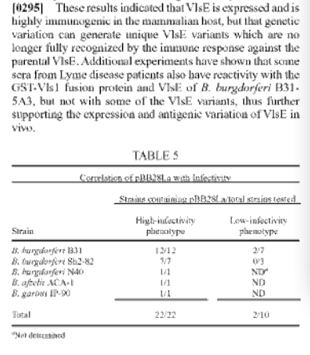
[0294] Since the C3H/HeN mice were infected with a large number (105)  of the organisms, it was possible that the antibody response against vlsE had resulted from the intial inocolum. To test this possibility, sera from the white-footed mice (Peromyscus leucopus) infected with B. burgdorferi B31 via tick bite and from human Lyme disease patients were used to react with the similar immunoblots. The representative results depicted showed that tick-infested Peromyscus leucopus mice also had strong reactivity to the VlsE protein of B. burgdorferi B31-5A3 and GST-Vsl fusion protein but not with GST alone. These results were further confirmed with sera from Lyme disease patients. [...] These results indicate that VlsE is expressed and is highly immunogenic in the mammalian host, but that genetic variation may generate unique VlsE variants which are no longer fully recognized by the immune response against the parental vlsE. They also indicate that antibodies generated against VlsE may be useful in immunodiagnosis of Lyme disease. (Got new tests, anybody? I hope this is a good thing!)
[0295] (Contains test data that just confirms more of what was said further upstream, but thought I'd add it here...)

Seriously, this is fascinating stuff, and I really hope that the knowledge about vlsE can be put to good use. My immediate thoughts, of course, are to ask how this can be used to create new treatments for Lyme disease and improve testing - as well as if a safe and effective vaccine can be developed. The vaccine issue - as always - is touchy, and is no different in this case... especially when they are proposing multiple shots will be needed over time. Also, there is more detailed information in the remainder of the patent describing ways of using bacteriophage therapy or attaching DNA to recombinant adenoviruses for  gene therapy treatment.

But the take home point I'm making here by sharing portions of this patent (and it is a multipage document, with lots of pages of data and genetic sequencing that most people will not want to plow through) is that Lyme diseases's Borrelia burgdorferi is unique, and closely related to relapsing fever, and has genetic behavior which is similar to - yet different from - relapsing fever.

Borrelia burgdorferi is highly complex in its presentation, multiple sources have stated that it can be refractory to treatment, and it has a chronic manifestation. It's all right here.
"This mechanism of genetic switching appears to be different from any other antigenic variation mechanism described in bacteria or protozoa and has important implications in Lyme disease. By combining different regions of the silent vls cassettes, it is possible for many different vlsE serotypes to coexist the same patient. It may be impossible for the host to mount a protective response against any one of these clonal populations, because of the small number of each typeEven mounting a response against one serotype would not protect against rapidly evolving, new serotypes."
We can't ignore this. The scientific truth isn't going to go away, whether it is posted in this patent or in the papers to which it refers.

ADDENDUM

There are more entries posted here related to this one. If you were interested in this post, check out these  - especially the one on the vlsE test kit package insert:
http://campother.blogspot.com/2011/02/more-on-that-vmp-like-sequence-aka-vlse.html
http://campother.blogspot.com/2011/02/package-insert-excerpt-athena-multi.html
http://campother.blogspot.com/2011/02/history-of-antigenic-variation-in.html
Read More

The Camp Other Song Of The Month


Why is this posted? Just for fun!

Get this widget

Lyme Disease

Borrelia

Bacteria

Microbiology