Lyme disease, science, and society: Camp Other
Showing posts with label vaccine. Show all posts

Tuesday, July 3, 2012

0 WBUR Series: Living With Lyme

On June 26, 2012, WBUR, Boston's NPR (National Public Radio) station, 90.9, began publishing a series, "Living With Lyme", on their website.

The series of articles are accompanied by free downloadable podcasts and sometimes photos and slideshows. In addition to these articles, a live streaming video discussion on Lyme disease was broadcast on June 28 and is available online in its archives.

Additional Lyme disease related articles continue to be published on WBUR after the initial series was posted.

Here is a comprehensive list of all the articles published in the "Living With Lyme" series, from the oldest to the newest post:

Resource List - Lyme Disease:
http://www.wbur.org/2012/06/25/lyme-disease-resources

In Lincoln, It's Town Vs. Ticks:
http://www.wbur.org/2012/06/25/lyme-disease-lincoln

Map: Lyme Disease Cases In Mass., By Town:
http://www.wbur.org/2012/06/25/massachusetts-lyme-disease-map

A Long, Painful Battle With Lyme Disease:
http://www.wbur.org/2012/06/26/barbara-macleod-lyme-disease

The Debate Over 'Chronic' Lyme Disease:
http://www.wbur.org/2012/06/26/chronic-lyme-disease

What To Do If You Think You've Been Exposed To Lyme Disease:
http://www.wbur.org/2012/06/26/lyme-what-to-do

Why Your Dog Can Get Vaccinated For Lyme Disease And You Can't:
http://www.wbur.org/2012/06/27/lyme-vaccine

Some Cape Residents Worry Tourists Aren’t Taking Precautions To Prevent Lyme:
http://www.wbur.org/2012/06/27/cape-cod-lyme

How Much Lyme Disease Are We Living With?:
http://www.wbur.org/2012/06/28/lyme-prevalence

Lyme Disease Complicates Doctor-Patient Relationship:
http://www.wbur.org/2012/06/29/lyme-science-controversy

The Complexities Of Diagnosing Lyme Disease:
http://www.wbur.org/2012/06/29/diagnosing-lyme-disease

Emerging Tick-Borne Diseases Causing Concern In Mass.:
http://www.wbur.org/2012/06/29/tick-borne-diseases

For a series on Lyme disease, it is surprising how few patients have left comments on a number of these posts to date. It's been my observation that most of the time, patients participate in commenting on articles about Lyme disease and ticks far more frequently than this series has been responded to so far.

There are a few exceptions, such as the vaccine thread, which I commented on some days ago and which is still receiving more new comments. Sometimes the comments are more informative than the article itself, so they are worth a look. (Other times, they are educational only as a magnifying lens under which one can view other people's psychology... use your judgment, do your own research, and weigh the evidence linked to what people have to state.)

Here is the link to the Special Lyme Disease Panel Discussion (online streaming video):
http://www.wbur.org/2012/06/28/lyme-disease-panel

Panelists include:
  • Dr. Thomas N. Mather, a.k.a. the TickGuy, conducts public education programs on tick-borne illnesses
  • Rep. David Linsky, sponsored the bill that created a state commission on Lyme disease
  • Dr. Sheila Statlender, a clinical psychologist and advocate for Lyme disease patients
And just today, an additional article was posted about tracking Lyme disease:

http://onpoint.wbur.org/2012/07/03/tracking-lyme-disease

A lot of thought-provoking articles to read at WBUR, with some thought-provoking comments in response. Check it out...


Read More

Wednesday, December 7, 2011

0 Comments On 2011 Lyme and TBD Conference Summaries

I have a few comments to make as they come up on October's 2011 conference.

I may add and repost to this entry a few times - stay tuned.

1) I looked at this part of the summary on Dr. Reinhard K. Straubinger's talk on “Canine and Equine Lyme Borreliosis” focused on Lyme borreliosis in animals, especially in dogs and horses:

"The highly variable surface protein VlsE is, according to current knowledge, exclusively expressed in the mammalian host. The invariable region IR6, and even a shorter peptide sequence of IR6 called C6 were found having a high potential as specific antigenic components in serologic test systems. This was shown by evaluating sera from infected humans, dogs, monkeys and mice. In experimentally infected dogs, C6-specific IgG antibodies appeared 3 weeks post infection; hence almost one week earlier than antibodies detected with ELISA based whole-cell preparations. Additionally, another benefit became clear when testing sera of people and dogs before and after antibiotic treatment. Contrary to antibodies against whole-cell components, research demonstrates that C6-antibodies declined substantially a few months after treatment. However, in animals with low C6-antibody levels prior to treatment, the decline obviously was minimal post treatment. Despite their high specificity for borrelial contact, C6-antibodies do not necessarily correlate with clinical signs in dogs and false-positive results may result from maternal antibodies in puppies born to infected bitches."

It brought to mind the following paper and a passage within it:

Lymphoadenopathy during Lyme Borreliosis Is Caused by Spirochete Migration-Induced Specific B Cell Activation. Stefan S. Tunev, Christine J. Hastey, Emir Hodzic, Sunlian Feng, Stephen W. Barthold, Nicole Baumgarth.

Source: http://www.plospathogens.org/article/info%3Adoi%2F10.1371%2Fjournal.ppat.1002066

"We did not include the VlsE protein in our studies, a surface-protein thought to subvert the immune response to B. burgdorferi through extensive genetic variation within the host. However, the N40 strain of B. burgdorferi, which we have used here, does not seem to express this protein, based on transcriptional analysis of the IR6 region of vlsE. Moreover, we found no evidence of seroconversion to the C6 antigen of vlsE from strain B31 (S. W. Barthold, unpublished). Recent sequence analysis of the N40 genome has confirmed that N40 vlsE and BBK01 are on different plasmids and that the vlsE locus is indeed significantly different compared to B31, the commonly used VlsE-expressing Borrelia-strain."

So what do we know about C6 tests, briefly?

C6 Lyme ELISAs are based on the synthetic peptide C6, which corresponds to the invariable region IR6 of the surface antigen VLsE.

IR6 is supposed to be highly preserved in all pathogenic strains of Borrelia, and is only expressed in vivo. It evokes a strong immune response.

As a diagnostic antigen, the C6 peptide shows only minor cross-reactivity to other pathogens (e.g. spirochetes for syphilis).

Knowing this, it's interesting to point out that using the C6 ELISA may not work as well for testing a host which is infected with a strain of N40 Borrelia. How can it, when this strain of N40 does not express the vlsE protein?

I have to wonder how many other strains may have vlsE on different plasmids - and not only that - a different locus?

2) Dr. John Aucott’s talk on “Early Lyme disease” reported from the SLICE prospective cohort and his Maryland studies. I want to point out this part of the summary:

"He emphasized that the classic description of a “bull’s eye rash” occurs only 20% of the time – it is not the most common manifestation of the Lyme rash. Rather, a uniformly red or reddish-blue rash, round or oval in shape, with sharply demarcated borders is most common. Most often the rash develops in places such as the knee, groin, or arm pit, occurring at prime tick season, such as the late spring and early summer."

It's important to know that these varied descriptions of so-called "bull's eye" or EM rashes found in Lyme disease are not the only variations found in Lyme disease culture positive lesions.

In an earlier entry about Dr. Vijay Sikand's testimony at an FDA Lymerix Vaccine Review, Dr. Vikand reported this about EM rashes:

"[...] However, erythema migrans is not a single beast. Certainly this is the one which we easily recognize and which I just referred to.Before I continue with further slides, let me point out that the erythema migrans lesions you are about to see are all biopsy lesions which were laboratory proven to be caused by Borrelia burgdorferi.

Sometimes erythema migrans can present as a pustular lesion as is this one in the popliteal fossa inviting the scalpel of a surgeon.

Sometimes the lesions are vesicular in nature, inviting a diagnosis perhaps of herpes simplex infection.

Sometimes our round lesion is actually triangular.

Sometimes it doesn't even look round or red at all and invites a diagnosis of an intertriginous fungal infection in the groin of this patient who was biopsied and proven to have Lyme disease.

Sometimes the lesion is more plaque-like, inviting diagnosis of nummular eczema, psoriasis, or other similar lesions.

Sometimes it is in unusual locations.

Sometimes it is large like this one. Sometimes it is small with satellite areas. Sometimes it is multiple, appearing almost like urticaria or erythema multiform.

Sometimes, as in this individual who was a placebo recipient in the Lyme 008 SmithKline Beecham trial, it presents with other manifestations of early dissemination. This individual came in mainly because he was concerned about his face and it felt kind of funny and it was weak on one side. When I asked him whether he had had any unusual rashes, he said oh do you mean this one, and he showed me his arm with that EM. This is simply to illustrate the infranuclar 7th nerve palsy with which he presented. This patient, by the way, had no history of a tick bite or any unusual antecedent illness which he could remember."

If Sikand's testimony is anything to go on, one has to wonder about the reliability of the "bull's eye rash" as a diagnostic marker.

(For what it's worth, my own EM rash was large, oval, dark red, slightly elevated, and expanding for several days after the bite.)

3) Dr. Karen Newell Rogers presented a talk about novel ways to target chronic inflammation and chronic immune activation among patients with chronic Lyme disease.

Now this part below - especially in bold - really caught my eye:

"[...]Some researchers would argue that chronic inflammation requires the continuous presence of bacteria, whereas others would suggest that continuous presence of bacteria does not always result in inflammation and that exacerbations of chronic symptoms could result from infection with a different organism--or that chronic symptoms could re-cur from unrelated pro-inflammatory events. Potentially reconciling these seemingly conflicting perspectives on the mechanism of Lyme disease may be the effect of Borrelia burgdoreri’s bacterial by-products on Toll Like Receptors, (TLR)-mediated immune activation. TLR appear to be the “gate-keepers” of an inflammatory response. Bacteria, including Borrelia, produce products that, by binding to TLRs on the cell surface, promote leukocyte activation, cytokine production, and acute inflammation. In some genetic backgrounds of mice, acute inflammation is sufficient to fight off infection and resolve disease. In other mouse strains, the pathogens, or in this case the bacteria, get past TLR-induced inflammation and remain symptomatically undetectable in cells and tissues (Barthold, etc); Barthold et al. have found that no matter how severe or mild the disease in any of the genetically inbred strains of mice, there was no more inflammatory disease when the bacteria were eliminated."

Reading this, I reflect back on an earlier entry I made about the combination of genetics effect on individual immune systems AND persistent infection as both leading to ongoing symptoms in hosts:

Immune + Infection = HLA-DR alleles determine responsiveness to Borrelia burgdoferi:
http://campother.blogspot.com/2011/08/immune-infection-hla-dr-alleles.html

Perhaps part of the answer to what is happening with ongoing symptoms lies both in Dr. Newell Rogers' work and Bettina Panagiota Iliopoulou, Mireia Guerau-de-Arellano, and Brigitte T. Huber's research?

It's certainly thought-provoking.

And Barthold's statement implies that ongoing inflammation is intimately tied to persisting infection.

How does one provide evidence this is the case?

Could the answer lie in longer term in vivo GFP and/or iRFP studies on mice and other mammals? Could it lie in maltodextrin enhanced imaging studies? Or something else?

Read More

Friday, November 11, 2011

2 Article: Anaplasmosis Plus Lyme Disease In Dogs = Sick As Dogs

The West Salem Veterinary Clinic reposted part of an August 2011 article on its site in the La Crosse Tribune in Wisconsin recently.

The original article is found here:
http://westsalemvetclinic.vetstreet.com/blog/ticks

Here are two paragraphs I want share with all dog lovers out there:
Anaplasmosis phagocytophilum, previously known as Ehrlichia equi, is very prevalent in this area. It is spread by the same ticks as Lyme Disease and it can be a co-infection (both infections occurring at the same time) with Lyme Disease. Experts at IDEXX Laboratories, the manufacturers of the IDEXX SNAP® 4DX™ test, maintain that when a dog contracts Lyme disease or anaplasmosis alone, its immune system is more likely to suppress disease. However, a dog with both infections at once is more likely to become sick. IDEXX created the 4DX test to test for Heartworm, Lyme, Anaplasmosis, and Ehrlichia canis (another tick-borne disease that is not as prevalent in this area.)

If your dog shows any of the previously listed symptoms, he or she should be examined and tested. If your dog is positive for anaplasmosis, he or she should have a complete blood cell count performed to further evaluate for active disease. If your dog lives in this area, he or she should be on tick control year-round, screened with the 4DX test annually and vaccinated for Lyme Disease. Visiting dogs from other areas need tick control and screening as well. You cannot catch these diseases directly from your dog, but you are exposed to the same ticks in the environment as your dog, so be sure to use tick repellent on yourself and check for ticks on yourself as well as on your dog on a daily basis.

Now, my question is, how much more severe is the course of infection in humans who are infected by both Borrelia burgdorferi and Anaplasmosis phagocytophilum?


How do humans differ from dogs in this infectious disease model?


Read More

Thursday, August 18, 2011

5 Abstract: A tick mannose-binding lectin inhibitor interferes with the vertebrate complement cascade

A tick mannose-binding lectin inhibitor interferes with the vertebrate complement cascade to enhance transmission of the lyme disease agent. Schuijt TJ, Coumou J, Narasimhan S, Dai J, Deponte K, Wouters D, Brouwer M, Oei A, Roelofs JJ, van Dam AP, van der Poll T, Van't Veer C, Hovius JW, Fikrig E. Cell Host Microbe. 2011 Aug 18;10(2):136-46.

Source: http://www.ncbi.nlm.nih.gov/pubmed/21843870?dopt=Abstract

Comments:

It occurs to me that a lot of the concern from the Lyme patient community over the use of vaccines could be eliminated if R & D shied away from human vaccine development.

Mice and other animals in the woods could ingest oral vaccines which could prevent the transmission of Borrelia burgdorferi to reservoir hosts on which ticks feed. Not only that, but this could have an extended effect of helping pets, too.

I think creating oral vaccines to block transmission of Bb to animals and pets is a good idea.

Read More

Monday, August 8, 2011

4 Comments on Comments On Yet Another Lyme Disease Article

So here we go again, another article on chronic Lyme disease - this time one which is more about the patients' experiences, and a little about the controversy on extended treatment.

Between May and September, the newspapers are full of individual patient stories about their experiences with Lyme disease. So many so, that on any given week if I google "news" and "lyme disease" and select the past week for articles, I'm bound to see several from across the continental United States.

There are so many individual stories at this point that I could make a blog out of them in and of themselves. I don't, though, because there are just too many of them, and I would have less time to write about other  Lyme disease and tickborne infection topical posts.

And after a while, the sad truth is that so many of these stories begin to sound very much like the first one I read. It's overwhelming. It's sad. I can't write about everyone's sad stories every day, though they do need to be heard.

Mainly, what I want to do is point out some comments or specific kinds of comments on this article - and provide both general commentary and a little constructive feedback on why they are not helpful in gaining support for more people to take this condition seriously - let alone gaining support for more research into chronic Lyme disease.

But even then, I am eventually going to tire of this because the comments begin to look the same the more one reads these kinds of news articles. The authors' names will change, their professions will change, and there will be pro-this and anti-that, and still... same content in the comments.

We need change.

This is getting has gotten old.

I'm weary.

Comments and questions on paraphrased random comments:

"If you researched this illness and talked to patients who were intelligent healthy people with no history of hypochondria before a CL diagnosis you would maybe reconsider your stance."

I agree this is a good point to make. Thank you, whoever you are.

"Chronic lyme has been proved already,"

If it has, then why is there still a controversy?

Read More

Tuesday, May 24, 2011

4 The FDA Vault: Dr. Vijay Sikand On Lyme Disease & Lymerix

You know how I've said you can never guess what you're going to come across when you surf the net looking for other things?

Well, I came across this FDA transcript for a discussion on the Lymerix vaccine back in 1998. The original transcript contains an endorsement for the vaccine from the founder of Lyme Disease Foundation (LDF, not to be confused with the ADLF), who later determined the vaccine needed to be pulled from the shelves based on adverse reaction reports.

I'm setting aside any discussion of the Lymerix vaccine for now and just posting this statement from Dr. Vijay Sikand, an MD who practiced in Lyme, Connecticut... (items of interest are in bold)

UNITED STATES OF AMERICA 

DEPARTMENT OF HEALTH AND HUMAN SERVICES
FOOD AND DRUG ADMINISTRATION
CENTER FOR BIOLOGICS EVALUATION AND RESEARCH
VACCINES AND RELATED BIOLOGICAL PRODUCTS ADVISORY COMMITTEE MEETING
Tuesday, May 26, 1998 

  
The meeting took place in Versailles Rooms I and II, Holiday Inn, 8120 Wisconsin Avenue, Bethesda, Maryland at 9:00 a.m., Patricia L. Ferrieri, M.D., Chair, presiding.  


VIJAY SIKAND, M.D., Sponsor Rep
:

"...As I was just saying, I included research in Lyme disease as part of a primary care practice for a number of years. In early 1995, 1,200 volunteers came to my office to enroll in the SmithKline Beecham vaccine trial which we are discussing today. Almost three and a half years later now, greater than 92 percent of those patients are still providing me with clinical follow-up.
        
Why do we need a vaccine for Lyme disease? It has been almost a quarter century since Lyme disease was first described as an emerging infection in this country. During these years a number of factors, epidemiologic factors and clinical factors, have resulted in considerable morbidity in burgeoning numbers of patients.This burgeoning load of disease as well as the increasing number of patients thus set the stage for prevention of this disease with a vaccine.Today, I will present to you some of the factors in a brief synopsis illustrating the need for a vaccine for Lyme disease.The illustrations which I will present to you, some of them are from my private practice and some of them are from the vaccine study.

The first factor is an epidemiologic factor,and this has already been discussed by Dr. Schoen. And that is that there is indeed a progressive increase in incidence of Lyme disease. The second factor also epidemiologic is the relentless geographic spread of this disease. There are new endemic areas being created annually and the disease burden is indeed growing.
        
The ineffectiveness of preventive measures which we attempt to practice is another important factor. We have tried various chemical and other means. Why have preventive measures, which are indeed important, not been effective in preventing an increase in cases of Lyme disease?  And before I answer that question, let me underline the fact that I indeed believe it is important that we continue to practice preventive measures because of co-infection with other illnesses besides Lyme disease. 

One obvious reason is that it is very impractical to practice certain protective measures.  This individual in the Lyme, Connecticut area desires to do some outdoor work and does not want to be bitten by a tick. But the point is it is very difficult to ask children or anybody else for that matter to tuck pants into socks, et cetera, in the middle of July and August when the ticks are questing. We can certainly check our pets, but checking one's dog is indeed a Sisyphean task when the dog goes in and out of the house all day long. Probably the best protective measure, I think, in preventing Lyme disease is checking for ticks.  Unfortunately, kids will only allow you to do this up to a certain age. And of course one must be vigilant with oneself.

More specifically, I think one of the important reasons to consider when thinking about why protective measures are difficult to utilize and be effective in preventing this disease is simply the nature of the Ixodid tick bite itself. The bite of this tick when it is infected transmits not only saliva infected with Borrelia burgdorferi, but the saliva also contains certain anti-inflammatory substances which have an anesthetic effect.The end result of that is that tick bites in general are not noticed. In one study, over 80 percent of the patients who presented with definite Lyme disease did not remember a tick bite. It is therefore very hard to correlate the incidence of definite Lyme disease cases with preceding tick bites, and this is well known.

Furthermore, as has been eluded to earlier, the recurrence of disease in individuals is also well known. Unfortunately, in the majority of patients, the vast majority of patients, natural infection with Borrelia burgdorferi does not confer protective immunity. 

Difficulties in clinical diagnosis of this disease are also well known, and it is not my place today to give you an overview or detailed presentation of the clinical aspects of Lyme disease.However, a couple of issues that do spring up and which I would like to address are as follows. In particular, the specter of asymptomatic infection is something that troubles me a great deal and troubles a great number of my colleagues who need to treat Lyme disease. The obvious analogy with syphilis infection with Treponema pallidus is there to consider. It is well known that Borrelia burgdorferi indeed after asymptomatic infection can lurk or secrete itself in certain areas of the body, perhaps the central nervous system or perhaps the joint spaces, only to reappear months or maybe years later in the form of late stages of illness which are harder to diagnosis and treat.

In terms of the variability of Lyme disease, it is indeed a very variable infection, if not a very complex infection.  In its very simplest form, it is erythema migrans, well localized, which we can all recognize and which we can all easily treat and from which most patients can get better. However, erythema migrans is not a single beast. Certainly this is the one which we easily recognize and which I just referred to.Before I continue with further slides, let me point out that the erythema migrans lesions you are about to see are all biopsy lesions which were laboratory proven to be caused by Borrelia burgdorferi.

Sometimes erythema migrans can present as a pustular lesion as is this one in the popliteal fossa inviting the scalpel of a surgeon. Sometimes the lesions are vesicular in nature, inviting a diagnosis perhaps of herpes simplex infection.  Sometimes our round lesion is actually triangular. Sometimes it doesn't even look round or red at all and invites a diagnosis of an intertriginous fungal infection in the groin of this patient who was biopsied and proven to have Lyme disease. Sometimes the lesion is more plaque-like, inviting diagnosis of nummular eczema, psoriasis, or other similar lesions. Sometimes it is in unusual locations. Sometimes it is large like this one. Sometimes it is small with satellite areas. Sometimes it is multiple, appearing almost like urticaria or erythema multiform. Sometimes, as in this individual who was a placebo recipient in the Lyme 008 SmithKline Beecham trial, it presents with other manifestations of early dissemination. This individual came in mainly because he was concerned about his face and it felt kind of funny and it was weak on one side. When I asked him whether he had had any unusual rashes, he said oh do you mean this one, and he showed me his arm with that EM. This is simply to illustrate the infranuclar 7th nerve palsy with which he presented. This patient, by the way, had no history of a tick bite or any unusual antecedent illness which he could remember.

The next slide is the electrocardiographic tracing of a 37-year-old mom from Lyme, Connecticut, mother of three. Generally healthy and no medical problems. Early on the day that this electrocardiogram was taken, she went to her local health club and did her usual work-out, which went fine. However, when she came home that day, she noticed that she had some palpitations, a little shortness of breath, malaise, and things just didn't seem quite right, but she wasn't sure what. When her husband came home, she told him that maybe she had worked out a little bit too hard at the club. A few minutes later, he was reading the newspaper in an armchair and he heard a thump on the floor above. He ran up the stairs to find his wife unconscious briefly on the floor and called 911. On arrival at the emergency department, the patient presented with this tracing, which in retrospect was a superventricular tachycardia representing an escape rhythm

There was fortunately a very vigilant emergency physician who didn't understand quite why a 37-year-old healthy woman had completely passed out, and she had what was a relatively benign rhythm at that point. But he was wise and admitted her to the coronary care unit for further monitoring. Late that night and the early hours of the following morning, the CCU nurse noted that the patient had gone through progressive degrees of AV block culminating in complete atrial ventricular dissociation. A cardiologist was summoned. He inserted a temporary transvenous pacemaker. The patient was started on intravenous antibiotics for about a week in the hospital followed by a few more weeks as an outpatient.This patient also had no history of a tick bite.

Besides the difficulties in clinical diagnosis, we are all aware that quandaries in laboratory diagnosis are rife.We rely pretty much on serologic testing in the United States today to assist us in diagnosing Lyme disease. Unfortunately, serologic testing, as with other infectious diseases, provides only indirect evidence of infection. When we order a serologic test, it just tells us that the patient has been exposed to Borrelia burgdorferi and doesn't tell us whether the infection is active or whether it is a past infection. It is probably worth noting, since I have learned a lot, that we don't have the clinical luxury in private practice that we had in the SmithKline Beecham trial in which we had baseline sera on all the patients who enrolled so that when they presented with symptoms, we could draw acute and convalescent serologies so as to compare them with each other and with baseline to better understand what symptoms they are presenting with. But your average physician in the office just can't do this. A patient comes in with symptoms or signs of Lyme disease and you have to make a clinical diagnosis and it is not always easy and serology doesn't help. The fact that in particular the ELISA creates a great deal of false positive results is also problematic. 

In particular and commonly in infectious mononucleosis and other spirochetal disorders, even healthy people, juvenile rheumatoid arthritis and other autoimmune disease all can produce false positive results. Indeed, even with Western blotting recent reports have shown that infection with the agent of human granulocytic Ehrlichiosis can cause false positive Western immuno-blots.The false negatives that we deal with are generally caused by use of serology testing in patients who have early Lyme disease and in whom the serologic response with immunoglobulin M has not occurred to the extent to which it can be measured.

What do we have in the way of direct testing to try to see if the organism itself is actually there or evidence of it? Well, culture and PCR are what are out there right now.  However, these are unreliable and impractical. Culture and PCR are certainly not warranted for the diagnosis of erythema migrans. The polymerase chain reaction is indeed sensitive in joint fluid. However, the diagnosis of Lyme arthritis does not require PCR testing since serology is almost invariably positive at that stage. Clinical conditions such as complex neurological conditions when a test like sensitive PCR would be useful, unfortunately cannot be diagnosed that way because PCR and indeed culture are not sensitive for cerebrospinal fluid, nor are they sensitive for urine, blood, and other body tissues when later in the disease one might care to employ these techniques.

Finally, there are indeed many dilemmas in therapy. In particular, untreated or inadequately treated Lyme disease may lead to the chronic morbidity with which we are very familiar. Most commonly arthritis and the not common but complex neurological syndromes are what often result and which confront the primary care physician in the office diagnostically and therapeutically.These particular outcomes result in much more intensive, long-term expensive therapy, often in the form of long-term intravenous antibiotics. These are the patients who often are refractory to treatment. Indeed, these are the patients in whom symptoms seem to persist despite what we have given in terms of adequate antibiotic therapy by any known measure.

            In conclusion, we need a vaccine for Lyme disease because it is increasing in incidence and geographic spread.We need a vaccine for Lyme disease because there are problems in clinical diagnosis, its laboratory evaluation, and its treatment. We need a vaccine for Lyme disease because preventive measures are unfortunately ineffective. Lyme disease is indeed vaccine preventable. Availability of this vaccine would lead to a significant reduction in chronic sequelae and substantive morbidity.  Lyme vaccine is thus a critical new public health approach to the primary prevention of Lyme disease in the United States. Thank you very much."

Dr. Sikand and Dr. Steere were at the same meeting. It's obvious Sikand knew Lyme disease could lead to serious late stage Lyme disease and chronic persistent symptoms of infection. If it could be easily resolved with 2-3 weeks of antibiotics, would they have spent this much time, effort, and money on developing a vaccine and running clinical trials?

Everyone at this meeting - including Lyme disease patient advocates - wanted a vaccine. That it would lead to adverse events in some patients and be pulled from the market later was not what everyone thought at first - at first it was welcomed as a solution to preventing the worst of what Lyme disease could do to a person because it was hard to diagnose and treat.

1998. Thirteen years ago.

How much have things changed since then?

Why are we still looking at the same problems and issues?
Read More

Friday, February 25, 2011

0 The Friday Four

Bringing you four news-worthy or interesting bits to your Friday, this edition focuses on nanoparticles in vaccine development (mentioned in the vlsE patent), differences in spinal fluid in Lyme disease and CFS patients,  an artificial intestine for researching bacteria, and how drug information is presented differently online for Americans and Canadians.

1) Virus-Mimicking Nanoparticles Can Stimulate Long-Lasting Immunity

Vaccine scientists say their "Holy Grail" is to stimulate immunity that lasts for a lifetime. Live viral vaccines such as the smallpox or yellow fever vaccines provide immune protection that lasts several decades, but despite their success, scientists have remained in the dark as to how they induce such long lasting immunity.

ScienceDaily. Retrieved February 25, 2011,
from http://www.sciencedaily.com­ /releases/2011/02/110223133846.htm

Original Source Publication:
Sudhir Pai Kasturi, Ioanna Skountzou, Randy A. Albrecht, Dimitrios Koutsonanos, Tang Hua, Helder I. Nakaya, Rajesh Ravindran, Shelley Stewart, Munir Alam, Marcin Kwissa, Francois Villinger, Niren Murthy, John Steel, Joshy Jacob, Robert J. Hogan, Adolfo García-Sastre, Richard Compans, Bali Pulendran. Programming the magnitude and persistence of antibody responses with innate immunity. Nature, 2011; 470 (7335): 543 DOI:10.1038/nature09737


Comments: It's worth reading more about this technology and how it affects the immune system, given it is one application of the vmp-like DNA sequence, vlsE, that patent holders are looking to use.

2) Spinal Fluid Proteins Distinguish Lyme Disease From Chronic Fatigue Syndrome

Patients who suffer from Neurologic Post Treatment Lyme disease (nPTLS) and those with the Chronic Fatigue Syndrome report similar symptoms. However unique proteins discovered in spinal fluid can distinguish those two groups from one another and also from people in normal health, according to new research conducted by a team led by Steven E. Schutzer, MD, of the University of Medicine and Dentistry of New Jersey – New Jersey Medical School, and Richard D. Smith, Ph.D., of Pacific Northwest National Laboratory. This finding, published in the journal PLoS ONE (February 23, 2011), also suggests that both conditions involve the central nervous system and that protein abnormalities in the central nervous system are causes and/or effects of both conditions.

Source: http://www.eurekalert.org/pub_releases/2011-02/plos-sfp021811.php
Original Source Publication: http://www.plosone.org/article/metrics/info%3Adoi%2F10.1371%2Fjournal.pone.0017287

Comments: This is a fascinating study, and I would like to see a confirmatory study with a larger group of subjects. Particularly notable to those with CFS or Lyme disease is this bit from the original paper: "An illustration, where the same proteins are elevated in abundance in both conditions, but at different magnitudes, is provided by inspection of proteins in the complement system. This is of interest because both syndromes may be triggered by infections (nPTLS in all cases by B. burgdorferi; many CFS cases by one or more microbes yet to be identified). We found that the complement cascade related proteins were identified and significantly enriched in both CFS and nPTLS pooled CSF proteomes by the Fisher Exact test (p = 0.005) implemented in Ingenuity Pathways Analysis (Figure S1A). In individual patient samples analyzed, we identified and quantified 4 components (C1S, C4B, C1QB, C1QC) which are seen with activation of the complement cascade and which were differentially increased in abundance consistently across the nPTLS patients compared to CFS (Figure S1B and C). This represents the type of data that can be useful in the formulation of pathogenetic hypotheses because the role of complement in these disorders is under-explored." Also noteworthy is this bit:"... identification of diagnostic CSF biomarkers may be the necessary prelude to a search for the same markers in the highly complex blood, because it permits targeted searches for markers that might otherwise be obscured or have uncertain relevance." This, I think, is a roundabout way of saying that CSF biomarker analysis may be of more utility than serological testing. The downsides are obvious: 1) this test could be used to support a hypothesis of a post-infectious syndrome without considering the possibility of current infection, and 2) lumbar punctures are higher risk and more invasive than standard blood tests. What I'd like to see, though, is a study comparing CSF proteins in those with "nPLDS" and acute Lyme disease... now that might be interesting.

3) Scientists Devise Artificial Intestine to Help Engineer Disease-Fighting Gut Bacteria

Confocal microscope image of caco-2 cells on
collagen scaffold, after staining for
actin (green) and nucleic acid (blue).
Cornell professor John March is attempting to transform bacteria in our gut into disease-fighting machines. Now, thanks to two members of his research team, he has a powerful new tool to help him do so: an artificial intestine.

The 3-D hydrogel scaffolds developed by graduate student Jiajie Yu and former postdoctoral researcher Jong Hwan Sung will allow scientists to grow cells under realistic physiological conditions, an important breakthrough. Until now, they have had to rely on two-dimensional cultures or live animal models.


Source: http://www.sciguru.com/newsitem/6306/Scientists-devise-artificial-intestine-to-help-engineer-disease-fighting-gut-bacteria-/

Comments: I just think this is cool... and imagine the potential applications, such as testing the action of probiotics against C. Diff. Seems like this is the closest we can get to an in vivo model but it's still in vitro.

4) Americans and Canadians Get Different Drug Information Online: UBC study

Americans and Canadians are getting vastly different search results when they look up prescription drug information online, says a study by researchers at the University of British Columbia.


Source: http://www.eurekalert.org/pub_releases/2011-02/uobc-aac022211.php

Comments: This is one reason why when doing drug side effect and interaction research, one should always be aware of what results are presented. I would actually invest some time in reviewing the pharmaceutical companies' package insert data sheets, because they are fairly reliable for what side effects do occur. But I would also look for additional less common side effects in patient reports on review sites -- and check reliable sites for interactions with herbs and supplements -- as those are rarely mentioned in any pharmaceutical insert sheets.
Read More

Tuesday, February 22, 2011

0 More on that Vmp-like sequence - aka vlsE in Borrelia

So I know many of you have read my entry on the patent, VMP-like sequences of pathogenic Borrelia species and strains, with Steven J. Norris and Alan Barbour as primary patent holders.

For some of you, the news of this patent may come as a total surprise. For others, it may not.

For those of you who were listening in on or attended the October 2010 Institute of Medicine (IOM) workshop - A Workshop on the Critical Needs and Gaps in Understanding Prevention, Amelioration, and Resolution of Lyme and Other Tick-borne Diseases: the Short-Term and Long-Term Outcomes -well...you might have remembered this presentation:

DAY 2  Institute of Medicine October 13, 2010
11:30 am Antigenic Variation as a Mechanism for Persistent Borrelia Infection
Steven Norris, Ph.D. Greer Professor Vice Chair for Research Pathology & Laboratory Medicine University of Texas, Houston

For any Lyme patients and others watching the IOM webcast or otherwise listening in, Dr. Norris presented on that day the following (I got these notes off a mailing list - roughly transcribed and spelling corrections/minor changes made - I also listened to the original web cast to check on the accuracy of these notes) information:

Lyme Bb
  • Motile invasive organism with unusual properties
  • invasive, persistent infection
  • disseminates fairly early on
  • in mice, found in skin, joints, bladder, heart, spleen, and other organs 2 years after innoculation.
  • virtually any tissue can contain them in lifetime of mice
  • Persistence in humans is not well understood.
  • Produce no known toxins or enzymes that are toxogenic - don’t have toxins that cause tissue damage. (compare to Botulin toxin and Gas gangrene - extreme toxin invasion of tissues)
  • Different pathogenic strategies for different species (gives examples of different organisms at different extremes of toxogenicity)

Lyme and Syphilis
  • both have local, disseminated, and long term stages
  • can draw from diseases that are similar in examining Lyme Disease
Bb infection pathogenesis (outline from book chapter he put together - Pathology of Lyme Disease Borrelia - from Borrelia: Molecular Biology, Host Interaction and Pathogenesis By Justin Radolf, D. Scott Samuels)

To cause persistent infection, it must have multiple ways of evading immune response.
These are possible mechanisms:
1) protective niches: sequestration of organisms in dense tissue (Barthold talks about this later in conference)
2) hiding or downregulating of antigens - known as masking (regulation of genes in Bb) - occurs early in infection
  • OspA is downregulated in ticks but not expressed in high levels in mammalian infection,
  • OspC and other proteins are upregulated in early stages of infection
  • There changes in gene expression are important in lifecycle of organism
3) inhibition of immune response (inhibition of complement cascade by proteins called CRASPS interfere with immune system, mentioned by Dr. Oliver earlier)
4) Today’s talk is on antigenic variation: a change in surface structure (usually) that occurs at rate higher what would be expected from mutation (what we’ll discuss today)

Vls

VMP-like sequence, resembles that of Relapsing Fever, but there are important differences.
We’re only going to talk about gene or locus today so I picked VLS in one plasmid of the organism.

In one plasmid of the organsim, expression site called VlsE and silent cassettes upstream from that, silent ones are 92% identical with central cassette site, called the expression cassette or region - if you align these areas next to another they show areas of identity and then areas of variability named variable regions 1,2,3,4,5, 6 (points to slide).

When this locus was present, we thought each silent cassette could exchange into central/expression site, and therefore cause 15 different variants - but instead we found there was a segmented exchange/recombination that occurs (we don’t know how this occurs) - which means gene conversion event occurs where the silent cassette donates genes to expression cassette

Can’t detect this segmented exchange in standard liquid culture or in ticks, but can we can detect this in infected mice.

There are so many different variations produced, so many that you can’t find the same VlsE combination or sequence in the same tissue twice 28 days post-infection.
  • 1032 amino acid sequence combinations possible.
  • Most sequence differences are very short - 1 or 2 amino acid differences (refer to Luft).
  • Protein is anchored to outer membrane of organism like umbrella.
  • Organism can change amino acids of the outer surface. These are colored regions with highest degree of sequence variation. Evolution favors this outer region to change to evade immune system; continual changing of this surface (amino acid sequence) leads to immune evasion.
VlsE is now used for a Lyme immunodiagnosis.
In particular, the IR6 or C6 region of organism has high antibody response. And other regions of the protein is reactive as well.

Dilemma: immune invasion but at the same time high antibody response to this protein.

How important is this system in terms of pathogenesis?

The real landmark study (Bankhead and Chaconas) was where they deleted out the LP281 plasmid that carries the VLS locus. (Removed right end and just preserve the left end of plasmid that carries this locus - see slide). They found when those organisms infected mice that they were now defective in infecting mice. They were LP281 deficient phenotype and they are quickly eliminated by immuno-competent mice. However, SCID mice (immuno-deficient) can’t clear the organism. Therefore this locus is very important in evading the adaptive immune response (B and T cells).

Little is known about VLS recombination.
VLS recombination involves gene conversion - replacement of VLS recipient sequence with donor silent cassette sequence.
Does not require RecA.
But gene conversion reduced in genes lack Holliday junction resolvase encoded by proteins RuvA and RuvB.
[...]
VLSe recombination occurs in mammalian host during infection, so far was not found in standard in vitro cultures of Bb.

One advanced study by (Dr. Diane Edmondson (sp?)):
  • Tissue on gel foam (collagen) and incubated in medium
  • Inoculated tissue implants with Bb (called explants)
  • Then after one day explants were moved to fresh dish and excess removed
  • And tissues monitored in artificial infection scenario - the ex-plants did quite well
  • Up to 16 days post culture heart looks normal, spleen less so - has loss of lymphocytes (devolution of the tissue)
  • Multiplication of Bb in tissue and it differed from tissue to tissue and with medium used
  • Still trying to work out best conditions to examine this situation and maintain that replication.
Had to develop method to measure VlsE gene recombination - it is rare, only occurs in
1/106 cells show VlsE recombinancy

in vitro used PCR technique where parental and recombinancy showed
Monitored change in PCR to identify sequences that underwent recombination
In 3 of 4 explant samples we found recombination - this is first detection of it in vitro (slide)
We’re trying to figure out exactly what the recombination events are - it’s not very easy

I’ll show you our final results:
In 3 of these instances, Cassette 7, 2, and 4 show recombination events - very long ones,
but in some incidences, shorter recombination events
This shows a model for the antigenic variation system.

Did a meta-analysis of Luft’s data of 13 different strains sequences
He looked at them evenings and weekends and analyzed the VLS sequences
The VLS sequences differ more than any LD Borrelia homologues
Within vlsE the identity is as low as 54% identity with a 69% similarity
OspC has overall the lowest sequence identity between diff OspC’s from different organisms/strains - 69% identity 79% similarity
VlsE system under high degree of evolutionary selection and pressure.

First identified this region in B31 strain (burgdorferi)
Emphasize that the silent cassettes are in a single continguous open frame - it is huge protein interrupted in only 3 places by stop codon and 2 frame shifts
We thought maybe that was important
There are direct repeats at the end of each junction between each of those silent cassettes

Analysis examples

64B - has 22 silent cassettes, opposed to only 15 in our initial characterised strain (B31)
3 frame shifts present
Initial annotation here (very hard to annotate the entire genome, let alone 13 genomes - this is what came out of their - Luft & co's - notes)
Took 2 days just to analyze this one locus
Borrelia 29805 - 17 silent cassettes and annotated initially as single long frame
strain 404 (B. garinii) - total 18 open [..] frames
There are no direct repeats in any of these that we can identify
most of the frame shifts are between silent cassettes and do not interrupt cassettes
a lot of theories of how the system worked were blown out of the water just by this meta analysis
I want to emphasize differences are quite marked in locii between these different strains
We are looking for correlate at differences in ribosomal types or OspC types
Also want to know how differences in VLS may relate to infectivity and virulence of different strains
Want to replace B VLS with VLS of other strains to see how it affects its pattern of pathogenesis
(how it operates or if it’s infectious)
Number of sequence differences obvious between B31 and 404 are there
[...]
VlsE antigenic variation important route of immune invasion
VlsE gene conversion not well understood but involves RuvA & RuvB resolvase
VlsE has higher sequence diversion than any other sequence including OspC

Questions

What are the cis- and transacting factors that regulate and carry out VLS recombination?
Can tissue explant models be used to study immune evasion better than other tissues such as in mice? [...]
Do differences in VLS recombination correlate to various outcomes (arthritis, chronic effects)?
How can protein that induces strong antibody response be involved in immune evasion?
What roles do other proteins or mechanisms play in infection by Lyme Disease infection? (i.e. sequestration, masking, inhibition of immune response)

See abstract http://www.ncbi.nlm.nih.gov/pubmed/12603744 for some of Norris’ earlier work (2003).


You can still watch the recorded webcast of the IOM workshop and watch Steven Norris' webcast presentation there (scroll down to each section and click on the section saying "Play Flash Video" - apologies to viewers who cannot view Flash on their computer or device.)


More people have been doing research on this sequence for some time - it is critical for beginning to grasp Borrelia's antigenic variation.

For example:

From CAP's web site:
"Mario T. Philipp, PhD, and colleagues first identified and characterized C6 for use in the serodiagnosis of Lyme disease. “We were hoping to try VlsE as a vaccine candidate,” says Dr. Philipp, pro­fessor of microbiology and immu­nology and chair of the Division of Bacteriology and Parasitology, Tulane National Primate Research Center. However, other researchers discovered that V1sE was a protein that changed its antigenic properties as infection progressed, making it possibly unsuitable as a vaccine. Attention then turned to invariant regions of VlsE, segments whose antigenic properties did not change over time. “What struck us was that invariant region six reacted with serum specimens taken from nonhuman primates early in infection,” Dr. Philipp says. “We thought we might have a candidate for early diagnosis.” When they tested C6 with a battery of human specimens, sensitivity ranged from 74 to 100 percent, depending on stage of infection. More important, specificity was close to 100 percent, with only two false-positives out of 176 samples (Liang FT, et al. J Clin Microbiol. 1999;37:3990–3996)."
Evidence That the Variable Regions of the Central Domain of VlsE Are Antigenic during Infection with Lyme Disease Spirochetes - 2002 -
John V. McDowell, Shian-Ying Sung,Linden T. Hu, and Richard T. Marconi

Immune responses to borrelial VlsE IR6 peptide variants - 2007 - Heidi Sillanpääa, Pekka Lahdenneb, Heikki Sarvasa, c, Maja Arnežd, Allen Steeree, Miikka Peltomaae and Ilkka Seppälä

Evaluation of the Recombinant VlsE-Based Liaison Chemiluminescence Immunoassay for Detection of Borrelia burgdorferi and Diagnosis of Lyme Disease - 2008 -
Thomas B. Ledue, Marilyn F. Collins, John Young, and Martin E. Schriefer

Oh, and by the way? There is already a test out there using vlsE for Lyme disease immunoblots.

Check out: http://www.zeusscientific.com/products/technology-systems/athena-multi-lyte/

Borrelia VlsE-1 IgG/pepC10 IgM Plus Test System

The ZEUS Scientific, Inc. AtheNA Multi-Lyte® Borrelia VlsE1/pepC10 IgM Plus Test System is a multiplexed sandwich assay for the qualitative detection of IgG class antibody to recombinant VlsE1 and the IgM class of antibody to synthetic pepC10 in human serum. The AtheNA Multi-Lyte® Borrelia VlsE1/pepC10 IgM Plus Test System is intended for use in testing human serum samples which have been found equivocal or positive by alternate serological procedures to provide supportive evidence of infection by Borrelia burgdorferi. This kit is for in vitro diagnostic use only. Assay performance characteristics have not been established for immunocompromised or immunosuppressed patients, cord blood, neonatal specimens, or infants.

Product code: A90151

You can bet this isn't the last you'll be hearing about vlsE - from me, or elsewhere...
Read More

Monday, February 21, 2011

7 Patent Watch: VMP-Like Sequences of Pathogenic Borrelia

To the dude that keeps writing in his blog that chronic Lyme patients are hypochondriacs, and to A.C. Steere, who in his March 2010 Powerpoint presentation insisted that there is no such thing as Chronic Lyme Disease and it is a misnomer, I have one question to ask:

If Lyme disease is easy to diagnose and treat and not chronic - as you and the IDSA have stated - why do people in the field put this stuff in a patent application posted December 2010?

Application number: 12/853,019
Publication number: US 2010/0317026 A1
Filing date: Aug 9, 2010

Check it out on Google Patents. You can download it as a PDF file on the upper right corner of your window.

Select snippets for your viewing enjoyment:

First, we'll start with the abstract so you know what they plan to do with these VMP-Like Sequences of DNA, anyway. Oh, vaccines? Why yes. But also possibility of therapeutic applications and in immunoblots as reagents.


If you download and read the entire thing, though, you either need to a) have some focus or b) a little of insanity or c) possibly both to get through it. If you do bother to download the PDF in its entirety, I recommend that you start looking at the early pages and skip over a few pages about a third through, then read again, then skip the DNA sequencing pages at the end - unless you are a molecular biologist or geneticist... then it will be more fun for you to read all of it.


[0006] These organisms are closely related and cause similar manifestations with multiple stages: an expanding rash at the site of the tick bite (erythema migrans), fever, lymphadenopathy, fatigue, and malaise; effects of disseminated infection, including carditis, meningoradiculitis, and polyarthritis; and chronic manifestations including arthritis and neurologic disorders. Lyme disease is often difficult to diagnose because of shared manifestations with other disorders, and it can also be refractory to treatment during late stages of the disease.

re·frac·to·ry
 (r-frkt-r)

adj.
1. Resistant to treatment, as a disease.
2. Unresponsive to stimuli, as a muscle or nerve fiber.

(Did anyone make a checklist out of reading the above symptoms and nod "yes" to them? I did...)

[0007] B. burgdorferi, the etiologic agent of Lyme disease, is able to persist for years in patients or animals despite the presence of an active immune response (Steere, 1989; Schutzer, 1992).


[0009] Lyme disease may be disabling (particularly in its chronic form), and thus there is a need for effective therapeutic and prophylactic treatment. (Noooo...  You think?)

[0010] However, animal studies indicate that OspA vaccination may not be effective against all strains of Lyme disease Borreliae. OspA is also not useful for immunodiagnosis, due to weak antibody responses to OspA in Lyme disease patients. (Wait... but... Lymerix... I thought you guys said you pulled it due to lack of sales? Oh shhhh... that's not what I heard...)

[0020] An important aspect of the invention is the recognition that Borrelia VMP-like sequences recombine at the vls site, with the result that antigenic variation is virtually limitless. Multiclonal populations therefore can exist in an infected patient so that immunological defenses are severely tested if not totally overwhelmed. Thus there is now the opportunity to develop more effective combinations of immunogens for protection against Borrelia infections or as preventative inoculations such as in the form of cocktails of multiple antigenic variants based on a base series of combinatorial VMP-like antigens.


[0127] The present work discloses the identification and characterization of an elaborate genetic system in the Lyme disease spirochete Borrelia burgdorferi that promotes extensive antigenic variation of a surface-exposed lipoprotein, vlsE. A 28-kilobase plasmid of B. burgdorferi B31 (pBB28La) was found to contain a vmp-like sequence (vls) locus that closely resembles the variable major protein (vmp) system for antigenic variation of relapsing fever organisms. Portions of several of the 15 non-expressed (silent) vls cassette sequences located upstream of vlsE recombined into the central vlsE cassette region during infection of C3H/HeN mice, resulting in antigenic variation of the expressed lipoprotein. The resulting combinatorial variation will potentially produce millions of unique antigenic variants and thereby contribute to immune system evasion, long-term survival, and pathogensis in the mammalian host.

(Note: C3H/HeN mice are reported to develop severe arthritis when infected with B. burgdorferi.)


These observations suggest that the vls locus may provide the Lyme disease Borreliae with the capability of antigenic variation analogous to the vmp system of B. hermsii (Barbour, 1993). The above similarities also indicate that the vlsE gene, silent vls cassettes, and large vmp genes of relapsing fever organisms, all evolved from a common ancestral gene. Their relatively high G+C compositions (e.g. 45% for vlsE and 37% for vmp17) when compared with Borrelia G+C content (~28%) are also consistent with this evolutionary relationship, and further suggest the possibility of lateral transfer from other organisms(Okay, these are more "may" and "indicate" and "suggest" statements, but given the weight of the evidence so far... something to consider.)

[0130] Lastly, each phase of B. hermsii infection is caused predominantly by organisms expressing a single vmp allele (Meier et al. 1985; Plasterk et al. 1985), whereas a high degree of vlsE allele variation occurs among organisms isolated even from a small ear biopsy specimen during B. burgdorferi infection.
[0137] Variation of B. burgdorferi surface proteins such as VlsE may also effect the organism's virulence and its ability to adapt to different micro-environments during infection of the mammalian host. Recent studies of a Borrelia turicatae mouse infection model that resembles Lyme disease showed that one serotype expressing VmpB exhibited more severe arthritic manifestations, whereas another expressing VmpA had more severe central nervous system involvement (Cadavid et al, 1994). The numbers of Borreliae present in the joints and blood of serotype B-infected mice were much higher than those of mice infected with serotype A, consistent with a relationship between Vmp serotype and disease severity (Pennington et al, 1997). (And? Where was the Borreliae present in mice in serotype A? Hm?)
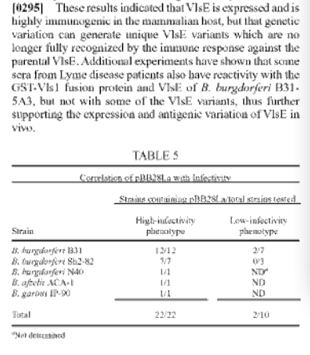
[0138] The importance of the vls-containing plasmid, pBB28La, during infection is supported by the following evidence: (i) all high-infectivity clones and strains tested thus far contain the vls-containing plasmid pBB28LA and loss of this plasmid correlates with a decrease in infectivity; (ii) pBB28La was maintained in all animal isolates tested thus far, and (iii) the vls sequences are preserved among three Lyme genospecies despite their genetic heterogeneity (Casjens et al, 1995).

[0139] VlsE (or, potentially, other genes encoded by pBB28La) appears to have another important but undefined function which is unrelated to antigenic variation. Low-infectivity clones lacking the vls-encoding plasmid pBB28La do not propagate in severe combined immunodeficiency (SCID) mice, indicating that the required factor(s) provides an important function unrelated to evasion of the adaptive immune system.

Also, in vivo selection against Bb clones lacking pBB28La appears to occur early in infection (within the first week), before the adaptive immune response would be expected to exert significant selection pressure. Therefore, it is likely that vlsE plays an important role in some aspect of infection (e.g. colonization, dissemination, adherence, extravasation, evasion of innate immune mechanisms, or nutrient acquisition), and that antigenic variation merely permits surface expression of this protein without leading to elimination of bacteria by the host's immune response.

[1041]  A genetic locus (called vmp-like sequence or vls) has been identified and characterized in B. burgdorferi that surprisingly resembles the vmp system of B. hermsii. [...] Examination of ear and blood isolates from C3H/HeN mice infected 4 weeks previously with B31 clone 5A3 demonstrated the occurrence of promiscuous recombination at the vlsE site, such that each of B. burgdorferi clones examined was unique and appeared to have undergone multiple recombination events with portions of the silent vls cassettes. The resultant vlsE variants exhibited a decreased reactivity to antiserum directed against the parental Vls1 cassette region. This elaborate genetic system permits combinatorial antigenic variation of vlsE in the mammalian host, thereby contributing to evasion of the immune response and long-term survival in the mammalian host.
Etc...
[0145] This mechanism of genetic switching appears to be different from any other antigenic variation mechanism described in bacteria or protozoa and has important implications in Lyme disease. By combining different regions of the silent vls cassettes, it is possible for many different vlsE serotypes to coexist the same patient. It may be impossible for the host to mount a protective response against any one of these clonal populations, because of the small number of each type. Even mounting a response against one serotype would not protect against rapidly evolving, new serotypes. The fact that B. burgdorferi has evolved such an elaborate mechanism for varying the sequence of VlsE indicates the importance of the protein in pathogenesis and/or immune evasion.
[0294] Since the C3H/HeN mice were infected with a large number (105)  of the organisms, it was possible that the antibody response against vlsE had resulted from the intial inocolum. To test this possibility, sera from the white-footed mice (Peromyscus leucopus) infected with B. burgdorferi B31 via tick bite and from human Lyme disease patients were used to react with the similar immunoblots. The representative results depicted showed that tick-infested Peromyscus leucopus mice also had strong reactivity to the VlsE protein of B. burgdorferi B31-5A3 and GST-Vsl fusion protein but not with GST alone. These results were further confirmed with sera from Lyme disease patients. [...] These results indicate that VlsE is expressed and is highly immunogenic in the mammalian host, but that genetic variation may generate unique VlsE variants which are no longer fully recognized by the immune response against the parental vlsE. They also indicate that antibodies generated against VlsE may be useful in immunodiagnosis of Lyme disease. (Got new tests, anybody? I hope this is a good thing!)
[0295] (Contains test data that just confirms more of what was said further upstream, but thought I'd add it here...)

Seriously, this is fascinating stuff, and I really hope that the knowledge about vlsE can be put to good use. My immediate thoughts, of course, are to ask how this can be used to create new treatments for Lyme disease and improve testing - as well as if a safe and effective vaccine can be developed. The vaccine issue - as always - is touchy, and is no different in this case... especially when they are proposing multiple shots will be needed over time. Also, there is more detailed information in the remainder of the patent describing ways of using bacteriophage therapy or attaching DNA to recombinant adenoviruses for  gene therapy treatment.

But the take home point I'm making here by sharing portions of this patent (and it is a multipage document, with lots of pages of data and genetic sequencing that most people will not want to plow through) is that Lyme diseases's Borrelia burgdorferi is unique, and closely related to relapsing fever, and has genetic behavior which is similar to - yet different from - relapsing fever.

Borrelia burgdorferi is highly complex in its presentation, multiple sources have stated that it can be refractory to treatment, and it has a chronic manifestation. It's all right here.
"This mechanism of genetic switching appears to be different from any other antigenic variation mechanism described in bacteria or protozoa and has important implications in Lyme disease. By combining different regions of the silent vls cassettes, it is possible for many different vlsE serotypes to coexist the same patient. It may be impossible for the host to mount a protective response against any one of these clonal populations, because of the small number of each typeEven mounting a response against one serotype would not protect against rapidly evolving, new serotypes."
We can't ignore this. The scientific truth isn't going to go away, whether it is posted in this patent or in the papers to which it refers.

ADDENDUM

There are more entries posted here related to this one. If you were interested in this post, check out these  - especially the one on the vlsE test kit package insert:
http://campother.blogspot.com/2011/02/more-on-that-vmp-like-sequence-aka-vlse.html
http://campother.blogspot.com/2011/02/package-insert-excerpt-athena-multi.html
http://campother.blogspot.com/2011/02/history-of-antigenic-variation-in.html
Read More

Friday, January 14, 2011

3 Syphilis and Vaccines

Let's learn a few things about Syphilis and the bacteria which causes it, Treponema pallidum

The reasons why I am looking at Syphilis on a tickborne-related illness blog are because a) it is spirochetal, b)  there is speculation on the similarities between Syphilis and Lyme Disease, c) some of the data on Syphilis may be informative in how one thinks about other infections or infection states, and last but not least d) some of the information given in this post provides background information for future posts.

So, what do we know about Syphilis? Nasty thing to get. I know I wouldn't want it. But then, I have Borrelia in me and that's bad enough; it's not even quite sure which Borrelia genotypes I'm hosting because tests I've had don't tell me.

Perhaps in the future, Dr. Ben Luft will develop a more accurate test, but I digress...

The overview

Syphilis is a sexually transmitted disease caused by the spirochetal bacterium Treponema pallidum subspecies pallidum. The primary route of transmission of syphilis is through sexual contact; however, it may also be transmitted from mother to fetus during pregnancy or at birth, resulting in congenital syphilis.

The signs and symptoms of syphilis vary depending on which of the four stages it presents in (primary, secondary, latent, and tertiary). The primary stage typically presents with a single chancre; secondary syphilis with a diffuse rash; latent with little to no symptoms; and tertiary with gummas, neurological, or cardiac symptoms. 

Blood tests are commonly used to diagnose syphilis; however those tests produce false negatives in 20-30 percent of primary syphilis cases, allowing for the possibility of ongoing transmission.[1]

Unfortunately, one of the reasons for inaccuracy in early detection of Syphilis is infectious disease specialist lack of access to darkfield microscopy. According to study author Deborah Dowell, MD, of the Centers for Disease Control and Prevention (CDC), "Eighty-one percent of our survey respondents did not have access to darkfield microscopy. These clinicians should treat presumptively if they suspect early syphilis in their patients." Dr. Dowell also notes that there is a clinical and public health need for a rapid point of care test to reliably diagnose primary syphilis.[1]

Right now, testing is a two-tier procedure:


Only if an EIA test is positive does the patient receive an RPR or VDRL test that is confirmatory, though it is a non-treponemal test that confirms the original reactivity. If the initial EIA test is negative, then the patient is considered to be uninfected with Syphilis. This is a serious problem due to the number of false negatives in the primary stage of infection.

The infection can be effectively treated with antibiotics in its earlier stages, specifically intramuscular penicillin G. There is also experimentation using oral azithromycin for treatment, though some strains are shown to be macrolide resistant.

Syphilis is believed to have infected 12 million people worldwide in 1999 with greater than 90% of cases in the developing world. Rates of infection have increased during the 2000s in many countries, including the United States.

The majority of cases have been concentrated in large cities, such as San Francisco, Baltimore, Miami, Washington, DC, and New York City, and scattered throughout the South. The highest numbers are found among inmates in correctional facilities, among men who have sex with men, and those co-infected with HIV.[2,3]

Syphilis infection increases the risk of transmitting and acquiring HIV infection. Not only are syphilis lesions a portal of entry for HIV but the immune cells that carry and are successful to the virus, macrophages and T lymphocytes, are found in abundance in syphilis lesions. There is also some experimental evidence for direct involvement of T. pallidum in facilitating HIV infection and progression.

Treponema pallidum

Treponema pallidum is a species of spirochaete bacterium with subspecies that cause treponemal diseases such as syphilis, bejel, pinta and yaws. It is not seen on a Gram stained smear because the organism is too thin.

What can we learn about it?

Electron micrograph of T. pallidum
Morphology 
  • It is small, about 0.2 µm in diameter and between 6-15 µm in length. A human hair, in contrast is 40-50 µm.
  • To get an idea of how small this really is, check out The Scale of the Universe and place the slider between the human body icon and the atom icon. Check out the red blood cell. Yeah, you're getting warm... that's how small it is.
  • It requires dark field microscopy to see it. 
  • It has regular, tight spirals and displays rotary, flexive and to-and-fro movements.
  •  It has a cytoplasmic membrane enclosed by an outer membrane. 
  • A thin layer of peptidoglycan is sandwiched between these membranes to give added stability.
  •  The periplasmic space contains endoflagella that facilitate the characteristic motility.

Small genome
The genome of T. pallidum is much smaller (1.14 Mb) than that of many conventional Gramm-negative bacteria, for example, E. coli (4.6 Mb) and B. subtilis

Infectivity
  • T. pallidum is transmitted by direct contact, usually sexual. 
  • Infection is initiated when T. pallidum penetrates dermal microabrasions (small cuts) or intact mucous membranes (e.g. oral, ocular, nasal, vaginal). 
  • Studies have shown that 16 to 30% of individuals who have had sexual contact with a syphilis-infected person become infected. Actual transmission rates can be higher. The 50% infectious dose is estimated to be only 57 organisms. 
  • Upon initial infection the parasites prefer to multiply at the point of entry causing the inflammatory response and formation of characteristic chancre (an open sore).
  • From the chancre the treponemes disseminate rapidly to the blood and lymphatics and make their way to different parts of the body including Central Nervous System (CNS). 
  • T. pallidum has been shown to induce the production of matrix metalloproteinase-1 (MMP-1) in dermal cells. MMP-1 is involved in breaking down collagen, which may help T. pallidum to traverse the junctions between endothelial cells and penetrate tissues.
  • The only known natural host of the bacterium is the human. Combined with transmission mode, this fact gives hope to a possibility of complete eradication of the syphilis in a future.
Challenges for research
  • Treponema pallidum cannot be cultivated long term (more than 100-fold ~7 generations) in vitro. 
  • In laboratory, T. pallidum can be only maintained by propagation in rabbits. 
  • Because of fragility of its outer membrane, researchers are unable to modify the bacterium genetically in order to conduct experiments, which in many other bacteria clarified various aspects of their biology such as protein functions, mechanisms of virulence, and others.
The detailed nitty-gritty about Treponema pallidum

Metabolic deficiencies
  • The bacterium lacks tricarboxic acid cycle enzymes and the electron transport chain. 
  • T. pallidum depends upon glycolysis as the sole pathway for the synthesis ATP. 
  • In addition, a pathway for amino acids and fatty acids synthesis as well as for metabolism of alternative carbon energy sources and for the synthesis of nucleotides and enzyme cofactors seems to be absent. 
  • These traits suggest that the bacterium derives most essential macromolecules from its host (enzymes for interconversion of amino acids and fatty acids as well as homologs of transporters for a variety of amino acids are present). 
  • Because the T. pallidum genome encodes no known homologs to porin proteins, it is unclear how nutrients are moved across the outer membrane into periplasmic space.
Slow multiplication rate
T. pallidum divides very slowly, doubling every 30-33 hours in vivo. In contrast, Nesseria gonorrhoeae divides approximately every 60 minutes, and E. coli every 20 min.

Limited stress response and heat tolerance
  • The lack of enzymes that detoxify reactive oxigen species such as catalase and oxidase makes T. pallidum vulnerable to oxygen. 
  • In a number of reports best survival occurred at low concentrations of oxygen (1-5%). 
  • At least one of its enzymes is unstable at normal body temperature. 
Heat therapy for late neurosyphilis was introduced in 1918 by the Viennese psychiatrist Julius Wagner von Jauregg, a discovery for which he later won the Nobel Prize in Medicine. He inoculated patients with malaria pathogen and 10 to 12 febrile episodes later, treated them with quinine. 

The high temperatures induced by this regimen, along with other methods of raising body temperature, presumably killed T. pallidum in the CNS. Doctors reported high percentage of complete or partial remission of general paresis symptoms (although the treatment killed about 10% of patients - don't try IHT at home, kids!).

For a long time researchers tried to explain mechanisms underlying the natural course of the syphilis: recurring clinical manifestations separated by prolonged asymptomatic periods. In early 1970s it was believed that treponemes cause specific or generalized immunosuppression and are resistant to phagocytosis by macrophages and neutrophils. 

Later studies showed, however, that initial immune response of host to treponemal assault, though slow to develop, is rather robust, and as treponemes reach peak numbers, macrophages begin to infiltrate the lesions resulting in rapid clearance of overwhelming majority of the parasites from the tissue. However, some portion of the treponemes remains untouched and continues living in the host causing a persistent infection.

Lack of endo- and exotoxins
  • The T. pallidum lacks liposaccharide (LPS), the endotoxin found in the outer membranes of many gram-negative bacteria. 
  • The attachment of T. pallidum to cells does not harm the cells (no swelling or indentation). 
  • The cultured cells survive for 5-7 days with actively motile attached treponemes in quantities up to 100 organisms per cell and remain viable. 
  • This indicates that cytolytic enzymes or other cytotoxins most probably do not play a role in syphilis pathogenesis.
Invasion of "immune-privileged" tissues
T. pallidum penetrates a broad variety of tissues, including so-called "immune privileged": the central nervous system, eye, and placenta, where there is less surveillance by the host's innate immune system.

Ability to maintain infection with few organisms
T. pallidum may also exploit its slow metabolism to survive in tissues, even those that are not immune privileged. By maintaining infection with very few organisms in anatomical sites distant from one another, T. pallidum may prevent its clearance by failing to trigger the host's immune response, which was speculated to require a "critical antigenic mass".

Lack of surface antigens
Outer surfaces of bacterial pathogens are the first bacterial component to encounter the host and are often the targets of host adaptive immunity. One of most prominent features of T. pallidum is that its cell has only rare integral proteins in its outer membrane, approximately 1% of the number found in the outer membrane of E. coli. The rare T. pallidum outer membrane proteins are likely to be very important in interactions with the host; for this reason, their identity has been the subject of intense research.


Low iron requirements, ability to obtain sequestered iron
Iron sequestration is one of the important defense mechanisms used by the infected host. The host's transferrin and lactoferrin proteins bind free iron making it unavailable to bacteria and impairing their growth. T. pallidum may be able to acquire iron from these host proteins. It may also overcome the iron sequestration by using enzymes that need metals other than iron as their cofactors. In addition it lacks an electron transport chain, which is made up of enzymes that use iron as a cofactor, which decreases its overall demand for iron.

Resistance to macrophages in subpopulation of the pathogen
Opsonizing agents are serum components, antibodies, or the complement protein C3b, which make the pathogen recognizable to macrophages via specific cell surface receptors. T. pallidum antigens, including Tp92 andTprK, have been shown to induce production of opsonic antibodies. Antibodies against the VDRL (Venereal Disease Research Laboratory) antigen, a complex of cardiolipin, cholesterol, and lecithin, also increase the phagocytosis of T. pallidum by macrophages. Majority of treponemes that multiplied in quantities at the site of initial infection usually are cleared by macrophages. However, a small subpopulation of the organisms persists and appears to resist ingestion by macrophages. This phenomenon suggests that opsonic antibodies do not bind these organisms, thus allowing them to survive in the face of active immune clearance.

[To translate: Antibody opsonization is the process by which a pathogen is marked for ingestion and destruction by a phagocyte. Opsonization involves the binding of an opsonin antibody to a receptor on the pathogen's cell membrane. The immune system cannot always eliminate T. pallidum even though it has "recognized" the existence of the disease.]

Resistance to neutralization by antibodies
Besides opsonization, there are other functions of antibodies produced during T. pallidum infection. Antibodies developed against T. pallidum immobilize organisms and block them from binding the host's cells. Administration of whole serum and fractionated IgG from long-term-infected rabbits delays lesion formation in challenged rabbits, but lesions develop at the inoculation site within days of discontinuing the treatment. This demonstrates that specific antibody alone, while inhibitory to the establishment of lesions, is not sufficient to kill T. pallidum and prevent infection.

Orchestrated regulation of expression of antigens
Several genes that encode candidate outer membrane proteins belong to the tpr gene family which contains twelve genes that are divided into three subfamilies I, II, and III). The proteins encoded by tprF, tprI, and tprK are predicted to be located in the outer membrane.

Most of the proteins encoded by the tpr genes (the Tprs) elicit an immune response in experimental syphilis. Antibody responses arise at different times after infection: anti-TprK antibodies are seen as soon as 17 days postinfection and are robustly reactive at day 30, while antibodies against the members of subfamilies I and II often are not detectable until 45 days after infection and reach peak titers at day 60.

The time of development of antibodies to specific Tprs may reveal the timing of expression of the proteins that induced those antibodies. Regulation of expression of related proteins is referred to as phase variation and may be used by T. pallidum to down-regulate the expression of those Tprs against which an immune response has been mounted, while simultaneously up-regulating the expression of new Tprs, which are not recognized by the existing immune response. This strategy may help T. pallidum maintain chronic infection.

Antigenic variation of TprK protein
Recent studies identified TprK as a membrane-localized protein. The tprK gene and predicted protein amino acid sequences are characterized by seven discrete variable (V) regions that are separated by stretches of conserved sequences.

Diverse tprK sequences have been demonstrated between subpopulations of every T. pallidum strain within single host. DNA sequence cassettes that correspond to V-region sequences were discovered in an area of the T. pallidum chromosome separate from the tprK gene. These cassettes are potential sequence donors and are presumed to replace portions of V-region sequences in the tprK gene.

The TprK protein elicits both cellular and humoral immunity in infected animals. Antibodies to TprK that arise in response to T. pallidum infection are specifically targeted to the V regions. Very slight changes of the amino acid sequence in a V region can abrogate the ability of antibodies to bind the V region.

Thus, the host immunity may eliminate organisms that express TprK sequences against which specific antibodies have been developed. Generating new variation in TprK may help pathogens to escape immune recognition and sustain the chronic infection.

Vaccine Development
There is no vaccine for Syphilis. The outer membrane of T. pallidum has too few surface proteins for an antibody to be effective. Efforts to develop a safe and effective syphilis vaccine have been hindered by uncertainty about the relative importance of humoral and cellular mechanisms to protective immunity  and the fact that T. pallidum outer membrane proteins have not been unambiguously identified.

Some Abstracts On Vaccine Efforts

Assessment of cell-surface exposure and vaccinogenic potentials of Treponema pallidum candidate outer membrane proteins
Microbes and Infection
Volume 9, Issue 11, September 2007, Pages 1267-1275
T. pallidum is believed to be an extracellular pathogen and, as such, the identification of T. pallidum outer membrane proteins that could serve as targets for opsonic or bactericidal antibodies has remained a high research priority for vaccine development. However, the identification of T. pallidum outer membrane proteins has remained highly elusive. Recent studies and bioinformatics have implicated four treponemal proteins as potential outer membrane proteins (TP0155, TP0326, TP0483 and TP0956). Indirect immunofluorescence assays performed on treponemes encapsulated within agarose gel microdroplets failed to provide evidence that any of these four molecules were surface-exposed in T. pallidum. Second, recombinant fusion proteins corresponding to all four candidate outer membrane proteins were used separately, or in combination, to vaccinate New Zealand White rabbits. Despite achieving high titers (>1:50,000) of serum antibodies, none of the rabbits displayed chancre immunity after intradermal challenge with viable T. pallidum.

Progress towards an effective syphilis vaccine: the past, present and future
Authors: Cullen, Paul A; Cameron, Caroline E
Source: Expert Review of Vaccines, Volume 5, Number 1, February 2006 , pp. 67-80(14)
Syphilis is a disease caused by infection with the spirochetal pathogen Treponema pallidum subspp. pallidum. Despite intensive efforts, the unusual biology of T. pallidum has hindered progress towards the development of a vaccine to prevent infection. This review describes previous endeavors to develop a syphilis vaccine, outlines the key issues in the field and proposes new directions in the design of a T. pallidum vaccine. Following a brief overview of the disease symptoms, epidemiology, diagnosis and treatment, a case is put forward for the benefit of pursuing a syphilis vaccine. Relevant material concerning immunity to T. pallidum infection is summarized and evaluated, and pilot experiments describing the use of whole-cell bacterin vaccines and similar preparations are included. A detailed section concerning subunit vaccines is provided, incorporating discussions pertaining to relevant antigen selection, the identification of putative T. pallidum surface-exposed outer membrane proteins, factors hindering previous attempts to vaccinate with recombinant outer membrane proteins, problems and pitfalls of syphilis outer membrane protein-based vaccines, anti-attachment vaccines and the potential use of nonprotein subunit preparations as vaccinogens. Subsequently, critical aspects concerning vaccine antigen preparation and delivery are noted, including protein conformation, synergy, post-translational modifications, live attenuated organisms as vaccine vectors, prime–boost methodologies, adjuvant selection and immunization routes. Finally, animal models are discussed with particular reference to immunoprotection studies. A more thorough understanding of immunity to syphilis, a comprehensive assessment of the immunoprotective capacity of the putative surface-accessible antigens of T. pallidum and utilization of the latest advances in vaccine science should set the scene for future development of a syphilis vaccine.

LUKEHART SA; Interscience Conference on Antimicrobial Agents and Chemotherapy.
Abstr Intersci Conf Antimicrob Agents Chem other Intersci Conf Antimicrob Agents Chem other. 2000 Sep 17-20; 40: 540.
Univ. of Washington, Seattle, WA
Syphilis is a major public health problem in developing countries and in certain regions of the United States. It is estimated that there are twelve million new cases of syphilis per year, and at least 25 million infected persons worldwide. Syphilis is a recognized cause of perinatal morbidity and mortality and is a cofactor in acquisition and transmission of HIV infection. Despite the existence of safe and effective penicillin therapy, syphilis is unlikely to be controlled globally without an effective vaccine. Proof of concept for a syphilis vaccine was obtained in 1973, when Dr. James N. Miller demonstrated complete protection against infectious challenge in the rabbit model of experimental syphilis following immunization with gamma-irradiated Treponema pallidum. Since that time, numerous attempts to achieve protection using killed T. pallidum or isolated treponemal antigens have failed to yield satisfying results. Recent efforts have focussed on the identification of antigens that may be exposed on the surface of the intact treponeme, although definitive identification of such molecules has been difficult. This presentation will describe a number of candidate vaccine antigens that are currently under active investigation. Concerns relating to possible lack of heterologous cross-protection will be discussed in light of recent data regarding molecular heterogeneity of strains of T. pallidum

Biological Basis for Syphilis
Rebecca E. LaFond and Sheila A. Lukehart
Clinical Microbiology Reviews, January 2006, p. 29-49, Vol. 19, No. 1
Departments of Pathobiology, University of Washington, Seattle, Washington
Syphilis is a chronic sexually transmitted disease caused by Treponema pallidum subsp. pallidum. Clinical manifestations separate the disease into stages; late stages of disease are now uncommon compared to the preantibiotic era. T. pallidum has an unusually small genome and lacks genes that encode many metabolic functions and classical virulence factors. The organism is extremely sensitive to environmental conditions and has not been continuously cultivated in vitro. Nonetheless, T. pallidum is highly infectious and survives for decades in the untreated host. Early syphilis lesions result from the host's immune response to the treponemes. Bacterial clearance and resolution of early lesions results from a delayed hypersensitivity response, although some organisms escape to cause persistent infection. One factor contributing to T. pallidum's chronicity is the paucity of integral outer membrane proteins, rendering intact organisms virtually invisible to the immune system. Antigenic variation of TprK, a putative surface-exposed protein, is likely to contribute to immune evasion. T. pallidum remains exquisitely sensitive to penicillin, but macrolide resistance has recently been identified in a number of geographic regions. The development of a syphilis vaccine, thus far elusive, would have a significant positive impact on global health.

Ongoing Research of Dr. Caroline E. Cameron
2006-present University of Victoria, Victoria, BC

The laboratory of Dr. Caroline Cameron focuses upon spirochetal bacteria, with a specific focus on Treponema pallidum and Leptospira. The overall objective of the research is to identify and characterize molecules that are central to the pathogenesis of these important human pathogens.

The first main project investigates the extremely invasive nature of T. pallidum. Within our laboratory we have discovered several adhesins that contribute to T. pallidum attachment and a protease that is central to dissemination within the host. We are currently developing methods to target these proteins, with the ultimate goal of developing a prophylactic intervention to prevent the establishment of chronic infection.

The second major project within the laboratory involves the identification of novel diagnostic antigens, and the translation of this research into an improved syphilis diagnostic test.

We also perform proteomic analyses of Treponema pallidum to identify potential surface-exposed proteins within this unculturable pathogen.

The long-term objective of the research performed within the laboratory is to expand our knowledge of spirochete pathogenesis, which will in turn allow for the development of novel therapeutic reagents and/or preventative measures to combat infection. Future research will investigate the role of identified virulence factors in the pathogenesis of T. pallidum and Leptospira.

Citations
[1] Infectious Diseases Society of America (2009, October 23). Syphilis Survey Reveals Need For Accurate Testing For Early Infection. ScienceDaily. Retrieved January 13, 2011, from http://www.sciencedaily.com­ /releases/2009/10/091022122334.htm
[2] Stevenson, J., & Heath, M. (2006). Syphilis and HIV infections: An update. Dermatol Clin, 24(4), 497.
[3] Peterman, T., Heffelfinger, J., et al. (2005). The changing epidemiology of syphilis. Sex Transm Dis, 32(1), S4.

Other citations also expanded upon from: Metapathogen and http://en.wikipedia.org/wiki/Syphilis


I'm guessing that for most of you, this is more than you ever knew about Syphilis or cared to know about it.

It's a start, really. There's more.

Think about everything you've read here, and anything you've read about Borrelia burgdorferi. There are differences and then there are similarities. They can't be treated interchangeably, but it is useful to look at the issues involved with both, where they do overlap, and how they've been approached in research. And also why each has been approached in research the way it has.
Read More

The Camp Other Song Of The Month


Why is this posted? Just for fun!

Get this widget

Lyme Disease

Borrelia

Bacteria

Microbiology